

Was 2025 the year democracy collapsed, or the year society refused to stay silent? Gülseren Onanç, founding president of SES Equality and Solidarity Association, argues that as politics failed and autocracy advanced, young people, women, and activists across the world organised resistance.
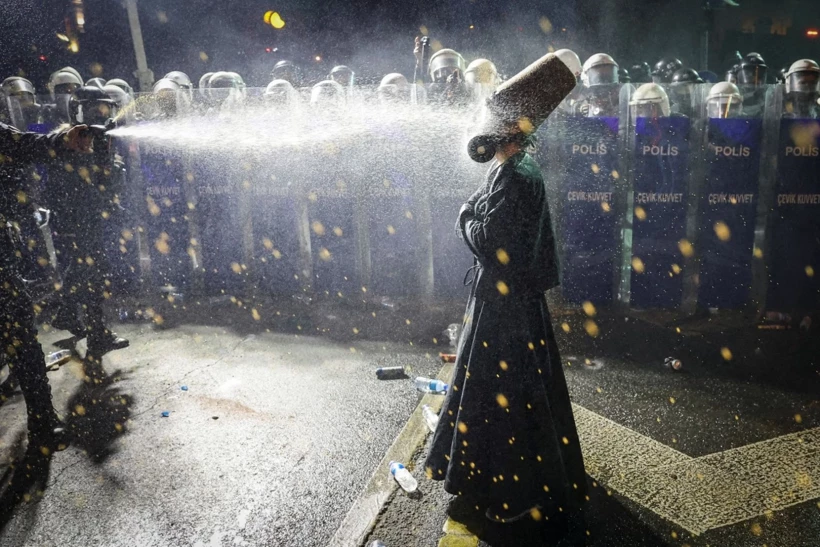
Reuters photo from the Istanbul Justice Protests, 23 March 2025
2025 will go down in history as a year in which politics, across the globe, failed to offer solutions to societies’ most pressing problems. For this reason, it will also be remembered as a year in which democracy and human rights were rolled back through political means, and autocracy continued its global rise.
Freedom House, which annually assesses countries based on political rights and civil liberties, stated in its 2025 report that “Across every region of the world, democracy is under attack by populist leaders and groups that reject pluralism and demand unchecked power in order to advance the narrow interests of their supporters—often at the expense of minorities and other groups cast as ‘enemies’.”
Varieties of Democracy (V-Dem), an organisation that evaluates democracy across multiple dimensions, wrote in its 2025 report: “Democracy has declined to its lowest level in the last 50 years. Nearly three-quarters of the world’s population (72%) now live under autocratic rule—the highest share since 1978.”
Trump, the Western Bloc, and Security Politics
It is fair to say that global politics in 2025 were shaped by Donald Trump. As the Russia-Ukraine war entered its fourth year, Trump openly declared that the United States would no longer assume its traditional role as the backbone of the “Western bloc”, sending a blunt message to the world: everyone is on their own.
By exerting pressure on NATO, he pushed member states to raise defence spending to 5% of GDP. With the exception of Spain, EU countries increased their military budgets. Europe, facing an acute security crisis, sought solutions primarily through higher defence expenditure.
Invest in Social Policy, Not Politics of Fear
In an article I co-authored with two academics for Politico.eu, we argued that the EU must not surrender to fear about the future, and that the resources being channelled into defence should instead be invested in social policies.
War, Genocide, and the Politics of Conscience
As Israel’s systematic violence against the Palestinian people in Gaza unfolded before the eyes of the world and turned into genocide, Europe and the United States remained largely silent. International law failed to function.
Yet university campuses and public squares became spaces where demands for justice for Palestine were most strongly voiced. From Columbia University onwards, students and academics across the US and Europe organised solidarity with Palestine. In response, demonstrations supporting the Palestinian people were banned, criminalised, and met with police violence.
The Simurg Flotilla, which set sail to deliver humanitarian aid to Gaza with the participation of Greta Thunberg and human rights activists from around the world, reminded the world of the moral compass that states had lost.
Women Journalists Bearing Witness to Palestine
Despite relentless pressure, the Palestinian people continued to resist and defend their homeland. Women journalists in Palestine, opposing the war, wrote, recorded, and bore witness under bombardment—amid power cuts and internet blackouts—fully aware that they themselves were targets.
Generation Z: “We Will Not Get Used to the Normalisation of Fear”
2025 was also a year in which authoritarian governments intensified repression. Generation Z rose up against this pressure and against the corrupt governance of their countries by narrow political elites. Declaring “we will not get used to the normalisation of fear”, young people took to the streets in Serbia, Turkey, Madagascar, Nepal, Morocco, and Kenya.
They protested corruption, poverty, and the theft of their future.
In Serbia, following the collapse of a train station roof, young people organised days-long protests demanding accountability for negligence.
In Turkey, as the Erdoğan government used the judiciary as a political weapon to target opposition mayors, politicians, and journalists, university students sustained weeks of protest across campuses and public squares. Through creative language and visual expression, they developed an opposition style that was at once sharp and disarming.
In the US, opposition to Trump’s anti-immigrant and anti-democratic policies coalesced around the slogan “No King”, offering a clear and powerful rejection of authoritarianism.
Women at the Frontline of Resistance
In countries where authoritarian and conservative governments attempt to control women’s bodies, visibility, and public presence, resistance most often takes shape through women.
Femena—founded by Afghan, Iranian, Syrian, and Egyptian feminist activists coming together in exile—has become a powerful transnational example of this struggle.
In Turkey, Berrin Sönmez’s act of civil disobedience, removing her headscarf in response to sermons delivered by the Directorate of Religious Affairs that sought to regulate women’s clothing under the guise of “morality” and “modesty” became a local echo of this global resistance.
Declaring, “Today, I throw my headscarf at the government and religious authorities,” Sönmez reminded society that women resisting erasure in Afghanistan, and young women risking their lives against compulsory veiling in Iran, that women’s bodies are not instruments of power.
As Governments Retreat from the Climate Crisis, Local Conscience Demands Ecological Democracy
Despite COP30 taking place in 2025, global climate negotiations once again failed to produce binding outcomes. Many states avoided the commitments required to meet rising energy demands.
Under President Donald Trump, the United States—the world’s largest emitter—rolled back regulations limiting carbon emissions and actively promoted fossil fuel production, further weakening global climate action.
At the same time, in Brazil’s city of Belém, the alternative People’s Summit held alongside COP30 produced the People’s Declaration, expressing the persistence of local conscience. The declaration articulated a demand for ecological democracy, grounded in Indigenous sovereignty and direct reparations.
In Turkey, women once again stood at the forefront of environmental activism. The Gökçeyazı Türkmen Mountain Environmental Protection and Solidarity Association continued its organised struggle—alongside local communities and women—against gold mining projects in the region. Under the slogan “No to cyanide exploitation”, the movement achieved a major legal victory by overturning a “positive” Environmental Impact Assessment decision through the courts.
Between Crisis and Resistance
While 2025 can be seen as a year of political crisis, it was also a year in which social resistance rose and civic activism was organised.
As politics produced pessimism, social movements continued to generate hope.
At SES Equality and Solidarity Association, we strive to amplify the voices of those who speak for democracy, equality, and justice.
In 2026, we will continue to stand alongside women, young people, and activists.
Let us end with the slogan of 2025 that we are used to hearing from social movements in Turkey:
There is no liberation alone.
Either all of us together,
or none of us.
Gülseren Onanç