

The struggle of women in Iran for equality and freedom has continued without interruption since the 1979 Islamic Revolution, taking different forms over time. In her article İ. Alina Çalaz argues that, sometimes violently suppressed, sometimes rendered invisible, this struggle has nonetheless resurfaced again and again, finding new pathways in each period.
The First Post-Revolutionary Protest: 8 March 1979
Only weeks after the Islamic Revolution, thousands of women took to the streets of Tehran on 8 March 1979 to protest the introduction of compulsory veiling. This demonstration went down in history as the first mass protest by women against the new regime. The protests were swiftly crushed, and mandatory hijab became a permanent feature of the political order. Yet this moment marked the beginning of Iran’s feminist collective memory.
A Quiet but Profound Struggle: Zanan Magazine (1992)
In the 1990s, the women’s movement shifted from the streets to the printed page. Launched in 1992, Zanan magazine opened public debate on women’s legal status, their position within the family, and interpretations of Islam, helping feminist thought enter the public sphere.
Although the magazine did not generate a street movement, it created a critical space where women could articulate their lived experiences. This intellectual legacy later laid the groundwork for digital activism. Repeatedly shut down by the state, Zanan nevertheless left a lasting imprint.
Collecting Signatures for Equality: The One Million Signatures Campaign (2005)
In the mid-2000s, women turned their attention directly to legal discrimination. The One Million Signatures Campaign sought reform of laws governing custody, divorce, inheritance, and legal testimony. Activists collected signatures door to door. Many were detained, and the campaign failed to achieve its formal legal goals.
Even so, it expanded women’s organizational capacity and spread the struggle nationwide.
Digital-Age Resistance: From White Wednesdays to the “Blue Girl”
In the 2010s, feminist resistance migrated to social media. Campaigns such as My Stealthy Freedom, White Wednesdays, and the Enghelab Street protests transformed the headscarf into a symbol of dissent.
In 2019, the death of Sahar Khodayari, known as the “Blue Girl,” who set herself on fire after fearing imprisonment for trying to enter a football stadium, sparked an international wave of solidarity. While it did not produce a new movement, it made women’s demand for presence in public space globally visible.
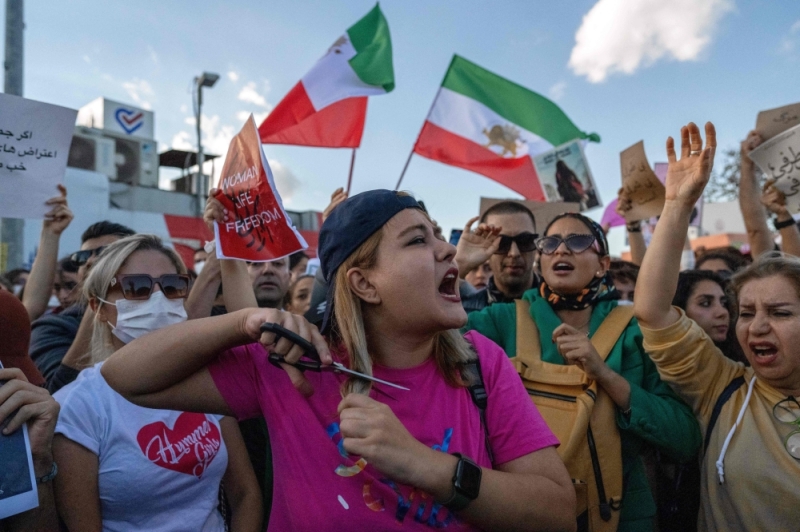
“Woman, Life, Freedom”: After Mahsa Amini (2022–2025)
The death of Mahsa (Jina) Amini in 2022 while in the custody of Iran’s morality police triggered one of the most powerful women-centered uprisings in Iranian history. The slogan “Jin, Jiyan, Azadi – Woman, Life, Freedom,” first chanted at her funeral, spread rapidly across the country, reaching more than sixteen provinces.
This wave did not overthrow the regime, but it placed women’s demands not merely for legal reform, but for existential freedom, at the heart of society.
A New Wave Fueled by Symbols: An Uprising Ignited Through Images
In late 2025 and early 2026, a new protest wave emerged, marked not only by slogans but by powerful symbols. Images circulated widely on social media showing women lighting their cigarettes with photographs of Supreme Leader Ali Khamenei and revolutionary leader Ruhollah Khomeini set on fire. These acts became some of the most striking protest images of the period.
This gesture went beyond hijab-centered resistance and directly targeted the regime’s most sacred symbols. The images quickly circulated globally, inspiring Iranian women in the diaspora and solidarity groups abroad to replicate the act.
Investigations by verification platforms and journalists later revealed that one of the most widely shared videos was filmed not in Iran but in Ontario, Canada, on 9 January 2026. Nonetheless, the act itself was adopted by protesters inside Iran, turning into a collective symbol.
This dynamic illustrates how Iran’s women’s movement has evolved into a transnational resistance network, extending beyond national borders through the diaspora.
Voices from Iran at the SES Awards: “Iran Is Burning with a Fire Lit by Women”
At the 2025 SES “Women of the Year” awards, figures such as Mohammadi, Golestani, and Ahmadi were honored for representing a broad spectrum of resistance, from artistic defiance of compulsory veiling to human rights activism carried out from prison. They symbolize the continuity of Iran’s women’s movement across art, thought, and law.
One of the most powerful moments of the ceremony was the speech delivered by Nargis Keshvaradze, who accepted the award on behalf of Nobel Peace Prize laureate Narges Mohammadi, writer Nina Golestani, and musician Parastoo Ahmadi. She described them as women who, “through different paths but with a single heart, stand up for women’s rights and freedom of expression.”
Her speech opened with a stark reminder: “In Iran, women lit the first torch. Today, Iran is burning for freedom.” This was not merely metaphorical but a direct reference to the collective memory of women who have paid the price through imprisonment, exile, and death since 2022.
The address soon shifted from symbolic gratitude to direct testimony. Keshvaradze described accepting the award not as an honor but as a heavy responsibility: to tell the truth that the Iranian state tries to hide from the world.
She recounted the killing of Aida, a 24-year-old woman shot dead during protests on Ashrafi Esfahani Street in Tehran. With a green laser trained on her, Aida reportedly removed her coat and said, “Shoot. I have nothing left to lose,” before being killed by a bullet to the head. Her death crystallized the fusion of desperation and courage defining this protest wave.
Keshvaradze linked this individual tragedy to a broader pattern of repression: live ammunition, internet shutdowns, blocked calls, and undelivered messages. “The truth is being plunged into darkness,” she said, emphasizing that the aim was to prevent both calls for help and documentation of violence.
Against this backdrop, the award from the Istanbul-based SES Equality and Solidarity Association took on deeper meaning. Keshvaradze stressed that this support was not symbolic but concrete proof that Iranian women are not alone. Coming from a regional neighbor, it underscored that Iran’s struggle is not confined to Western human rights narratives but embedded in a regional network of women’s solidarity.
The speech concluded with a powerful rejection of silence as destiny. As the audience responded with “Our hearts are with you” and “You will never walk alone,” the host’s reminder of Aida’s final words made clear that for Iranian women, freedom is not an abstract ideal but a decision made at the line between life and death.
From Economic Spark to Regime Opposition
The new protest wave began on 28 December 2025, when Tehran’s Grand Bazaar merchants closed their shops in response to a deepening currency crisis. Within a year, the Iranian rial had lost nearly half its value against the dollar, annual inflation exceeded 40 percent, and food prices rose by more than 70 percent. Protests quickly spread from Tehran to at least twelve provinces, including Tabriz, Mashhad, Isfahan, and Shiraz.
Initially framed around economic survival, the protests rapidly evolved into direct regime opposition, with chants targeting clerical rule and the Supreme Leader.
State Response: Repression, Blackouts, and Arrests
From early January, security forces responded with severe force. Human rights organizations reported hundreds killed and thousands detained. After 8 January, internet and mobile communications were largely cut in many cities, hindering both organization and information flows.
By mid-January, mass street protests were effectively halted. On 21 January, the government declared the uprising suppressed. Independent observers, however, described not social calm but enforced silence.
Reports noted residents chanting “Death to the dictator” from their windows at night, suggesting anger had gone underground rather than disappeared.
Women at the Forefront of a Regional and Transnational Struggle
Iran’s women’s movement is increasingly part of a broader regional feminist wave. Organizations supported by SES, such as FEMENA, situate Iran’s struggle alongside those of women in Afghanistan, Syria, and across the Middle East. FEMENA’s characterization of Taliban-ruled Afghanistan as a system of “gender apartheid” highlights how the systematic erasure of women from public life has become a regional political model.
In this context, Iran’s protests represent not only a national regime crisis but a regional challenge to women’s exclusion from citizenship.
Women have remained central not only symbolically but organizationally. The slogan “Woman, Life, Freedom” resurfaced during the 2025–2026 protests, now intertwined with economic demands. Chants such as “Bread, work, freedom” echoed alongside feminist calls, signaling a convergence of material and existential grievances.
Regime Change or Regime Transformation?
Political scientist Dr. Ezgi Uzun Teker, speaking on Medyascope on 13 January 2026, described the protests as “not a temporary revolt, but accumulated pressure for transformation.”
According to Teker, the Islamic Republic in its current form is unsustainable. Even without regime change, she argued, the system will be forced to transform itself. She emphasized that legitimacy has eroded deeply, especially among younger generations.
On the Threshold of a New Era?
Since 1979, women’s struggles in Iran have been repeatedly suppressed, fragmented, and redirected. None has single-handedly toppled the regime. But each has passed on experience, symbols, and courage to the next.
Today, women are no longer alone. Workers, students, the middle class, and ethnic minorities are moving alongside them. This multilayered opposition signals a rare moment of social convergence in Iran’s history.
The streets may be quiet today. But the anger, solidarity, and hope accumulated by Iranian women are resonating across society as never before.
The question is no longer simply whether this uprising has been suppressed.
The real question is whether what was suppressed has truly come to an end.