

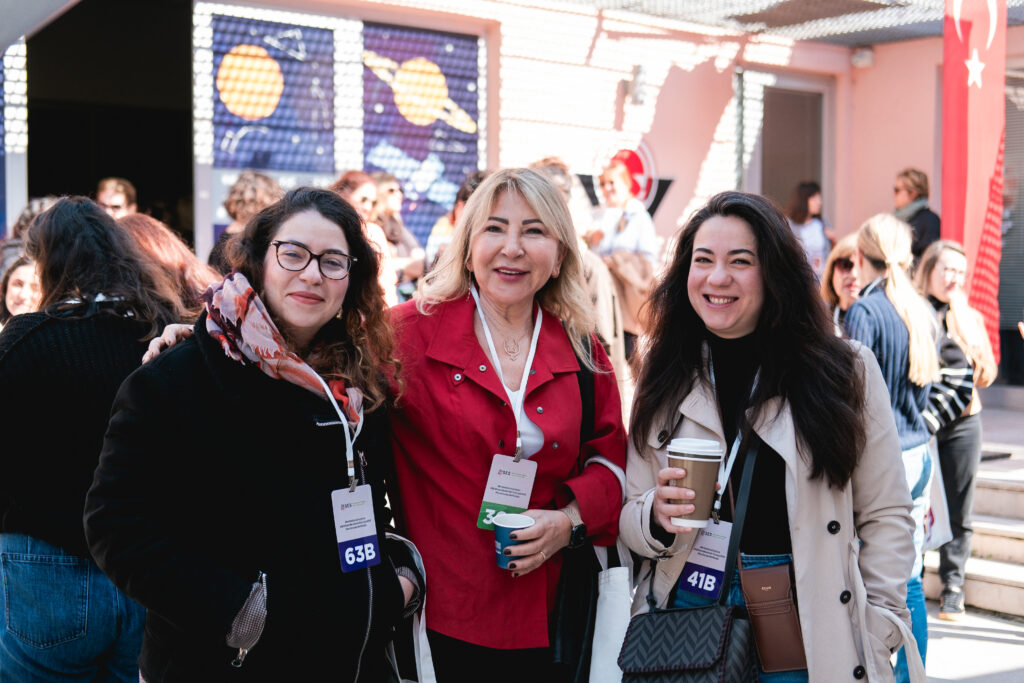
The SES Women Mentoring Walk took place on Sunday, April 5, in the heart of Istanbul, in Pera. More than a hundred women of different ages and experiences came together and added women’s confidence to Istanbul’s thousands of years of culture. That day, Istanbul became a safer city. Within the framework of her opening speech, SES Equality and Solidarity Association President Gülseren Onanç shared her reflections.
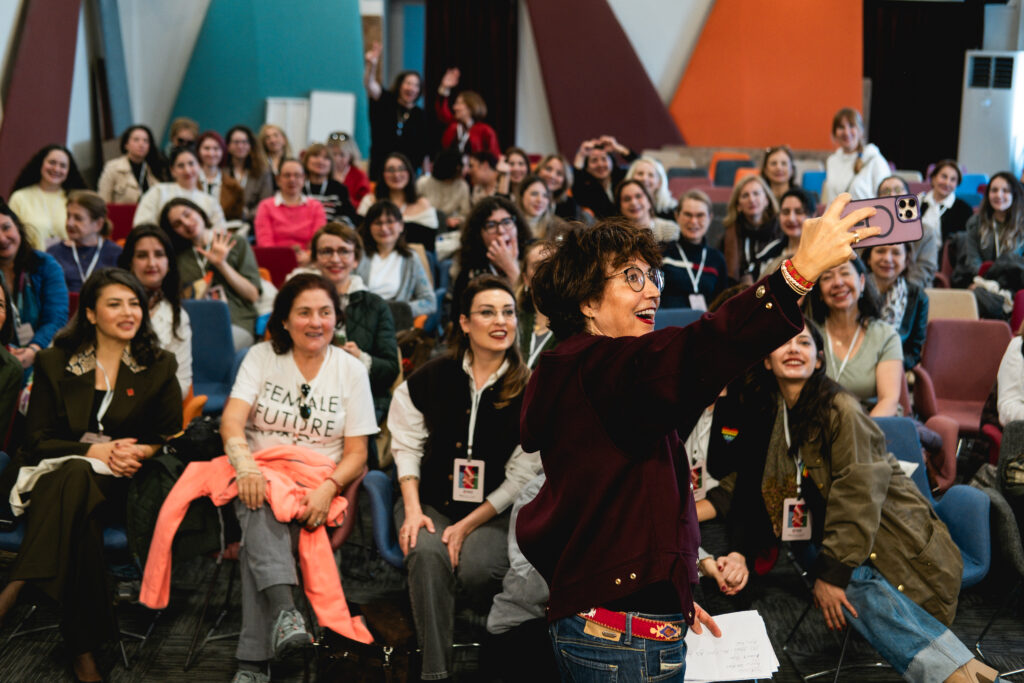
This year, we held the fifth edition of our SES Women Mentoring Walk on Sunday, April 5, in Pera, the heart of Istanbul.
The SES Women Mentoring Walk was the first project we launched when we founded the SES Equality and Solidarity Association. In these gatherings, where we apply the Women Mentoring Walk format of Vital Voices, we aim to bring together women of different experiences, ages, and backgrounds, women who might never meet in other way, and encourage them to step outside their own echo chamber.
In a polarized country like us and world, we need more than ever to step outside our own echo chambers.
The SES Women Mentoring Walk works as follows: we match the women who apply to us based on their expectations from the meeting. We bring together those who want to start or grow their businesses with successful entrepreneurs; those who want to advance in their careers with senior executives; and those who want to move forward in civil society or politics with women from these fields.
The happiness on the faces of the women who come together in this project shows how nurturing women are for each other. That is why it is one of my favorite projects. I believe it serves our association’s mission of women’s solidarity and contributes to organizing collective resistance at a time when we need women’s resistance the most.
The Wisdom of Indigenous Women in Colombia
I used to think that women’s solidarity emerged from the need for organization and support during the struggle for equality and freedom.
My experience in Colombia last week took this belief to another level. I learned that women’s solidarity has a much deeper history than the struggle for rights and that it is a natural part of the cycle of life.
Sierra Nevada is a region on the Atlantic coast of Colombia. It takes about an hour and a half to reach Santa Marta from Bogotá by plane. This tropical region has two seasons: less rainy and very rainy. Daytime temperatures range between 25–30°C, and evenings between 20–25°C. With mountains rising right after the coast, Sierra Nevada has a unique nature. The indigenous communities living there believe that it as the heart of the world, a sacred place.
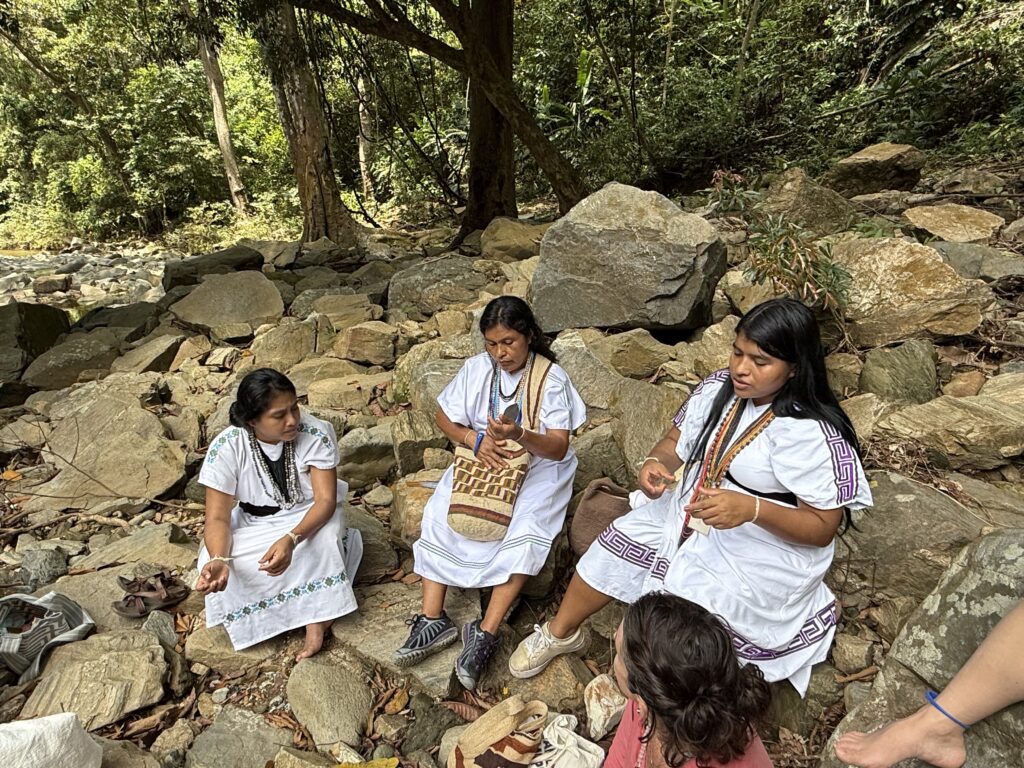
I attended a program in the Sierra Nevada, organized by Project Dandelion. I joined this gathering with fifteen women from Project Dandelion, all deeply committed to climate justice and each leading impactful work in civil society and business.
Project Dandelion is an initiative that women around the world would aspire to be part of, a women-led global campaign for climate justice. Founded by Pat Mitchell and Ronda Carnegie, it is a movement I am proud to be part of. The spokesperson for Project Dandelion is Mary Robinson, the former President of Ireland
The Sierra Nevada retreat was organized with cooperation with two remarkable young Colombian women, Isabella and Natalia. Having spent many years abroad, they returned to their homeland and immersed themselves in the wisdom of the Sierra Nevada, a journey that has transformed them into climate activists reaching out to the world. We tried to understand the wisdom of the local women living in this region of Colombia and to draw lessons for women’s leadership.
Together with indigenous women, we experienced an intense sharing process from sunrise to sunset.
During this time, we met with women from the Wiwa, Arhuaco, and Kogi communities.
These communities, who have lived in this region for centuries, see the world as a living system that must be kept in balance. Women and spiritual leaders (Mamos) place intention and thought at the center of their daily practices. For them, thought is not something that comes before action—it is action itself. Before solving a problem, one must organize the invisible field, meaning thought and intention.
While Western approaches define change through concrete steps, plans, and measurable results, indigenous women believe that change begins first in the mind, in intention, and in inner balance.
Indigenous women define themselves as “Elder Sisters.” They believe they carry the responsibility of maintaining the balance of the world and reminding forgotten knowledge. They see those of us from the modern world as “Younger Sisters” and say they have the responsibility to remind us of what is right.
There Are No Rights, There Is Responsibility
The most striking moment for me was the words of Gunna, who is only 29 years old:
“For us, there are no rights, there is responsibility.”
This was a difficult idea for me to understand. As someone who has devoted a large part of my life to the struggle for women’s rights, I have placed the concept of “rights” at the center of my life. For me, “rights” are an ideal not yet fully reached. In a world where even equality between women and men requires centuries of struggle, I cannot imagine an approach without the concept of rights.
Another local woman, Kundi, explained this approach as follows:
“Responsibility starts with the individual. As women, we, the ‘elder sisters,’ are responsible for you, the ‘younger sisters.’ We have a responsibility to protect the world. We do not have the right to use the land, the trees, or nature; we have the responsibility to sustain them. We do not have the right to only take from society; we have the responsibility to support it and give back. As women, we carry the responsibility of transferring knowledge and experience across generations to keep society in balance and sustainable. Passing on what we receive from those before us to those who come after us is a life cycle. As women, we complete this cycle by giving back to each other the strength we receive from one another.”
This reminded me of the words of Maya Angelou:
“When you learn, teach. When you get, give.”
This is exactly what the SES Women Mentoring Walk does: it contributes to completing this life cycle by enabling the transfer of knowledge between women across generations.
Women Are Tired and Their Trust Is Low
This year, unlike previous years, very few experienced women applied to the Mentoring Walk while applications from younger women have exceeded those of last years. The pandemic, anti-democratic developments in Turkey, wars in our region and around the world, oppressive capitalism have caused women to withdraw more into themselves and prefer staying within spaces where they feel safe.
We knew that the energy and enthusiasm of young women would be good for more experienced women in the SES Women Mentoring Walk. After the meetings, we were very happy to see hope on the faces of the women.
Tired and Insecure White-Collar Women
The research we conducted at the beginning of this year with Future Bright research company, titled “Invisible Problems of White-Collar Women,” confirms this picture. It shows that women are tired of working and that their trust in institutions and colleagues has decreased. Women trust their families and themselves the most.
These results are both surprising and very sad. We know that a society without trust is fragile. For this reason, we see increasing trust among women not only as important for solidarity but also as a vital need for the health of society.
Talking to Each Other Is an Action
As the SES Equality and Solidarity Association, these findings placed a responsibility on us. We began to think about what we can do to strengthen trust in our society and among women. In this searching process, we started collaborating with Civity, a civil society establised by two incredable women from US. The mission of Civity is working in community building and conflict resolution
Civity’s main approach is this: deliberately building and maintaining relationships based on respect and empathy is the foundation of society. A dialogue consciously and intentionally established between two people is not passive action, it is a powerful action that transforms society.
The relationships you build with people who are different from you in age, neighborhood, social class, and identity create social trust and strengthen democracy. I believe that we can overcome the problem of lack of trust in our country if more people build intentional and open relationships.
The women who came together in the SES Women Mentoring Walk contributed to Istanbul’s weakening social trust by walking together through the streets of Pera, sitting in cafés, getting to know each other more closely, opening their hearts, sharing their stories without filters, and truly listening to one another. In the triangle of the Golden Horn, the Bosphorus, Pera, and Istiklal Street, they added women’s solidarity to Istanbul’s thousands of years of memory.
Like the indigenous women of Colombia, the women who participated in the SES Women Mentorship Walk on Sunday, April 5 completed the life cycle by sharing their knowledge and experience.

I would like to thank all the women who participated in the Women Mentoring Walk for contributing to making Istanbul a safer city, to social peace, and to women’s solidarity by walking together.
Gülseren Onanç
Founder and President, SES Equality and Solidarity Association