

New research by Cherian George, a professor of media and politics at Hong Kong Baptist University, documents a growing but largely overlooked global movement aimed at countering polarization through dialogue and face-to-face engagement.
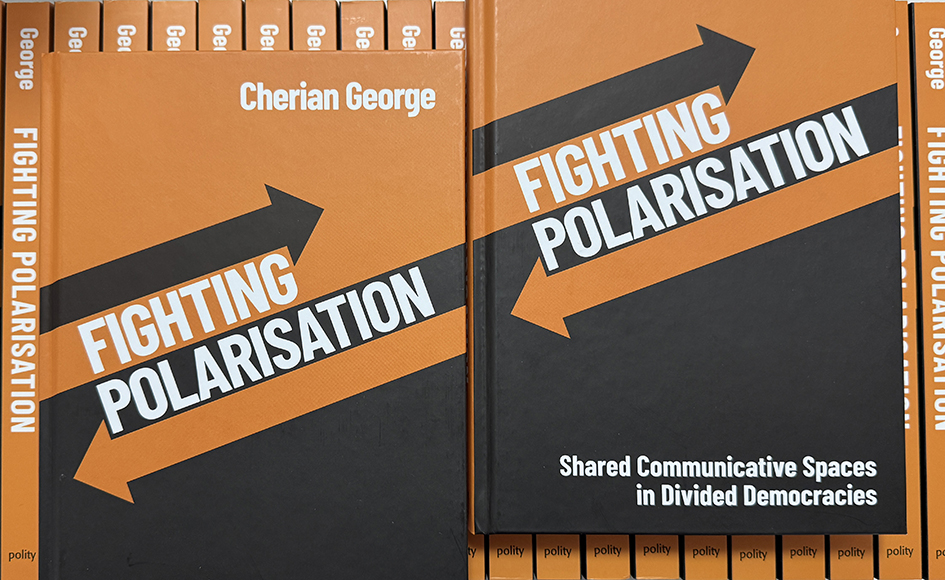
A review of George’s book has been published at Journal of Democracy. To access click here.
Across the world, deepening political polarization is straining democratic systems and fuelling social conflict. As “us versus them” divisions harden, compromise has become elusive, violence more common, and democratic norms increasingly fragile. Yet beneath the surface of high-level political confrontation, small civic initiatives are quietly working to reverse these trends.
New research by Cherian George, a professor of media and politics at Hong Kong Baptist University, documents a growing but largely overlooked global movement aimed at countering polarization through dialogue and face-to-face engagement. Drawing on fieldwork across more than a dozen countries, George argues that polarization is not inevitable but socially constructed and therefore open to challenge.
At the core of these efforts are spaces designed to allow citizens to speak directly with one another, bypassing politicians, mass media, and social platforms that often amplify division. While these mediating institutions do not always promote hate explicitly, George argues they frequently benefit from segmentation and antagonism, which make societies easier to mobilize and control.
The initiatives he studied range from citizens’ assemblies and community organizing to interfaith dialogue, educational programs, and conflict-resolution projects. Though diverse in method and philosophy, they share a focus on reducing what scholars call “affective polarization” the emotional hostility that erodes mutual respect even when political disagreement persists.
Some of the most institutionalized efforts are citizens’ assemblies, which have been adopted in parts of Europe and North America. These forums convene representative groups of citizens to deliberate on complex policy issues with expert input and trained facilitation. The European Union has increasingly turned to such assemblies to deepen democratic participation, while groups such as Extinction Rebellion have championed them as a response to political gridlock.
Research suggests that while citizens’ assemblies may struggle to overcome entrenched political or corporate resistance, they consistently reduce hostility among participants. Even without consensus, face-to-face deliberation tends to soften attitudes toward political opponents.
Elsewhere, grassroots groups are applying similar principles outside formal deliberative settings. In the United States, Down Home North Carolina works in rural and working-class communities, using “deep canvassing” techniques that emphasize listening, empathy, and shared local concerns rather than partisan messaging. In Turkey, long marked by extreme polarization, youth-focused initiatives such as the Arayüz Campaign seek to build cross-party dialogue around common issues like employment and housing.
These approaches deliberately avoid demonizing voters who support populist strongmen, instead treating authoritarian support as a symptom of deeper social and economic grievances. Advocates argue that sustained, civil engagement is essential if those grievances are to be addressed democratically.
What unites these varied efforts is careful design. Organizers emphasize that unstructured encounters can easily worsen conflict or reproduce social inequalities. Effective dialogue requires skilled facilitation, intentional inclusion, and a focus on storytelling rather than debate.
George notes that while charismatic national leaders have sometimes helped societies overcome deep divisions, most polarized democracies cannot wait for figures of that stature to emerge. Instead, change is being driven incrementally by facilitators, students, activists, and ordinary citizens willing to sustain difficult conversations.
The scale of the challenge remains immense, and few involved believe their efforts alone can reverse global polarization. Yet in a political environment dominated by zero-sum conflict, these small, locally rooted initiatives offer a different model of democratic repair. As George concludes, in the absence of sweeping solutions, the steady cultivation of dialogue may be one of the few tools available to hold divided societies together.