

At stake in Paris’s mayoral race is more than leadership. The contest pits a social and ecological model of urban governance against a security-driven, order-focused alternative.
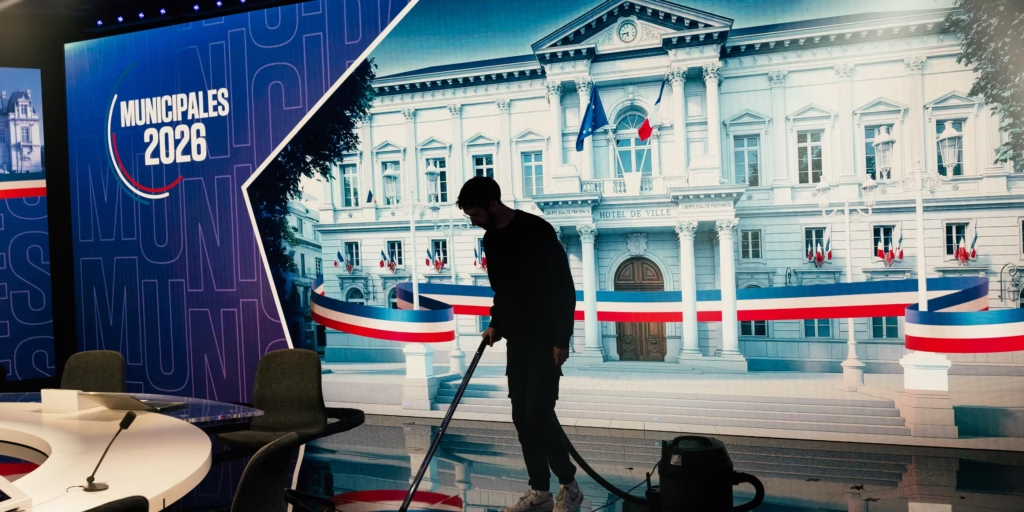
France went to the polls on Sunday, 15 March, to determine the future of its local governments in elections held across approximately 35,000 municipalities. While much of the country delivered decisive results in the first round, attention quickly shifted to major cities such as Paris, Lyon, and Marseille, where no candidate secured an absolute majority, setting up a high-stakes second round on 22 March.
The outcome of that second round has now confirmed both continuity and constraint in France’s political landscape. In the capital, Emmanuel Grégoire has been elected mayor of Paris, defeating right-wing candidate Rachida Dati with around 52% of the vote and extending the left’s decades-long control of the city following the tenure of Anne Hidalgo.
More broadly, the results represent a setback for the right and the far-right National Rally, which failed to secure key urban strongholds such as Marseille and Toulon despite targeting them heavily. The left retained its grip on major cities, with Benoît Payan re-elected in Marseille, while Édouard Philippe held Le Havre, reinforcing his position ahead of a potential presidential bid.
Taken together, the results point to the resilience of left-wing coalitions in France’s major urban centres and a more limited-than-expected breakthrough for the far right, even as the country moves toward the 2027 presidential election.
The Mathematics of the Second Round: From Alliance Politics to Outcome in Paris
In the capital, the first-round results made clear that the election would ultimately be decided less by initial vote shares than by post-first-round alliances. Emmanuel Grégoire led with 38%, while his conservative rival Rachida Dati followed with 25.5%, setting the stage for an intensely competitive second round shaped by bloc consolidation.
On the right, Dati sought to construct a “unity list,” reaching out to centre-right candidate Pierre-Yves Bournazel (11.7%) and opening channels with far-right candidate Sarah Knafo (10.4%). In theory, such an alignment could have pushed the right and far-right bloc close to parity with the left.
On the left, consolidation proved more decisive. The third-placed radical left candidate, Sophia Chikirou (11.7%), moved toward alliance with Grégoire, enabling a broader left coalition to form around a unified ticket.
The final result on 22 March confirmed the effectiveness of this strategy. Grégoire secured the Paris mayoralty with around 52% of the vote, demonstrating that left-wing coordination ultimately outweighed the right’s attempted bloc-building.
Municipal Socialism Endures
The outcome reinforces a broader pattern in French politics. Despite its relative weakness at the national level, the Socialist Party continues to demonstrate resilience in major urban centres. Strong performances in cities such as Paris, Montpellier, and Nantes suggest that “municipal socialism” remains electorally viable, particularly when supported by alliances with the Greens and the radical left.
Two Political Visions: Continuity and Challenge
The contest in Paris crystallised a wider ideological divide.
The model associated with Anne Hidalgo, and continued by Grégoire, emphasises environmental transformation, reduced car use, social housing, and urban inclusivity.
By contrast, Dati’s platform, rooted in the Republicans, prioritised security, order, and a rollback of certain environmental restrictions, particularly on traffic. Her candidacy also reflected a more complex political trajectory, combining a background as the daughter of immigrants with a strong law-and-order agenda.
What the Result Means
While the arithmetic of the first round suggested a potentially competitive race, the second-round outcome ultimately confirmed the enduring strength of the left in Paris. The election was not only a local contest but also a signal of how coalition-building continues to shape French urban politics.
Despite efforts by the right and far right to coordinate, it was the left’s ability to unify its vote that proved decisive, ensuring that Paris remains governed by a social and environmentally oriented agenda.