

The intervention in Venezuela signals a shift in how US power is exercised globally and how the international order is being reshaped.
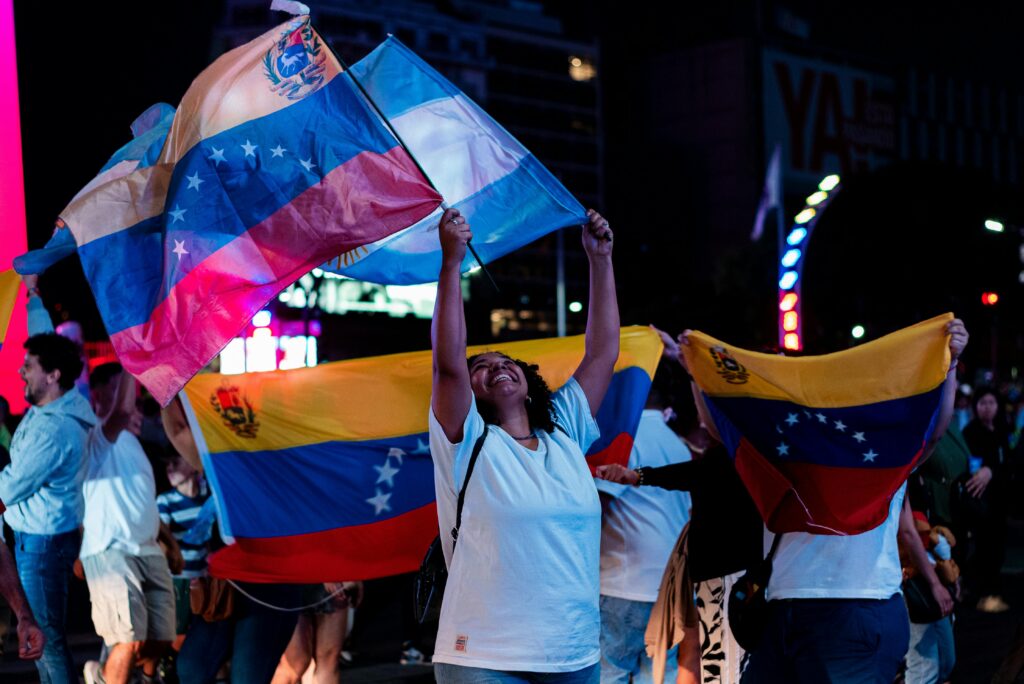
Photo by Alex Dos Santos
Begum Zorlu, City, St George’s University of London
On 3 January 2026, US special forces carried out what the Trump administration described as “Operation Absolute Resolve”: the abduction of Venezuelan President Nicolás Maduro and his wife from Caracas. While the media has largely presented this as a swift and decisive operation, up to 100 people were killed, including around 30 Cuban military personnel. Beyond the loss of life, the operation constituted a profound violation of Venezuelan sovereignty, marked by a disregard for international law and an extreme demonstration of hard power. Yet in the extensive international commentary that followed, these deaths have been largely invisible, with attention instead focused on US objectives and strategic gains.
In Venezuela, what we witnessed can be named as a form of remote coercion, in which the US exploited the country’s existing weaknesses to project power without resorting to full occupation or overt regime change. This operated as a form of coercion strong enough to reshape political outcomes, yet structured to allow the coercing state to avoid accountability or serious constraint.
The capture was illegal
First it is important to underline that the intervention exposes a set of contradictions between its stated justifications and the practices through which it was carried out. From the standpoint of international law, the operation was unlawful. There was no UN Security Council authorisation, no credible case for self-defence under Article 51 of the UN Charter, and no plausible humanitarian justification. According to international law experts, the administration’s attempt to reframe the operation as a law enforcement action supported by military force is manifestly untenable given its scale, military character, and strategic intent.
Drug trafficking charges against Maduro lack substantial evidence and are disputed by many (even those critical of Maduro), while the invocation of domestic criminal indictments cannot transform what was clearly an act of force against a sovereign state into a legitimate policing operation. If being a “bad guy or dictator” justifies military abduction, the logic has no clear limits. Why Maduro but not Kim Jong Un? This selective application of standards accelerates the collapse of any pretence to a rules-based international order.
How to read the moment?
What distinguishes remote coercion from more familiar forms of intervention is its underlying operational logic. It is neither military occupation, which requires a sustained troop presence and entails responsibility for governance, nor sanctions-based pressure, which relies on time, attrition, and multilateral coordination. It also does not resemble classic regime change, aimed at dismantling existing power structures and installing preferred alternatives. Remote coercion instead operates according to a different calculus, combining a discrete act of force with a sustained threat.
This strategy was made possible in part by Venezuela’s growing isolation and structural vulnerability in recent years. A prolonged campaign of diplomatic isolation, punitive sanctions, and eroding regional ties significantly weakened Maduro’s international position. What emerged was an intervention that was symbolically dramatic yet structurally limited, reflecting a deliberate preference for what the administration appeared to view as a manageable level of disorder rather than the risks associated with full-scale regime change and potential collapse.
This pattern did not emerge suddenly. Venezuela has long functioned as a testing ground for US punitive strategies. During Trump’s first administration, Washington pursued a “maximum pressure” campaign built around sweeping sanctions, particularly targeting the oil sector. The assumption was that economic strangulation would rapidly dislodge the regime. Instead, Maduro remained firmly in power, the opposition strategy unravelled, and sanctions neither produced political change nor improved human rights conditions. If anything, repression deepened.
The Biden administration sought to recalibrate rather than abandon this approach. It offered conditional sanctions relief tied to concrete commitments, including the release of political prisoners and steps toward competitive elections. In practice, however, compliance was uneven and short-lived. Commitments were repeatedly undermined, enforcement mechanisms lacked credibility, and the threat of renewed sanctions failed to meaningfully alter regime behaviour.
By 2026, Trump’s current administration moved beyond both sanctions-based pressure and conditional diplomacy. The shift was signalled by a campaign of US military strikes on suspected drug-trafficking vessels in the Caribbean and eastern Pacific, marking a turn toward overt force. The latest escalation came with the capture of Nicolás Maduro and his wife, Cilia Flores.
Why the Venezuelan Regime Will Comply
The Venezuelan regime is likely to comply with US pressure because it has few viable alternatives. Losing power carries the risk of imprisonment, exile, or worse, while free and fair elections are not considered an option for the regime. Long-standing debates over negotiated transition or elite defection, therefore, appear even less settled than before.
One key fault line runs between the civilian government and the armed forces. Venezuela’s military remains a central political actor regardless of who holds the presidency, and Interim President Delcy Rodríguez’s authority depends heavily on her ability to manage military and security leaders with their own power bases. Her immediate challenge is to sustain elite cohesion while responding to US pressures, especially over control of oil and other resources.
The second fault line concerns regime strategy. One camp may favour limited accommodation with US economic demands to reduce pressure while another views any opening as an existential risk that could ultimately force negotiations with the opposition. Internal negotiations among these power centres remain opaque. The available evidence points not towards consolidation but towards continuous bargaining, with the coming months likely to expose fractures that are not yet fully visible.
Fears of escalating violence are also mounting. As Phil Gunson of the International Crisis Group warns, pro-government armed collectives remain active, military counterintelligence patrols are visible on the streets of Caracas, and an emergency decree authorises the arbitrary detention of individuals suspected of supporting the operation or aligning with the US. Public sentiment is therefore marked by apprehension and uncertainty about what lies ahead.
Indications of splits within the military also matter because they underscore how the intervention has unsettled the very institutions on which regime stability depends. The dismissal of General Javier Marcano Tábata, who commanded Venezuela’s presidential honour guard in the days after Maduro’s capture, points to suspicion and internal turmoil over how the operation unfolded. Some observers have suggested insider cooperation, but the nature and extent of any internal divisions remain unclear. What matters is not solely the proof of collusion, but the way this episode has deepened mistrust within the security forces, contributing to wider fragmentation and uncertainty.
Bad News for a Rules-Based International Order
The gap between Trump’s rhetoric and practice is stark. When asked about Venezuela’s political future or the fate of political prisoners, Trump dismissed these concerns outright, remarking, “We haven’t gotten to that. Right now, what we want to do is fix up the oil.” There has been no serious engagement with democratic transition, no articulated framework for reconstruction, and no sustained interest in human rights beyond their rhetorical usefulness.
What has emerged instead is an explicit language of domination. The administration has argued that Venezuela’s leaders have “no choice” but to comply, that the United States will “run” the country, and that oil companies will recover wealth previously “stolen” from them. Secretary of State Marco Rubio has argued that the operation was “trigger-based”, dependent on conditions aligning at short notice, and therefore did not require prior notification of Congress, a rationale that points to a broader erosion of constitutional and institutional restraint.
More troubling still is the uneven international response. Western reactions, in particular, have been marked by ambivalence. The failure of key European states to clearly identify the US as a violator of international law has weakened the universality of the prohibition on the use of force. This inconsistency also risks undermining opposition to other unlawful interventions, including Russia’s aggression in Ukraine or potential future Chinese actions. The central question is whether international law retains any capacity to constrain powerful states, or whether selective legality has already become the governing norm.
The Limits of Solidarity Under Coercion
In the region, initial responses to the intervention revealed a clear left–right divide. Brazil, Colombia, and Mexico condemned the operation as a violation of sovereignty and international law. Colombia’s reaction was particularly significant. After Trump warned President Gustavo Petro to “watch himself”, Bogotá called for a UN Security Council meeting under threats to international peace and security, signalling concern not only with Venezuela but with the broader precedent such an intervention sets.
Beyond these immediate condemnations, most governments adopted a cautious posture. While some quietly welcomed Maduro’s removal, few have been willing to endorse the means through which it was achieved. Unease over precedent cuts across ideological lines, including among centre-right administrations, reflecting awareness that regional agency can be overridden even in democratic states when confronted with direct US coercion.
The episode also exposed the practical limits of Global South solidarity. No actor offered Venezuela meaningful support in the face of US military pressure. Turkey, which had cultivated close ties with Maduro since 2016 through rhetoric opposing coups and external interference, confined its response to cautious statements and avoided concrete diplomatic action. China condemned the US operation as a violation of Venezuelan sovereignty and international law, but beyond diplomatic statements it took no steps to raise the costs of US action or offer Venezuela concrete protection.
Performative solidarity proved fragile when confronted with hard power.
Conclusion: More Uncertainty, Not Less
The operation in Venezuela should not be treated as an isolated case. Since 3 January, the administration’s threats have escalated across multiple fronts. Trump declared that Washington would now ‘run’ Venezuela and repeatedly paired this with menacing rhetoric toward neighbouring states, portraying Colombia’s President Gustavo Petro as a ‘sick’ leader who might be targeted next and vowing that no more Venezuelan ‘oil or money’ would go to Cuba. Rhetoric surrounding the seizure of Greenland has also intensified, treating Danish sovereignty as negotiable in light of US security interests.
For Venezuela, military coercion now seeks what neither sanctions nor negotiation could achieve: the subordination of the regime without any political settlement, and compliance extracted without legitimacy. This reflects the absence of any coherent strategy for political resolution on the US side. Rather than pursuing a negotiated settlement or any framework for political transition, the Trump administration has relied on coercion as an end in itself. Sanctions, oil leverage, and the threat of renewed force operate together as a single mechanism of pressure.
This form of remote power is destabilising not only for Venezuela but for the international order more broadly. Rather than reducing uncertainty, the operation has intensified it. A weakened Chavista regime is likely to remain in power, constrained by external pressure and fragmented internally. Free and fair elections remain unlikely, while elite fractures are set to widen under sustained coercion.
Beyond elite politics, remote coercion has also eroded the prospects for long-term reconciliation and internal peace. The operation has reinforced a climate of suspicion, deepening institutional mistrust and encouraging conspiratorial interpretations of political events. Rather than stabilising the political landscape, coercive intervention hardens divisions, weakens already fragile channels of dialogue, and undermines the social foundations necessary for any future political settlement.
The intervention in Venezuela crystallises a wider transformation in the exercise of power in international relations, in which sovereignty and legal restraint are increasingly treated as contingent rather than binding. This trajectory is not new, but builds on post-9/11 practices through which successive US administrations blurred the line between war and law enforcement while circumventing constitutional oversight and detainee protections. What is new is the intensification of this approach: as the Trump administration turns towards reshaping hemispheric geopolitics around strategic assets and great-power competition Venezuela emerges not as an anomaly but as a central site where this transformation is being tested and enacted.