

Populist leaders don’t just claim to represent the people – they embody them. Through strongman toughness or maternal guardianship, populists model idealised versions of a nation’s citizens, and they naturalise exclusion. Selina Mabrouki shows how contemporary populist leaders exploit gendered role models as tools of emotional persuasion.
Gendered populism and the fight for the ‘real people’
If populism pits a liberal elite against ‘the people’, who, precisely, are the real ‘people’? Exclusionary populism revolves around this simple question. Today’s populist leaders do not merely speak for the nation – they embody it, using gendered role models.
Gendered emotions, symbols, and identities shape populist projects. By presenting themselves as archetypes of the ideal male or female citizen, populist leaders naturalise belonging through their gender. The strongman and the mother-figure are not metaphors; they define the national community.
Such leaders do not focus solely on anti-gender policies, or rely only on personal charisma. What matters more to them is using gendered performances to model the nation in their own image. Hungarian Prime Minister Viktor Orbán and US President Donald Trump stage authority, toughness, ‘petro-masculinity‘ and national protection. Italian Prime Minister Giorgia Meloni and Deputy of the French Rassemblement National Marine Le Pen evoke moral guardianship, care, and familial purity, as Meloni’s ambiguous stance on gender rights illustrates.
Today’s populist leaders model the nation in their own image – and gender is the medium through which they convey authenticity
These gendered performances are not stylistic flourishes but mechanisms of exclusion. By positioning themselves as prototypes of the ‘real people’, leaders quietly mark everyone who deviates from these gendered ideals as lying outside the ‘moral community’. For them, gender is not an accessory to exclusionary populism but its operating system, and gender is the medium through which they convey authenticity.
The strongman blueprint for belonging
Masculine authority has long been central to exclusionary populism, but not all strongmen perform masculinity in the same way. What unites them is that they turn masculinity into a template for national belonging – a model of strength, protection, toughness, and emotional control that signals who the ‘real people’ are. Yet the stylistic and emotional registers through which leaders embody this ideal vary significantly, shaping different forms of exclusion.
Orbán performs a paternal and disciplined masculinity, grounded in steadiness, not confrontation. He presents himself as the stable father of a vulnerable nation: protective, measured, and morally anchored. This performance naturalises a vision of ‘the people’ as traditional, responsible, and culturally rooted. And, of course, it subtly excludes those who fall outside this ideal. Orbán’s tactics align with broader insights associating hegemonic masculinity with order, control and authority.
Strongman leaders turn masculinity into a template for national belonging – a model of strength, protection, toughness and emotional control
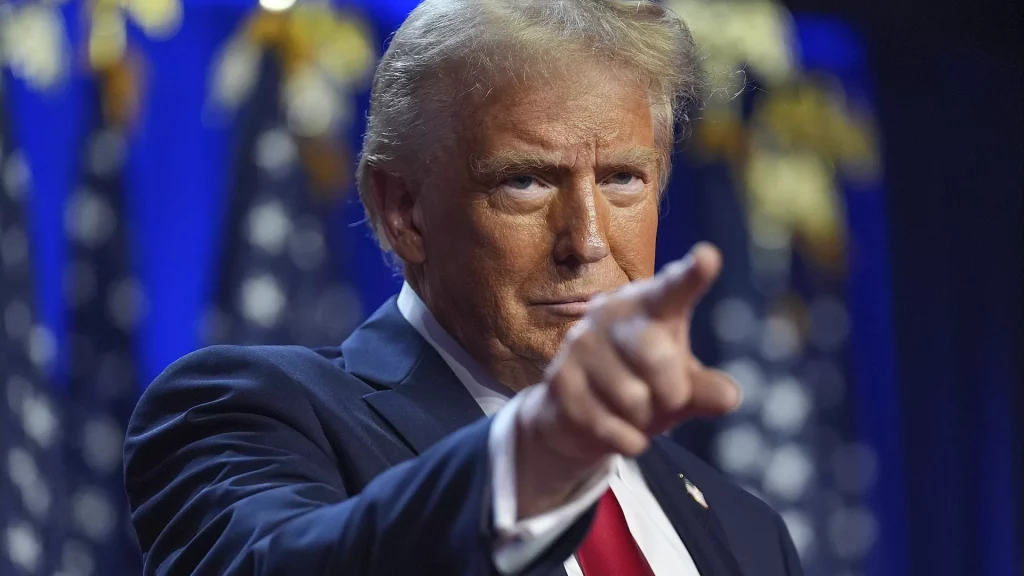
Trump, by contrast, embodies an aggressive, combative, and emotionally unfiltered masculinity. His strongman persona is not paternal but confrontational: politics is conflict, opponents enemies, and dominance a moral virtue. This hypermasculinity reinforces the boundary between ‘real Americans’ – unapologetic, anti-elite – and those associated with pluralism, restraint, or equality, who Trump casts as weak or untrustworthy. Such performances resonate in moments of anxiety and perceived decline. They offer emotional clarity through strength and dominance.
Despite their stark differences, Orbán and Trump both transform masculinity into a criterion of political membership. Orbán’s version reassures; Trump’s provokes. One stabilises, the other disrupts. Yet both teach their publics what kind of behaviour, affect and moral outlook qualifies as truly belonging to the nation – and who must be pushed out.
The mother-figure as the moral community builder
If the strongman models the nation through toughness and protection, the mother-figure performs it through care, purity, and moral authority. Feminised populist performances do not soften exclusion; they render it moral. They reimagine the nation as a fragile family whose cohesion depends on traditional gender roles. The leader becomes the symbolic mother of the nation, whose duty is to guard the moral community.
Meloni exemplifies this repertoire. Her frequent appeals to ‘our families’, ‘our children’, and ‘our roots’ align with what Sara Farris terms femonationalism: the mobilisation of women’s and children’s protection for exclusionary nationalist projects. As recent analyses of her ambiguous stance on gender rights show, this maternal persona allows Meloni to present restrictive policies not as punitive, but as necessary acts of care. By embodying the archetype of the protective mother, Meloni narrows the definition of ‘the people’ to those who conform to heteronormative, culturally anchored family roles.
Populist ‘mother-figure’ leaders model the national through care, purity, and moral authority
Le Pen deploys a similar strategy, though with a more controlled emotional register. Research on gender and far-right politics notes that female leaders often draw on moral and maternal authority to legitimise hardline positions. Le Pen’s persona recasts exclusion as protection for French women and children. This logic resonates strongly with the anti-gender narratives documented by Agnieszka Graff and Elżbieta Korolczuk, which depict gender equality and LGBTIQ+ rights as foreign threats undermining the national family.
Far from offering an alternative to masculine leadership, these feminised repertoires work in tandem with strongman politics. They create a softer aesthetic for the same boundaries: by performing care and moral duty, mother-figures legitimise exclusion as a necessary defence of the imagined national home.
Why gendered role models make populism persuasive
Strongmen and mother-figures do more than merely enact personal styles; they offer embodied blueprints of a nation. Their performances translate political values into personality traits, transforming exclusionary agendas into moral and emotional common sense. By modelling the ‘real people’, populist leaders make their projects appear not ideological but natural and necessary. This is why gendered performances matter: they bridge the gap between abstract populist narratives and citizens’ everyday identities.
Orbán’s paternal steadiness, Trump’s combative dominance, Meloni’s maternal guardianship, and Le Pen’s moral restraint each teach their audiences what belonging should look and feel like. These gendered role models stabilise exclusion by embedding it in the leader’s persona, allowing followers to relate to political boundaries as a reflection of shared values rather than strategic choices.
Understanding these dynamics is crucial. Populist leaders gain traction not despite their gendered performances, but because these performances make their claims emotionally credible. To grasp why exclusionary populism resonates so widely, we must first recognise the gendered scripts that make it persuasive – and that allow its leaders to embody the nation they pledge to defend.
This article was originally published at The Loop and is republished here under a Creative Commons license.