

Drawing on the voice of Fairuz and the warnings of Amin Maalouf, Gülseren Onanç, the founding chair of SES Equality and Solidarity Association, calls for peace through the resistance of women defending their cities and dignity.
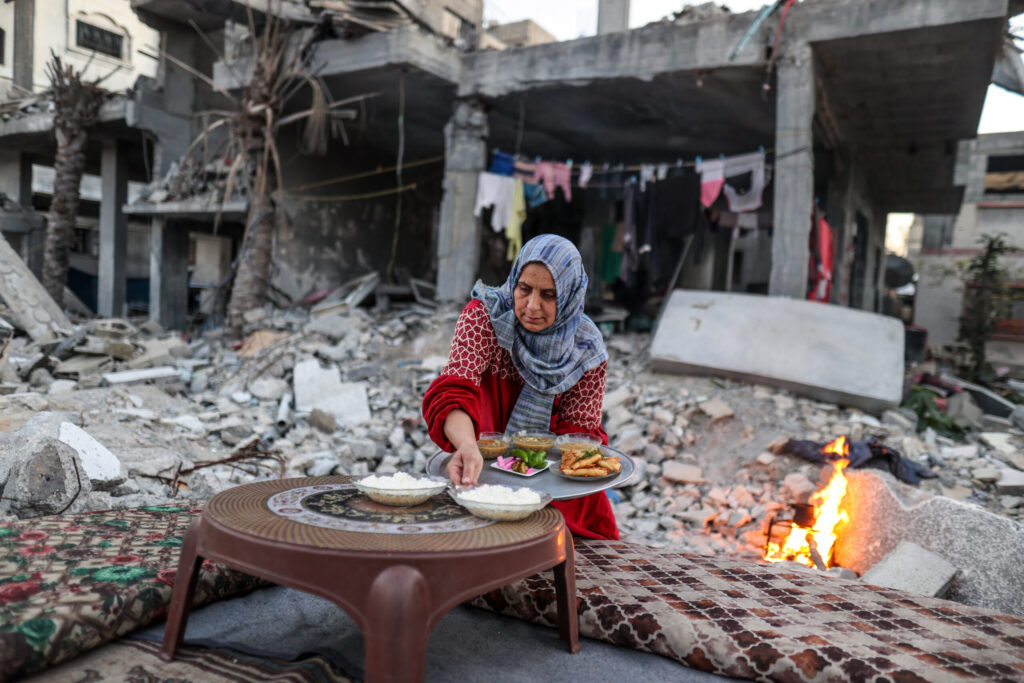
Holidays in our region have traditionally been celebrated with joy, hope, and enthusiasm.
But that is no longer the case. As in recent years, this year too the holy month of Ramadan and the Eid that follows have been marked by deep sorrow and pessimism.
Once again, war has returned to these ancient lands that have sustained a cultural heritage stretching back thousands of years.
While Trump attempts to legitimize attacks by persuading us that the United States faces a threat from Iran, Israel openly declares that it aims to end the Iranian regime, not even needing a justification for war.
Yet we know from all past wars that there has never been a true winner. The losers are humanity as a whole, especially women and children.
Will the World Not Mourn Innocent Children Killed in War ?
In the three-week-long war in Iran, more than 2,000 people have already lost their lives according to official records, and there are fears that this number will rise rapidly as those trapped under rubble are accounted for. In Gaza, since October 2023, the death toll has surpassed 40,000, reaching an unimaginable scale, with the majority of victims being women and children. In Lebanon, intensified attacks since early March have claimed hundreds of lives.
Yet despite all this devastation, we do not see a strong, collective global will taking to the streets to demand peace or a ceasefire. Today, apart from Spain, there are almost no Western countries clearly and diplomatically voicing opposition to this war and the escalation of violence.
This collective silence is carving a wound in the conscience of humanity that will not heal for a long time.
We must ask: has war become a normalized feature of this “new world order”? Will we grieve no more for dead children than we do for rising oil prices or fluctuations in stock markets?
The Spirit of the Levant and Being Levantine
I was born in Mardin, on Turkey’s Syrian border, and grew up in Istanbul. My family roots trace back to Lebanon. Recently, I have begun to define myself as “Levantine.” As a woman born in Mardin, raised in Istanbul, and rooted in Beirut, I feel that I belong to the ancient, multicultural heritage of the Levant.
For me, the Levant is not just a place on a map. It is the shared spirit formed by the quiet wisdom of Mardin’s stone buildings and the dignified resilience of Beirut rising from the sea. It is a cosmopolitan oasis in the eastern Mediterranean where languages, religions, and cuisines intertwine.
The Levant stands as a testament to the possibility of coexistence among diverse identities in a region that the West today reduces to a single cycle of violence under the label “Middle East.”
Identifying as a Levantine woman intensifies both my sorrow and my anger at what is happening in this region. I feel deep grief over the endless conflicts, systematic destruction, and the transformation of the Levant into a laboratory of war.
Moreover, the West’s dismantling of the very “human rights” and “democracy”-based world order it once championed has deeply disappointed activists like myself who trusted in and believed in the universality of these values.
Edward Said and Modern Orientalism: The Illusion of Superiority
What strikes me first, when I look at the language used by Trump and other Western politicians, is a mindset rooted in a sense of superiority. We are witnessing a modern manifestation of the very worldview that Edward Said diagnosed decades ago. This perspective constructs the East as an irrational “other” that must be tamed, and it is now used to legitimize military interventions from Gaza to Lebanon to Iran.
Fairuz’s Love for Beirut and Women Who Stand for Their Cities
On the other hand, I think of the resilient women of Beirut, a city repeatedly brought to its knees. Recently, I watched an interview on an international channel: a woman from Beirut, forced to evacuate her home, told the reporter, “Thank God we did not leave our city.” The bittersweet expression on her face captured how vital Beirut, and all cities, truly are.
We saw this same unwavering stance among Palestinian women who refused to leave their land despite the threat of death, and we will see it among women in Tehran as well.
This emotional state is captured in Fairuz’s song “Li Beirut.” Every time I listen to it, it brings tears to my eyes. With her enchanting voice, she calls out:
To Beirut, from my heart, peace to Beirut
And a kiss to the sea and the houses
To a rock as if it were the face of an old sailor
She is, from the people’s spirit, wine
She is, from its sweat, bread and jasmine
So how has its taste become
The taste of fire and smokeMy banner, and the stone of tomorrow, and the wave of my voyage
The wounds of my people have bloomed, bloomed
The mothers’ tear
You are Beirut to me, you are mine
This is a feeling the West will never understand. Women who love their cities like Fairuz stand silently as symbols of a form of resistance that cold military strategies can never comprehend.
Lebanese thinker Amin Maalouf, in The Disordered World, speaks of a world “coming undone,” describing how the West betrays the very universal values it once created. As a Levantine, I find his sense of disillusionment deeply familiar.
The Dilemma of Iranian Women Under Pressure and War
I believe it is necessary to strongly criticize the repressive policies of the Islamic Republic of Iran, especially toward women, and to apply international pressure for change. I am not an international relations expert, but I know the importance of negotiation and compromise.
To transform this outdated and undemocratic regime, diplomatic and democratic avenues must be pursued, and fear and insecurity must be addressed. Sanctions and constant threats have, in my view, only pushed the Iranian regime into greater isolation and rigidity.
Although some see this war, initiated by the United States and Israel, as a move to end the regime, it may instead make it appear more indispensable, like a protective shield.
Images of young girls killed in a primary school strike send a powerful message of victimhood to the world, fueling hatred toward the West while potentially strengthening the Iranian regime. I fear that the courageous struggle of Iranian women for dignity and freedom will be overshadowed by the defensive reflex created by war, allowing the regime to emerge even stronger from this chaos.
Conclusion: Peace Will Come from Within These Lands
History shows us that the order imposed by the West has not brought lasting peace to the region, but has instead laid the groundwork for further conflict.
As a Levantine woman, I make this call: peace in these lands can only emerge from our own internal dynamics, from our ancient culture of coexistence and shared life. Expecting a lasting solution from the West will only lead to further disappointment.
At the same time, for the progress of humanity, the West must confront its own weaknesses and, as it did after the Second World War, reorient itself toward peace and democracy.
Ultimately, I believe that we can cultivate peace in our region with our own hands, drawing on the deep-rooted will embedded in the very fabric of these lands. This means reclaiming the Levantine culture of coexistence, which since the Phoenicians has woven the eastern Mediterranean into a network not only of trade but of shared living.
From the multilingual wisdom of Mardin to the dignified resilience of Beirut, this historical legacy provides a strong foundation for lasting peace.
If only Turkey could first succeed in building a model of internal social peace and pluralism, it could become the strongest bearer of this heritage and a true architect of regional peace.
Gülseren Onanç