

Gülseren Onanç, President of SES Equality and Solidarity Association, writes about the deeply moving story of a woman she encountered at the Women Working for the World conference in Bogotá, Colombia. The story, which also takes a closer look at Colombia’s recent political history, centres on a woman who lost her husband after he was assassinated, yet chose to preserve her language of love and peace.
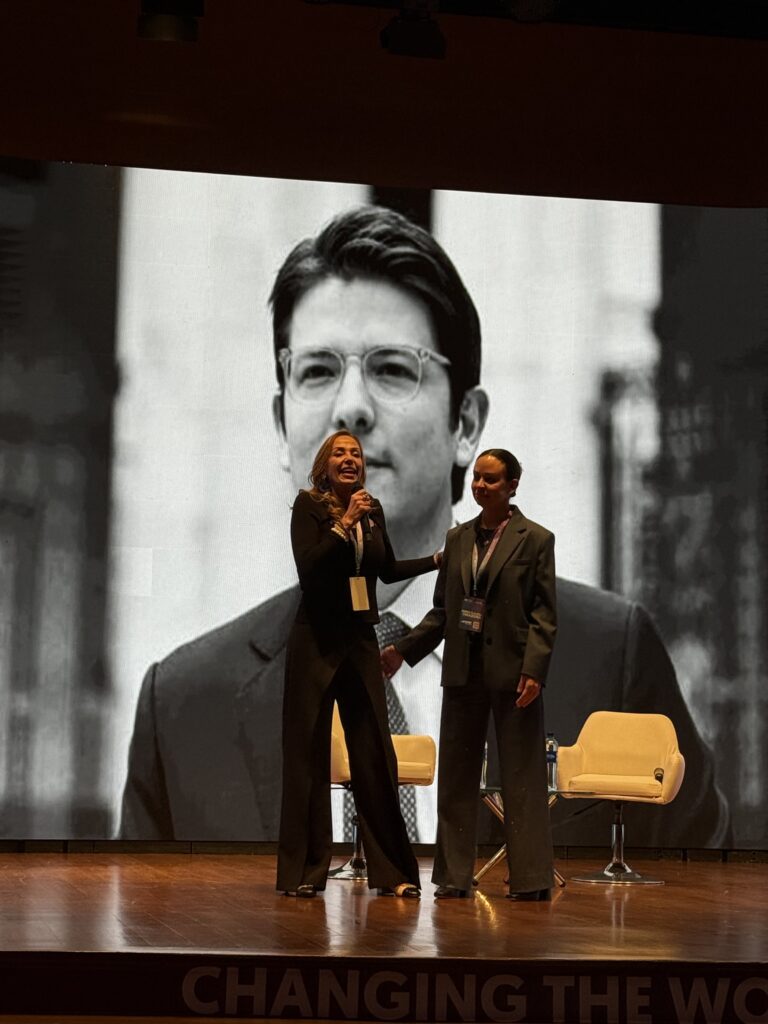
I was in Colombia last week. I attended the WW4W (Women Working For the World 2026) conference. The conference, organized in Bogotá by the Juanfe Foundation, was chaired by the foundation’s founding president, Catalina Escobar, and Pat Mitchell, climate and women right activist, who founded TEDWomen, serves on the boards of the Sundance Film Festival and many other institutions, and launched the Dandelion project on climate justice.
The Juanfe Foundation, which Catalina Escobar established in the name of her son whom she lost in an accident at the age of two, is one of Colombia’s most successful foundations, empowering adolescent mothers.
In the WW4W conference, which has been organized annually for 12 years, a wide spectrum was presented to participants this year, ranging from female athletes and famous actors to businesspeople and politicians, to help them understand Colombia’s political and cultural life.
Colombia: Land of Warm-Blooded, Kind People
Colombia, the country of the famous Latin pop singer Shakira, does not require a visa for Turkish citizens. Turkish Airlines has daily flights to Bogotá. After a flight of nearly 14 hours, you arrive in Bogotá, one of the highest cities above sea level. The population of this city, which rivals Istanbul, is estimated to be between 12 and 13 million. All the Colombians I met, young and old, are very warm-blooded, smiling and kind people.
The conference was like an accelerated course in Colombian sociology and politics for me in a single day. The emotional weight of the speeches was very high. A few days prior, 69 soldiers and crew members had lost their lives and 57 soldiers were injured in a military plane crash. This event had re-triggered security concerns in the country, plunged the nation into grief, and intensified feelings of nationalism. Rather than the Spanish-to-English translation, I was more moved by the sincere performances on stage, sometimes weeping and sometimes laughing.
Lives Lost at the Same Age: The Cycle of Colombia
One woman at the conference moved me very deeply. I cried for minutes over the story of María Claudia Tarazona, the wife of Miguel Uribe Turbay, who was assassinated while he was a presidential candidate and lost his life after months of struggling to survive.
Her story tells of how dangerous a business politics is in Colombia; it is the heartbreaking tale of an idealistic, well-educated, loving and caring father who did not want to be away from his four-year-old son for even a minute, and most importantly, the story of a woman who translated the pain she experienced after her husband’s death into a language of peace.
It will be useful to look at Colombia’s political past over the last ten years for the story to be understood.
The Peace Agreement That Polarized Society
In 2016, the Colombian government under President Juan Manuel Santos ended a conflict exceeding fifty years by signing a peace agreement with the FARC armed terrorist organization. However, this peace agreement was not accepted in a referendum held in the country. Despite this, the agreement was approved by congress with a few changes and entered into force.
Opponents accuse Santos, who was awarded the 2016 Nobel Peace Prize for ending the conflicts through the peace process he maintained, of throwing the country into the fire just to receive the Nobel.
Following the agreement, FARC laid down its arms and joined the political scene. Although the period of armed conflict ended, conflict began on the political stage this time. Society was sharply divided in two: those who saw peace as a beginning and those who saw the peace process as a surrender.
Gustavo Petro, who in 2022 was elected as Colombia’s first president from the left, was a member of the M-19 movement, known as urban guerrillas in his youth. M-19 integrated into politics by laying down arms in the 1990s; Petro built a political path originating from this transformation, leading to parliament, then the Bogotá mayoralty, and finally the presidency.
Gustavo Petro is one of his country’s most controversial politicians. While supporters see him as a reformer trying to deepen peace, critics attack him for being distant from state authority, underestimating security risks, and having an approach that grants too many concessions in the peace process.
Social Justice or Harsh Security?
For this reason, the upcoming presidential elections are proceeding not as a classic right-left rivalry, but as a struggle over the divided meaning of the peace process in the country. Gustavo Petro cannot run again by law. The leftist politics represented by the candidate he supports advocates for deepening peace and expanding negotiation. According to them, the source of violence is inequality; the solution is social justice. The right, however, views the same process as the weakening of the state. According to them, peace is only possible through a strong state and harsh security policies.
While the left block seems closer to winning the elections to be held on May 31, the performance of the various candidates in the fragmented right-wing block could also affect the result. Ultimately, a coalition is seen as a certainty.
I have detailed this Colombian political history and the presidential election process so that the heroes of the story can be better understood.
Now, let’s come to the heroes of the story that deeply saddened and moved me:
Miguel was born in Bogotá in 1986. His mother was the famous journalist Diana Turbay, and his grandfather was Julio César Turbay, who was the President of Colombia between 1978 and 1982. His father was a figure in the business world. His mother, Diana, went to a meeting thinking she would interview a guerrilla leader, but was actually lured into a trap set by Pablo Escobar and kidnapped. After being held hostage for months, she lost her life during a rescue operation.
Miguel was only four years old when his mother was killed. Miguel received a law education at a prestigious university in Bogotá to continue the political connections he inherited from his family and attended short-term programs at the Harvard Kennedy School. He took on important roles in both city and national public administration in Bogotá. He became a member of the Centro Democrático party, one of the main veins of the Colombian right, which looks critically at the peace process and is security-oriented.
He emerged as one of the prominent candidates of the party for the 2026 Presidential elections. He conducted an active campaign for about a year during the presidential candidacy process. He traveled from city to city, establishing direct contact with voters, focusing especially on regions where security problems were intense. Strengthening state authority and a harsher fight against crime became the prominent themes of his campaign. He adopted the slogan “If the state remains weak, there will be no peace”. He used a corporate and technical language and promised to bring a new leadership approach as a 39-year-old young, dynamic presidential candidate.
María Claudia is also a lawyer from Bogotá. She has a respected career in her profession. She is a spouse who preferred not to be in the foreground during Miguel’s political journey. When she married Miguel, she had three daughters from her first marriage. Their son Alejandro was born from her union with Miguel. She describes how they were a happy family with her three daughters and son. For Miguel, his marriage to María Claudia became a harbor where he took refuge, escaping from the wavy and harsh sea of politics.
Nothing Is More Powerful Than a Look Full of Love
When Maria Claudia took the conference stage, an applause broke out in the hall, which was mostly comprised of women. At first, I thought this was support for a grievance. After all, she was the victim of a heart-wrenching story. She was a woman in her early forties who had lost her husband, whom she loved, got along with, and admired, simply because he fought a political struggle, and she was left a widow with four children.
From the answers she gave to the questions asked, I saw that Maria Claudia was much more than a grieving widow. She was a woman with a huge heart who wanted to be a remedy for the country’s division. I was very moved by her sincerity and the peaceful language she developed with the maturity given by her pain.
I want to share the notes I took from her speech:
“Miguel was always full of ideas. He would motivate us, move us to action, constantly visit different cities, talk to people, learn something new every day, and teach what he learned to others. And today, what causes the most pain is not just his absence; our daily life has also vanished. At night, Miguel would turn into a soldier, a superhero for Alejandro, play games with him, and fill his life with dreams. I had asked Miguel to be careful, not to put himself at such risk. That day, a few hours before leaving the house, he said something to me I will never forget: ‘I don’t want to lose even a single minute of the time I will spend with Alejandro’. He embraced us and left the house. And he could never return. He could never return to his family, to that life he loved so much.
But today I want to tell you this: I am at peace with Miguel’s death. It might be hard to say this, it might be hard to believe, but today I am at peace with his death. I know that his sacrifice will not be in vain. I accept the pain that fills me with all its reality. At the same time, I accept to forgive. And I am ready to put forth my own effort, service, and life for my country, for women who are victims of violence, and for the beautiful future of this beautiful country. There is much to be done. There are children in need of guidance. There are refugee children in need of a compassionate look.
Because I believe this: Nothing is more powerful than a look full of love. It can be more powerful than a therapy or a psychologist. The thing that changes a heart most deeply is a compassionate look. And wherever I am, in whatever position I am, I will be there to serve my country. Because this is the only way to turn the void Miguel left, that pain, that absence, and that silence into meaning. I thank you all for your words of support and for accompanying me.”
As Maria Claudia stood up and walked past me, I could not hold back my tears.
I wanted to hug this big-hearted woman and whisper in her ear: “I wish you were the President of Colombia and peace came to this beautiful country through a woman’s hand“.
I don’t know if one should call it fate. Miguel’s son Alejandro was four years old when his father was killed, just as Miguel was at the age when he lost his mother.
Gülseren Onanç
7.4.2026