

Honduras’s latest political shockwaves underscore the widening fractures in US–Latin American relations. Washington’s pardon of former Honduran president and convicted drug trafficker Juan Orlando Hernández has once again raised troubling questions about its willingness to align itself with authoritarian leaders in the region.
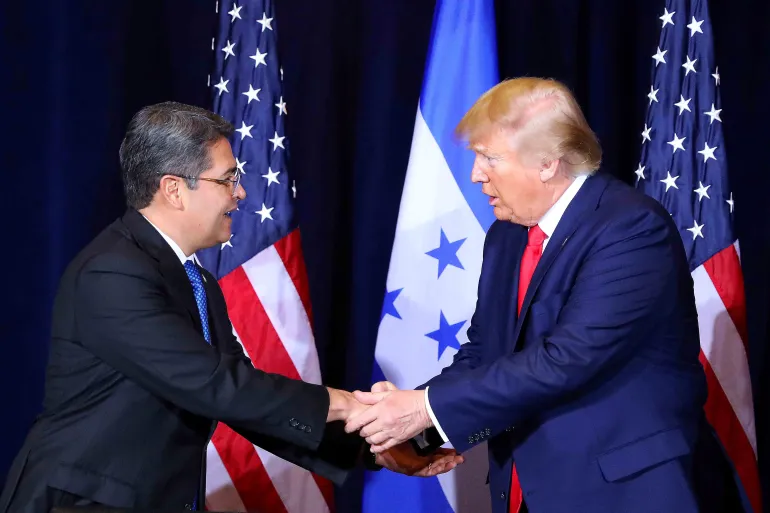
As Honduras navigates a turbulent and disputed vote count after its 30 November elections, the United States has reasserted itself as a central and deeply contentious actor in the unfolding crisis. Trump’s sudden pardon of former president Juan Orlando Hernández, convicted in the United States for running a major cocaine trafficking network, and his interventions in favour of Nasry “Tito” Asfura, including unfounded claims that officials had “stopped counting” and threats of “hell to pay” if results shifted, have intensified uncertainty in a race already overshadowed by fraud allegations and rising political tension.
With just over five hundred votes separating the leading contenders, Nasry “Tito” Asfura of the right-wing National Party and Salvador Nasralla, the centrist former television presenter running for the Liberal Party, the country remains in a state of uncertainty as officials work toward presenting final results by 30 December. Trump’s emphatic endorsement of Asfura, coupled with his warning that the United States would reconsider its support if Hondurans chose another candidate, has deepened unease about the scale of American influence at a moment of acute institutional fragility.
Everything else than the drug trade
Speaking on the BBC’s Global Story, reporter Will Grant examined Trump’s rationale for pardoning the former leader convicted of drug trafficking. His account suggests that the motives behind the decision lie in almost everything except the drug trade itself.
In the conversation Grant emphasised that Hernández, once regarded as one of Washington’s most dependable regional partners, had been sentenced to forty five years in the United States for conspiring to traffic four hundred tonnes of cocaine, accepting bribes from major cartels including Joaquín “El Chapo” Guzmán’s Sinaloa organisation, and using drug proceeds to reinforce his political machine. Prosecutors described him as having “paved a cocaine superhighway” to the United States. Yet after serving less than two years, he walked free. Trump defended the decision by claiming Hernández had been “treated very harshly and unfairly,” portraying him as the target of a politically motivated prosecution.
Grant notes that the shock inside Honduras had been immense. He describes a public mood marked by disbelief and anger, with many Hondurans unable to comprehend how the same US government that dedicated years to building the case against Hernández could now reverse it. Grant also reminded listeners that Hernández’s presidency is widely recalled as one of the country’s darkest periods, defined by corruption, electoral manipulation, and deep entanglement with organised crime. His disputed 2017 re-election, marred by a sudden collapse of vote counting systems and followed by deadly clashes, remains a defining moment in the erosion of Honduran democracy.
It is important to underline that Honduras had opened a path of political change after Hernández’s repressive rule. The 2021 Honduran election concluded the National Party’s twelve-year tenure, which was defined by widespread corruption and the rise of narco politics under President Hernández, whose 2017 re-election was deemed illegitimate. His association with organized crime was highlighted by US drug-trafficking charges against his inner circle, leading up to his own subsequent extradition. In 2021, Xiomara Castro, the left-leaning leader of the Libre Party, won decisively, becoming the nation’s first female president. Her victory was a clear repudiation of the National Party’s system of governance, signaling a desire to end political impunity and the influence of drug-trafficking networks. This outcome was a significant regional event, ending a key US-aligned conservative rule and giving Castro a mandate for structural reform to address corruption and inequality.
However we see a regional order that is becoming increasingly difficult to maintain this progressive change. While Trump orders aggressive anti narcotics operations in the Caribbean and threatens military action in Venezuela under the banner of combating “narco terrorism,” he has released a man convicted of organising one of the largest drug trafficking conspiracies in recent hemispheric history. Members of Congress, analysts, and even US law enforcement officials involved in the case have voiced astonishment, arguing that the decision undermines years of painstaking prosecutorial work. Grant notes that most of the evidence against Hernández was gathered during Trump’s own administration, directly contradicting his claim that the case was a “Biden setup.”
For many Hondurans, this episode reinforces the long held perception that Washington treats Central America as a geopolitical afterthought, intervening when convenient and overlooking abuses when politically useful. Grant points out that analysts in Tegucigalpa view the pardon as a return to a Cold War style logic in which the United States supported authoritarian or compromised leaders as long as they aligned with U.S. strategic interests. Today those interests revolve less around anti communism and more around migration control and ideological affinity. Trump’s efforts to reassemble a network of loyal regional leaders, alongside his direct intrusion into Honduras’s electoral process, suggest a renewed willingness to act unilaterally and without regard for institutional norms.
We recommend the full conversation Will Grant, which offers crucial context and first hand reporting.