

Hannah Spencer, a plumber and local councillor from Greater Manchester, defeated both Britain’s ruling Labour Party and the far-right Reform UK in one of the most closely watched by-elections in recent British history. Her victory was built on a grassroots campaign that united working-class and minority communities around shared economic grievances and delivered the Green Party its first-ever parliamentary by-election win.
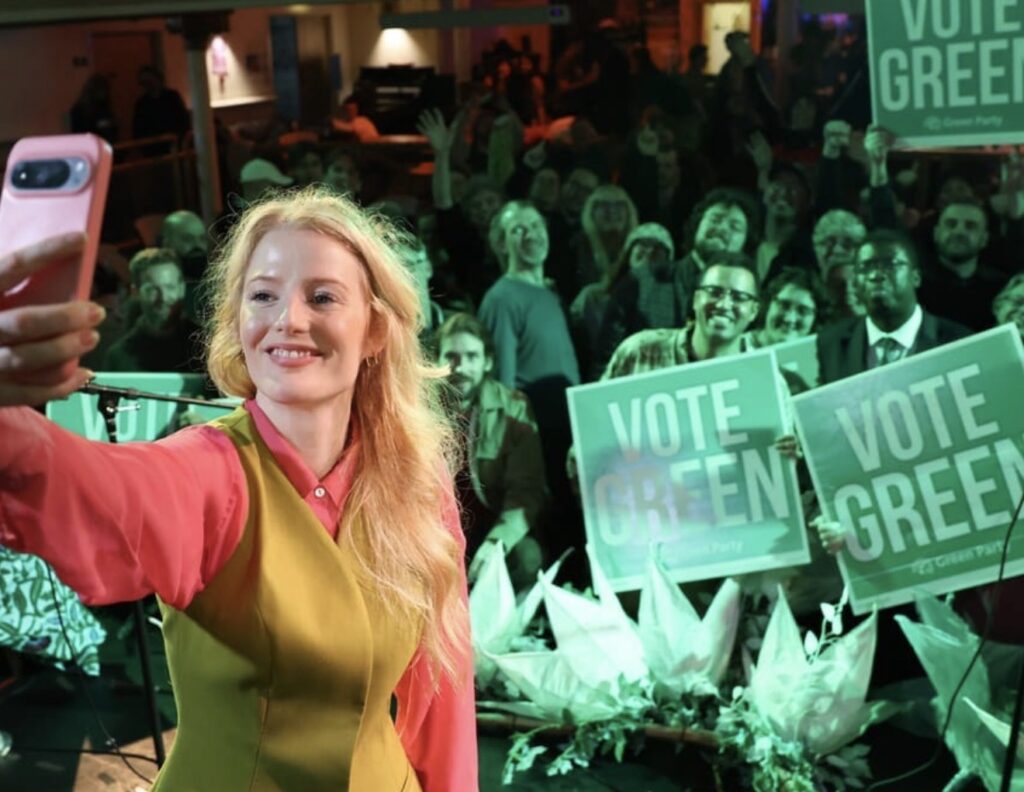
For most of the past century, British politics has been a story of two parties sharing power. That trend is changing, and nowhere was it more visible than in a by-election in Greater Manchester last week. The Labour government, elected with a large majority in July 2024, has faced growing public frustration over living costs, public services and foreign policy. At the same time, Reform UK, led by Nigel Farage, has been mobilising voters around an anti-immigration platform and opposition to the political mainstream. Against that backdrop, a by-election in the Greater Manchester constituency of Gorton and Denton emerged as an unexpected test of how much of its traditional support Labour had actually retained, and whether the Greens’ mass mobilisation across the UK was translating into actual votes.
The scale of the result was not anticipated. Most pre-election polling had suggested a competitive three-way contest, with analysts cautioning that fragmentation of the progressive vote could deliver the seat to Reform UK, which has been consolidating support among socially conservative and economically frustrated voters. This did not materialise. The Greens secured 40.7 per cent of the vote, a swing of more than 28 percentage points on their performance in the same constituency at the 2024 general election, while Labour fell from 51 per cent to 25 per cent. Reform came second on 28.7 per cent. The Conservatives and Liberal Democrats both lost their deposits.
Who is Hannah Spencer?
Hannah Spencer’s candidacy challenged traditional expectations about who gets to enter politics, making her victory all the more significant. The 34-year-old, born in Bolton and raised in Greater Manchester, left school at 16 to train as a plumber before establishing her own business, Hannah’s Household Plumbing, which specialises in domestic energy retrofitting. She joined the Green Party in 2022 and was elected to Trafford Council the following year. She now becomes the party’s fifth MP, its first to represent a constituency in northern England, and its youngest ever. Her victory highlights the continued underrepresentation of working-class women in Westminster.
Furthermore, her career in a male-dominated trade also challenged entrenched stereotypes about women’s work. During the campaign, Spencer faced false claims online suggesting she was not a “real” plumber or that she was exaggerating her working-class background. She dismissed these attacks as sexism from a vocal minority who could not accept a woman working in a trade traditionally dominated by men. By confronting the accusations head-on, Spencer shifted the conversation away from questioning her own qualifications and toward the broader assumptions that still shape perceptions of gender and authority. In doing so, she exposed how women in both manual trades and public life are often required to prove their credibility in ways their male counterparts rarely are.
The Campaign and the Politics of Solidarity
Under the leadership of Zack Polanski, elected last year, the Green Party has recalibrated its political strategy. While environmental policy still remains crucial, the party has adopted a more left-populist tone that places greater emphasis on everyday economic concerns, particularly the cost-of-living crisis. This shift reflects an effort to move beyond the long-standing perception of the Greens as “just” a climate party and to position the party as a broader vehicle for economic and social justice. Alongside this rhetorical shift, the party has increased its media visibility and canvassing. This allowed the party to reach audiences that previously sat outside its traditional support base.
Hannah Spencer’s victory speech reflected this strategic repositioning. Speaking directly to the diversity of her constituency, she argued that communities often treated as politically distinct shared common experiences of marginalisation. White working-class and Muslim communities, she suggested, both understood what it meant to be “looked down on,” whether because they “didn’t do well at school, maybe because they do dirty manual jobs, [or] because they are shut out of places they should be in.” The formulation was widely noted as an attempt to build solidarity across groups that political campaigns more often treat as separate, if not competing, constituencies.

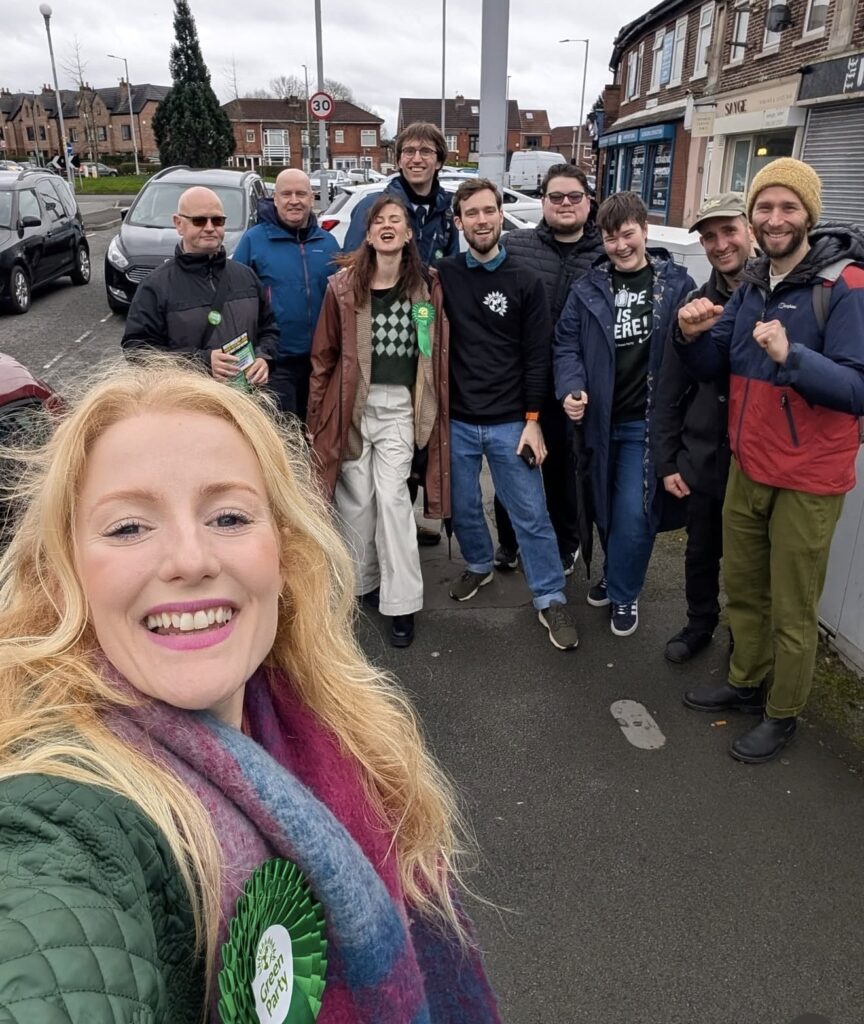
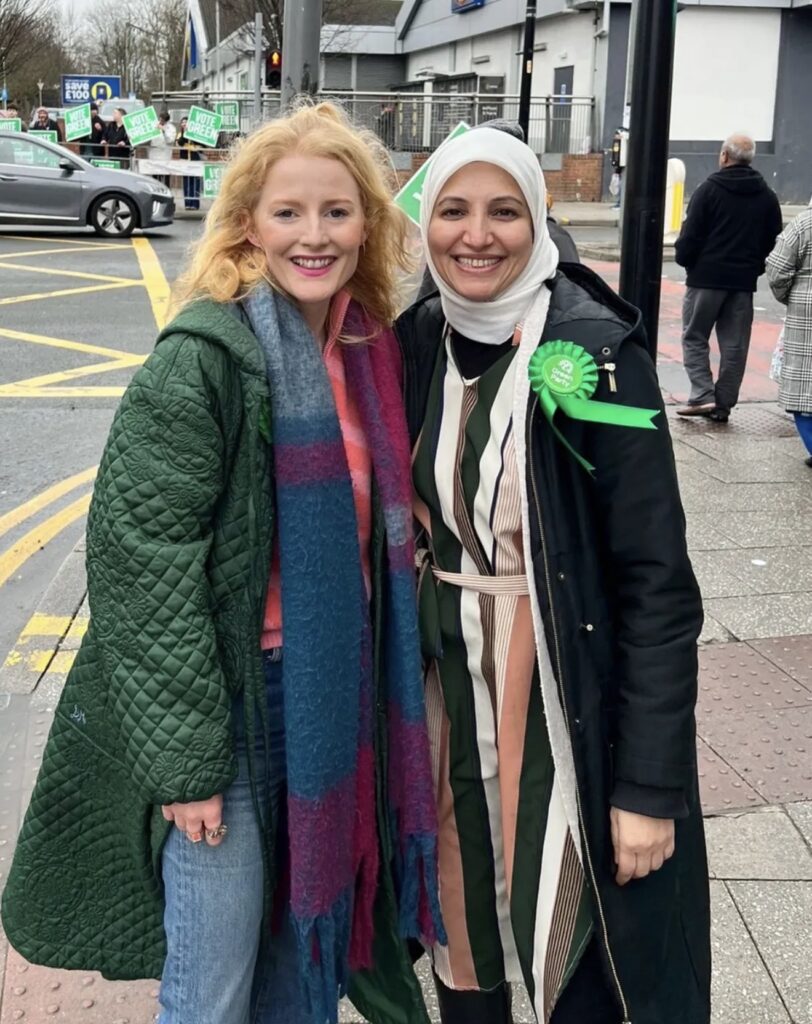
She went further, explicitly rejecting the divisive narratives that have increasingly shaped British political discourse:
“I won’t accept this victory tonight without calling out politicians and divisive figures who constantly scapegoat and blame our communities for all the problems in society. We have shown that we don’t have to accept being turned against each other at all, and we did this with the people who live here, side by side, shoulder to shoulder, just as we have always done in this constituency and in the whole of Greater Manchester.”
Implications for British Politics
The result presents acute challenges for the government of Keir Starmer. Gorton and Denton ranks as the seventh largest Labour majority to be overturned in a by-election since 1945. Labour’s vote share fell by nearly 26 percentage points, and its candidate finished behind Reform UK.
For the Greens, however, the implications are more expansive. In the immediate aftermath of the result, party membership surged from around 68,000 in September 2025 to more than 200,000. The scale of the victory has reinforced the party’s belief that voters increasingly see the Greens as a viable alternative to Labour rather than simply a protest vote.
Polling appears to support this perception. Recent YouGov data places the Greens at 21 per cent of the national vote, ahead of Labour and only slightly behind Reform UK, which stands at 23 per cent. If sustained, these figures suggest that British politics may be entering a more fluid and competitive phase in which the traditional two-party system is no longer the dominant organising structure of electoral competition.