

Hungary’s case demonstrates that electoral turnover remains possible under conditions of democratic backsliding. However, whether this moment leads to durable democratic renewal will depend not only on leadership change alone but also on the capacity to sustain institutional reform, economic recovery, and political pluralism over time.
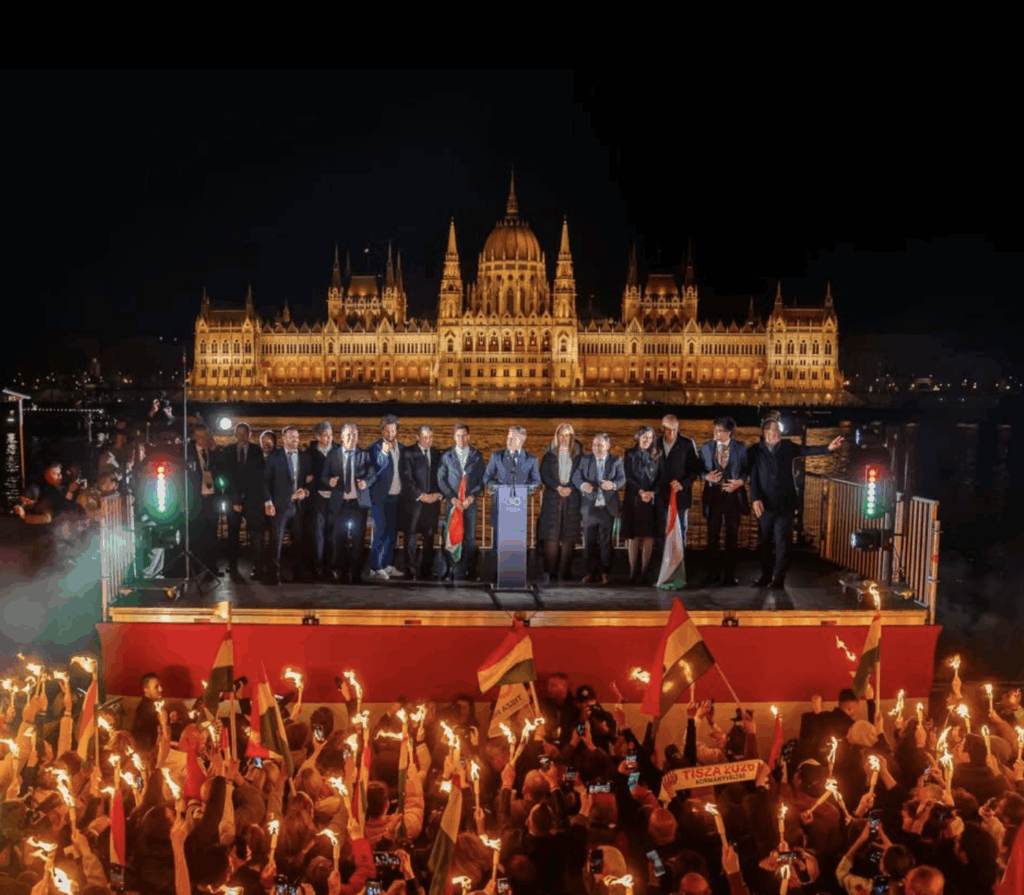
In Hungary, Viktor Orbán, who had dominated the country’s political landscape for 16 years and secured four consecutive landslide electoral victories has suffered a historic defeat. The Tisza Party, led by Péter Magyar, won a decisive parliamentary victory and has ended one of the most controversial governments of the European Union.
Magyar, a conservative former Orbán loyalist who shares elements of the outgoing prime minister’s positions, particularly on immigration, offered a different political style: less confrontational, less divisive, and more technocratic in tone. This distinction proved decisive. Rather than a wholesale ideological rupture, the election signals a shift in how right-leaning politics is articulated and performed in Hungary.
The result also reverberated internationally. Orbán had long been celebrated by figures such as Donald Trump and European politicians like Geert Wilders, who had openly supported him. His defeat therefore represents a significant moment not only domestically but also for transnational right-wing networks that had invested in his continued leadership. Abroad, Orbán was admired for his strong rhetoric against what he termed “the woke movement” and for defending national sovereignty against the European Union.
At home, however, the foundations of his power were more material. A dense network of state institutions and private businesses, often aligned with Fidesz, sustained his rule. Reflecting widespread concerns, Transparency International recently ranked Hungary as the lowest-scoring EU member state on corruption measures, underscoring the structural grievances that shaped the election outcome.
How Did Orbán Lose?
In the run-up to the election, the country’s economic decline became a decisive factor. Years of stagnating growth were accompanied by rising inflation and a sharp erosion of real wages. The cost-of-living crisis, combined with chronic underinvestment in education and healthcare, led many voters to conclude that the Orbán government no longer had anything to offer them.
Orbán placed foreign policy at the center of his campaign, but this strategy possibly backfired. Reports and concerns about Russian influence in the election, along with controversy surrounding Foreign Minister Péter Szijjártó’s ties with his Russian counterpart Sergey Lavrov, significantly weakened his position. For Orbán, who began his political career by demanding the withdrawal of Soviet troops, these developments carried symbolic weight.
Orbán maintained dominance over most of the traditional media outlets. However, when Meta and Google removed political advertising from its platforms, this shift, which may have affected campaign dynamics, placed Fidesz at a relative disadvantage. Meanwhile, Magyar and Tisza gained momentum through viral videos and direct voter engagement.
Pre-election polling suggested that Hungarians under the age of 30 wanted Orbán to leave power. In the weeks leading up to the vote, hundreds of thousands of young people attended large protest-concerts in Budapest. Many indicated that they would consider leaving the country if Orbán were re-elected, highlighting the generational stakes of the election.
Post-Election Developments
Following the election, Magyar moved quickly to outline an ambitious reform agenda. In announcing his first cabinet, which initially includes a small group of ministers and is expected to expand, he appointed prominent figures from outside traditional party structures. Signaling a break from Orbán’s centralized governance model, he pledged to abolish “super ministries” and divide key portfolios into separate ministries.
Within days of the election, Magyar issued an ultimatum to key Orbán-linked figures, including senior judicial and state officials, demanding their voluntary resignation by a set deadline. He stated that if they did not step down, they would be removed based on the electoral mandate. He also announced the establishment of a whistleblower hotline following reports of document destruction within various ministries.
Magyar also announced an end to the “VIP asylum” policy under which Hungary had served as a safe haven for foreign politicians facing corruption charges, including former North Macedonian Prime Minister Nikola Gruevski.
The new government inherits a fragile economic landscape marked by low growth, weak investment, and structural corruption. Its most urgent priority will be to restore economic confidence and improve relations with European partners.
What Did Magyar Get Right?
Over the past two years, Magyar traveled extensively across villages, towns, and cities, mobilizing citizens disillusioned with entrenched patronage networks and corruption. He effectively used social media to bypass Fidesz’s media dominance.
Addressing supporters on election night, he declared: “Today, Hungarians said yes to Europe, yes to a free Hungary.” He described his success as a form of “good populism,” signalling not a rejection of populist politics but its reformulation.
Crucially, he broke the widespread belief that elections could not produce meaningful change. Writing in The New York Times, Michelle Goldberg described a rally in Püspökladány where Magyar repeatedly told supporters, “Do not be afraid,” to which the crowd responded, “We are not afraid.”
What Does Hungary’s Change Tell Us?
Orbán’s defeat has implications beyond Hungary. It represents a significant moment for right-wing nationalist networks in Europe. Orbán had been a central figure alongside Marine Le Pen and Santiago Abascal, and a key reference point for the MAGA movement.
At the same time, this outcome should not be overstated. The election was not only shaped by a shift toward liberalism but also by dissatisfaction with economic conditions and corruption. Hungary’s political landscape has still roots in right-wing, nationalist, and sovereignty-oriented politics.
Yet, Hungary’s case demonstrates that electoral turnover remains possible even under conditions of democratic backsliding. Whether this moment leads to durable democratic renewal will depend not only on leadership change, but on the ability to sustain institutional reform, economic recovery, and political pluralism over time.