

Marta Kos’s visit to Ankara highlights a growing shift in EU–Turkey relations: a gradual move away from a norm-driven accession framework towards a more pragmatic model of strategic cooperation. While official statements during the visit stressed shared interests in security and economic integration, the wider political context raises questions about whether the relationship risks sidelining the EU’s long-standing commitments to democratic norms.
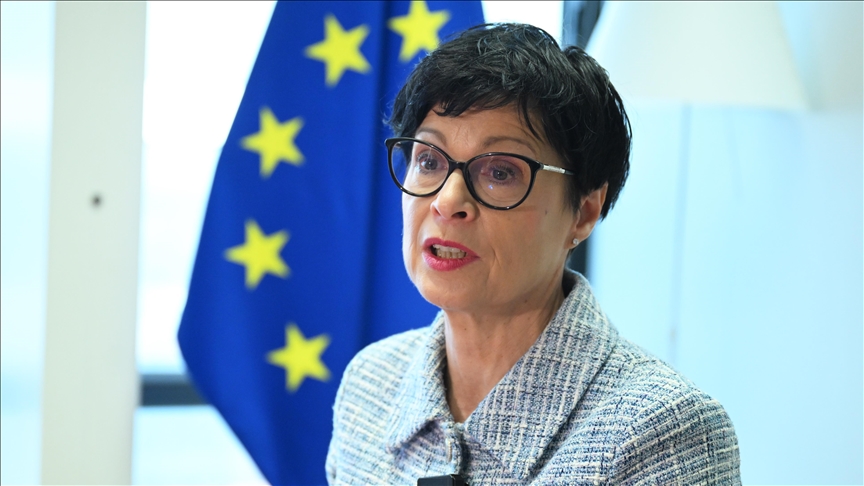
European Commission Commissioner for Enlargement Marta Kos visited Ankara in early February, where she held meetings with Foreign Minister Hakan Fidan, Treasury and Finance Minister Mehmet Şimşek, Vice President Cevdet Yılmaz, and representatives of the Turkish business community. The visit followed efforts in 2025 to revive stagnating relations between Turkey and the European Union and took place at a moment when both sides appear to be reinterpreting the nature of their relationship. In contrast to previous periods, discussions increasingly revolve around ideas such as strategic partnership, connectivity, and confidence-building rather than the traditional framework centered on Turkey’s status as an EU candidate country.
During her meeting with Treasury and Finance Minister Mehmet Şimşek, a letter of intent was signed between Turkey’s Ministry of Treasury and Finance and the European Investment Bank (EIB). Under the agreement, the EIB will provide €100 million loans each to Türk Eximbank and the Development and Investment Bank of Turkey (TKYB). The EIB had suspended its activities in Turkey in 2019 following tensions in the Eastern Mediterranean.
Speaking at a joint press conference after the meeting, Kos described the agreement as symbolically significant, emphasising that in an increasingly unpredictable world, Turkey and the EU need a new approach to recalibrate their relationship. As she put it, “Turkey and the EU need a new perspective to reorganise their relationship.”
Minister Şimşek echoed this assessment and stressed that deeper cooperation between Turkey and the EU is no longer optional. He argued that “closer cooperation between Turkey and the EU is no longer a choice but a necessity.” At the same time, he reiterated Ankara’s long-standing position on EU membership, stating that “full membership in the European Union remains our strategic goal.” He also emphasised that the agreement with the EIB would open the door to broader and more ambitious cooperation, particularly in areas such as green transformation, connectivity, and resilience.
Highlighting the economic dimension of the relationship, Şimşek noted that Turkey is the EU’s fifth-largest trading partner, yet the existing Customs Union framework has become outdated because it does not include services, public procurement, or agricultural products. While acknowledging the EU’s expanding economic engagement with regions such as Latin America and India, he argued that overlooking deeper integration with its fifth-largest trading partner is difficult to justify.
As part of her visit, Marta Kos also met with Foreign Minister Hakan Fidan, after which the two sides issued a joint written statement. The statement emphasised that cooperation in areas of shared interest, particularly security and connectivity, has gained strategic importance in light of developments in the region and globally. It also highlighted the growing significance of Turkey–EU relations for regional stability and economic resilience. Both sides stressed the importance of close coordination between Turkey and the EU in shaping a regional connectivity agenda that includes the Black Sea, the South Caucasus, and Central Asia, particularly in areas related to stability, resilience, and sustainable growth.
Alongside cooperation in security and energy, the statement reaffirmed the importance of economic integration between Turkey and the EU. In this context, Foreign Minister Fidan emphasised the urgency of modernising the Customs Union in response to broader global changes. As he stated, “in light of changing global trade dynamics, increasing geopolitical and economic uncertainty, supply chain vulnerabilities, and green and digital transformations, updating the Customs Union has become increasingly urgent.” At the same time, Kos reminded that dialogue on democratic standards remains an integral element of the relationship, stressing that “dialogue on the rule of law and democratic standards is an inseparable part of EU–Turkey relations.”
Kos also met with Vice President Cevdet Yılmaz at the Presidential Complex in Beştepe. The meeting was attended by Trade Minister Ömer Bolat, Deputy Foreign Minister Ambassador Mehmet Kemal Bozay, and Deputy Trade Minister Mustafa Tuzcu. According to a statement shared by Yılmaz on social media following the meeting, the discussions addressed several key issues, including Turkey’s EU accession process, the modernisation of the Customs Union, visa liberalisation, and the reactivation of high-level dialogue mechanisms between Turkey and the EU.
To reflect on these meetings, both the EU and Turkey appear to be reassessing their relationship in light of broader geopolitical and economic transformations. Issues such as energy cooperation, the strategic importance of the Black Sea region in the context of the war in Ukraine, and the unpredictable economic and security policies of US President Donald Trump have emerged as key factors shaping this reassessment. The timing of Kos’s visit has therefore attracted particular attention, especially as the EU advances its “Made in Europe” strategy, which aims to strengthen European industrial production in response to global economic competition and geopolitical uncertainty.
The Vocabulary of Strategy
Turkey is also increasingly viewed as a key actor in potential peace negotiations regarding Ukraine and in the broader post-war regional order. In a written statement to POLITICO before her visit, Kos underlined the strategic importance of Turkey in this context, stating that “peace in Ukraine will change Europe’s reality, especially in the Black Sea region; Turkey will be a very important partner for us.” She further emphasised the connection between Europe’s future stability and cooperation with Ankara, noting that “preparing for peace and stability in Europe also means preparing for a strong partnership with Turkey.”
Taken together, these developments suggest that EU–Turkey relations may be entering a new phase characterised by a growing emphasis on strategic partnership, particularly in areas such as economic cooperation, energy, and security. At the same time, it remains uncertain whether this sector-specific cooperation could eventually evolve into a broader political partnership.
In an analysis of Kos’s visit, EU expert Ayşe Yürekli argued that the message delivered in Ankara effectively reopens this possibility. According to Yürekli, “Kos’s message in Ankara actually puts this possibility back on the table: commercial and economic rapprochement between Turkey and the EU could reopen space for political dialogue.” However, she also emphasised that Turkey’s ongoing political challenges regarding democracy, human rights, and the rule of law continue to shape the limits of this relationship. As she noted, “the EU will not abandon the Copenhagen criteria, but it is also clear that the EU is developing a new approach toward Turkey that does not deny current realities.”
“Overlooking Democratic Concerns”
Kos’s visit program also drew criticism from the Turkish opposition. Utku Çakırözer, a member of parliament from the Republican People’s Party (CHP) and a member of the Turkish Parliament’s Foreign Affairs Committee, criticised the visit for overlooking democratic concerns in Turkey. He argued that “while hundreds of political prisoners, journalists, and human rights defenders remain in prison, while elected mayors in cities such as Istanbul, Adana, and Antalya have been unjustly imprisoned, and while dozens of municipalities have been placed under government-appointed trustees, ignoring these issues during the visit of the EU’s top enlargement official is a major democratic disgrace.”
Çakırözer also recalled Kos’s earlier decision to boycott an event in Antalya in response to the arrest of Ekrem İmamoğlu, arguing that her previous stance had been justified but that the current visit sent the wrong message. As he stated, “that stance was correct, but today’s approach is equally misguided and unfortunate.” He further criticised the visit for excluding the main opposition party and civil society actors, arguing that “there is no precedent for a visit program that ignores the CHP, other opposition parties, and civil society organisations that have been working for decades under pressure in the areas of human rights, women’s rights, press freedom, and the rule of law.”
Although Çakırözer expressed support for strengthening cooperation between Turkey and the EU in areas such as the modernisation of the Customs Union, energy, and defence, he argued that such cooperation should not come at the expense of democratic principles. As he concluded, “the EU process is first and foremost about the Copenhagen criteria, meaning democracy, rights, law, and justice. You cannot say in your reports that there is democratic backsliding in Turkey while at the same time looking the other way. This is hypocrisy and double standards.”
These criticisms also reflect a broader perception within the opposition that the EU’s approach toward Turkey’s political landscape may be changing. As EU–Turkey relations shift away from a framework centered on accession and candidacy toward a more pragmatic model of strategic partnership, the EU’s engagement with civil society and opposition actors in Turkey also appears to be evolving.