

On 28 February, coordinated US–Israeli strikes on Iran escalated regional tensions, hitting both military infrastructure and the regime’s leadership core. Alina Çalaz argues the attack has reopened questions not only of security, but of Iran’s political trajectory and the future of women’s rights.
How Did the Attack Begin and What Justifications Were Put Forward?
The strikes began in the early hours of 28 February and continued throughout the day, hitting multiple military and strategic sites across Iran. US and Israeli officials framed the operation as an effort to constrain Iran’s nuclear programme and neutralise regional security threats. The escalation is widely seen as the continuation of tensions that had been building since the 12-day Iran–Israel air confrontation in 2025.
How Was Khamenei’s Death Announced?
Iranian state television confirmed the death of Ali Khamenei in the early hours of 1 March. According to official reports, he was killed during a high-level security meeting at the time of the strikes. Details regarding how such a breach of security occurred remain undisclosed. State narratives have framed his death as martyrdom resulting from foreign aggression.
What Was the State’s Response in the First 48 Hours?
A period of national mourning was declared, and a temporary Leadership Council was established under Article 111 of the constitution. The Assembly of Experts is expected to convene to appoint a new Supreme Leader, although the process is likely to remain opaque. The Islamic Revolutionary Guard Corps (IRGC) signalled a firm security response, while official rhetoric emphasised national unity and resistance to foreign intervention.
What Was the Initial Reaction on the Streets?
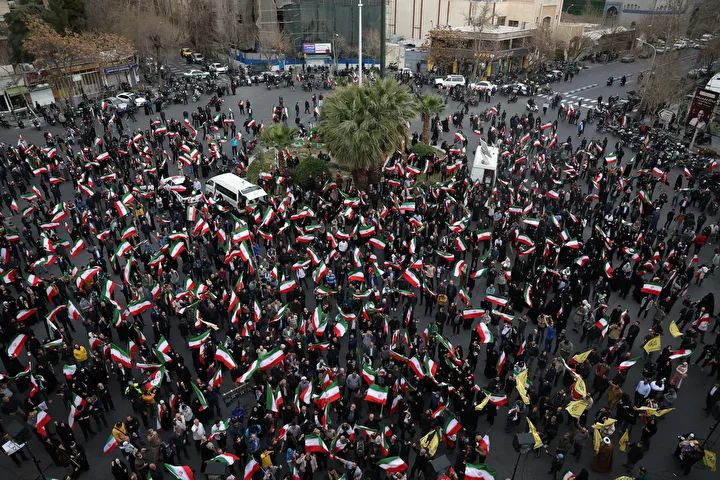
Early reactions suggest that Iranian society is far from unified. While mourning ceremonies were held in cities such as Tehran and Qom, social media captured scenes of celebration in other areas. Reports also indicate slogans shouted from balconies and attempts to topple statues. At the same time, a broader mood of cautious silence appears to prevail.
What Do Iranians Think About the Attack?
Public opinion appears fragmented along three main lines. Regime supporters view the strikes as a violation of national sovereignty. Opposition groups interpret the leadership vacuum as a potential opening for political change. Meanwhile, a larger segment of society remains apprehensive, concerned about the risks of war and the possibility of “Iraq-like” instability.
Are Women Present on the Streets?
Women’s presence has not yet reached the level of mass mobilisation. However, social media activity suggests that women are closely monitoring developments and making cautious interventions. Earlier forms of protest, particularly within universities, have not fully disappeared. For now, the women’s movement appears to be in a phase of observation and strategic positioning.
How Are Women Interpreting This Moment?
Two main perspectives have emerged. Some view the leadership vacuum as an opportunity to expand public space and political participation. Others fear that a strengthened role for the IRGC could result in intensified repression. As a result, many women activists are adopting a cautious and watchful stance.
Has the Security Environment Tightened?
There are clear signs of tightening control. Internet connectivity dropped significantly on the morning of the strikes, while access to VPNs became more restricted and some digital services were temporarily disabled. Although there is no confirmed data on mass detentions, the increased visibility of security forces is notable. There is currently no verified evidence of targeted operations against women activists.
What Awaits Women?
Two short-term scenarios stand out. A growing dominance of the IRGC could reinforce a security-oriented political order, narrowing public space. Alternatively, a prolonged leadership transition could expose elite divisions and create limited openings for political relaxation. In either case, women’s visibility and mobilisation will be critical in shaping outcomes.
Will Women’s Rights Be Sidelined in a Crisis?
Research shows that in times of conflict and political transition, women often face heightened risks of violence and exclusion from decision-making processes. Nationalist mobilisation tends to frame women’s rights as secondary concerns. However, such periods of crisis can also create opportunities: when legitimacy is contested, women’s movements can emerge as central actors in political transformation.
Crisis or Opportunity?
These developments represent more than the death of a single leader; they mark a systemic turning point for Iran. Women may either emerge as more visible political actors within this opening or lose ground under a renewed phase of authoritarian consolidation.
The central question remains: will this crisis become a moment of liberation for Iranian women, or the beginning of a more entrenched and restrictive political order?
The answer, as ever, will be shaped in the streets and in the public sphere.