

In this piece, Gülseren Onanç, founder of the SES Equality and Solidarity Association, reflects on the recent political developments in Turkey, arguing that the political coup carried out against the Republican People’s Party was directed not only at the party itself, but at everyone who wants to live with dignity.
In May 2026, a Turkish appeals court annulled the Republican People’s Party (CHP)’s 2023 congress, which had elected Özgür Özel as leader over allegations of irregularities like vote-buying, effectively suspending Özel and the current leadership in what the opposition calls a “judicial coup” orchestrated by President Recep Tayyip Erdoğan to neutralise his strongest political rival ahead of future elections. Writing in the immediate aftermath of the ruling, Gülseren Onanç reflects on what this moment means for Turkish democracy and resistance under increasing authoritarianism.
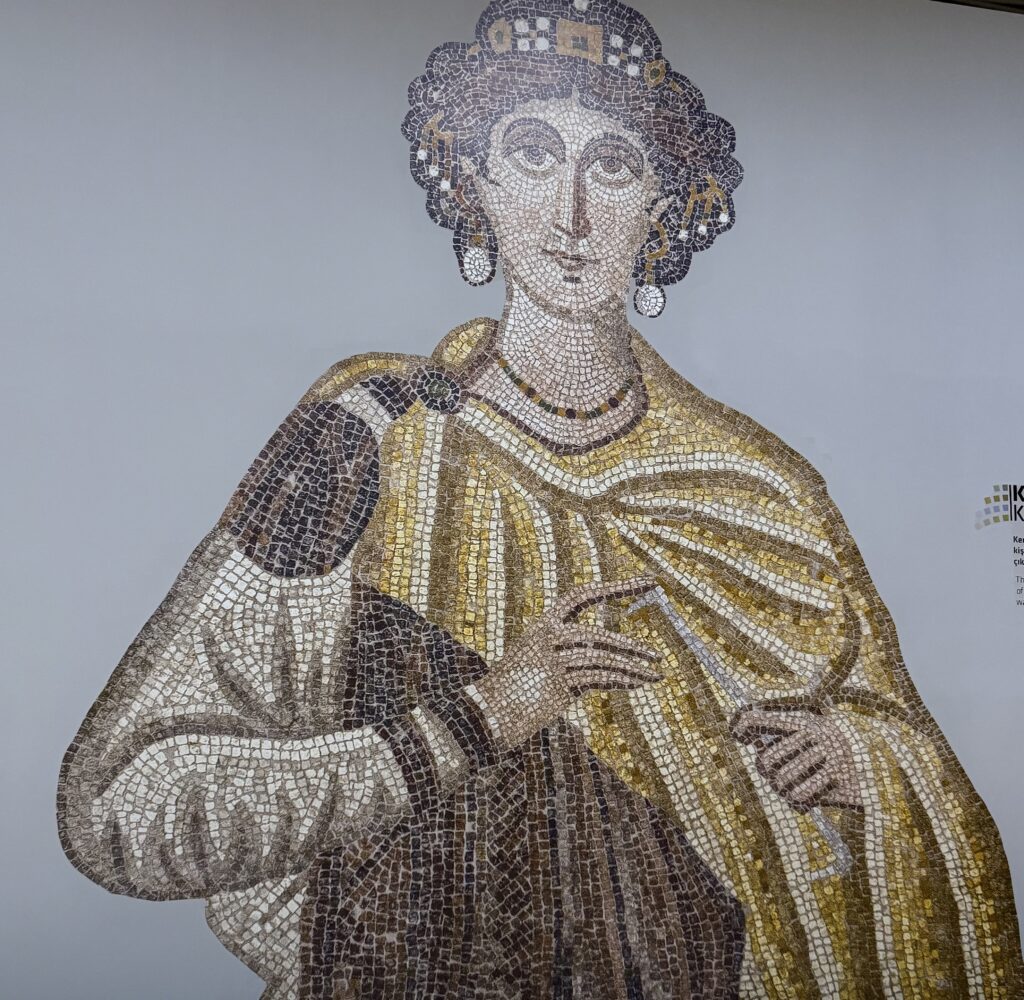
The photograph is my own, taken during a visit to the Urfa Mosaic Museum. It depicts the goddess Ktisis, known in Greek mythology as the founder and protector of cities and structures, whose presence in this mosaic is thought to symbolise the prosperity and flourishing of the city. I could think of no more fitting symbol for this piece.
As the famous story goes, if water is suddenly brought to a boil, the frog reacts and jumps out. But if the water is heated slowly, it becomes immobilised without noticing the approaching death. It mistakes the danger for a new normal. In the end, it no longer has the strength to jump.
I keep asking myself: how are we going to jump out of this constantly heating water before it boils?
Since the Gezi movement, the water in this country has been steadily and deliberately heated, and all of us citizens, like the frog in the story, have gradually slowed down. We are losing our ability to take action, and we are tying our hopes more and more to a single person or institution. And when that person or institution is taken away from us, we realise what we have lost. We become devastated and hopeless.
We must jump out together before we become completely unable to move in the ever-heating waters of this country.
The process that began ten years ago with the imprisonment of opposition politicians and party leaders such as Selahattin Demirtaş and Figen Yüksekdağ continues today. Osman Kavala has been imprisoned for eight years to “settle accounts” over the Gezi Protests. Then came the other Gezi detainees, Çiğdem, Mine, Can, and Tayfun, who have now been imprisoned for four years. Trustees were appointed to replace elected mayors. Dozens of opposition journalists were jailed, and opposition TV channels were shut down or placed under trusteeship. Overnight, Turkey withdrew from the Istanbul Convention, which had provided the legal basis for combating violence against women. Boğaziçi University was targeted, a trustee rector was appointed, and the institution was hollowed out. Just two days ago, the 30-year-old Bilgi University was shut down by a two-line presidential decree.
While the authoritarian system destroys institutions one by one every day, and each new act of lawlessness makes the next one possible, we as citizens are forced to watch helplessly.
Despite all these conditions, the main opposition party, the CHP, managed to achieve success against the government in the 2024 local elections. But to prevent that success from leading to a loss of power, the diploma of Ekrem İmamoğlu, the opposition politician who disturbed the government the most, was first annulled after 30 years, and then he was imprisoned on baseless accusations. When Özgür Özel, the other leader who enabled the CHP’s transformation, continued the struggle, this time a politicized judiciary was activated to shut down or render dysfunctional Turkey’s oldest political institution, the 100-year-old Republican People’s Party (CHP).
A New Step Toward Absolute Authoritarianism
With this judicial coup against the CHP, society’s greatest hope against Erdoğan’s authoritarian rule is being taken away. A new step toward absolute authoritarianism has been taken.
I think we are now closer than ever to the boiling point.
Now is the time to jump together out of this cycle of authoritarianism. We must embrace a movement that can reignite society’s belief in democracy and a dignified life.
Erdoğan’s use of the judiciary as a political tool against the CHP is not only an attack on the CHP. It is an attack on everyone in Turkey who wants to live with dignity.
This assault on the CHP as an institution was also directed at young people who want to live in a democratic and free country; women demanding equality and a life free from violence; LGBTQ+ individuals who want to live without interference in their way of life; workers seeking a secure future; Kurds demanding peace and believing in a democratic country where different identities can coexist; journalists who want to write and speak freely; and academics who want to teach freely.
We know, and are experiencing firsthand, that the goal of authoritarian regimes is not only to weaken the opposition but also to destroy society’s capacity to nurture even the smallest hope.
Like other authoritarians, Erdoğan wants people to withdraw from politics, to be afraid, and to feel isolated and powerless. He wants us to lose confidence in politics, in the parties we support, and in the politicians we believe in.
He wants not only to weaken the opposition but also to neutralise civil society and networks of social solidarity. Through fear, he seeks to shrink the space for civic action. We have seen how Turkey’s largest business organisations were silenced for even the smallest criticism. We know how artists who spoke out were systematically subjected to smear campaigns.
He Wants Us to Lose Alongside Him
My answer to the question “What does President Erdoğan want?” is clear: as he loses, he wants us to lose too. He wants to take away our confidence and hope in the future of this country.
They Still Have Not Taken Away Our Hope
But as Turkish society, we have still not completely surrendered. In the face of every injustice, we have continued to resist, continued to win elections, and we still hold hope that things can become better.
After Ekrem İmamoğlu’s arrest, tens of thousands of people took to the streets, young people stood at the forefront of protests, and broad segments of society continued to demand justice. A very large public opposed the assault on the CHP. Public opinion polls showing that politicians like Ekrem İmamoğlu and Mansur Yavaş could defeat Recep Tayyip Erdoğan at the ballot box are also important indicators of society’s resistance.
This country still has a strong conscience.
In a few days, it will be Eid al-Adha in this country. I hope no sacrifices are made, and that the only thing sacrificed is hopelessness.
When Bolsonaro won the election in Brazil, one of the democratic opposition’s strongest slogans was: “Ninguém solta a mão de ninguém.”
“Let no one let go of anyone’s hand.”
This holiday, let no one let go of another’s hand. Even if authoritarian power seeks to isolate us and break our hope, let us hold onto each other tightly.
We can defend our hope, our dignity, and our democracy only by standing side by side and holding hands.
By holding tightly onto each other’s hands, we can throw ourselves out of the water before it boils.
Before it is too late.
Happy holiday.