

In this article, gender policy specialist Serena Fiorletta explores how disputes over gender equality at the UN’s Commission on the Status of Women reveal wider tensions and democratic challenges within the multilateral system.
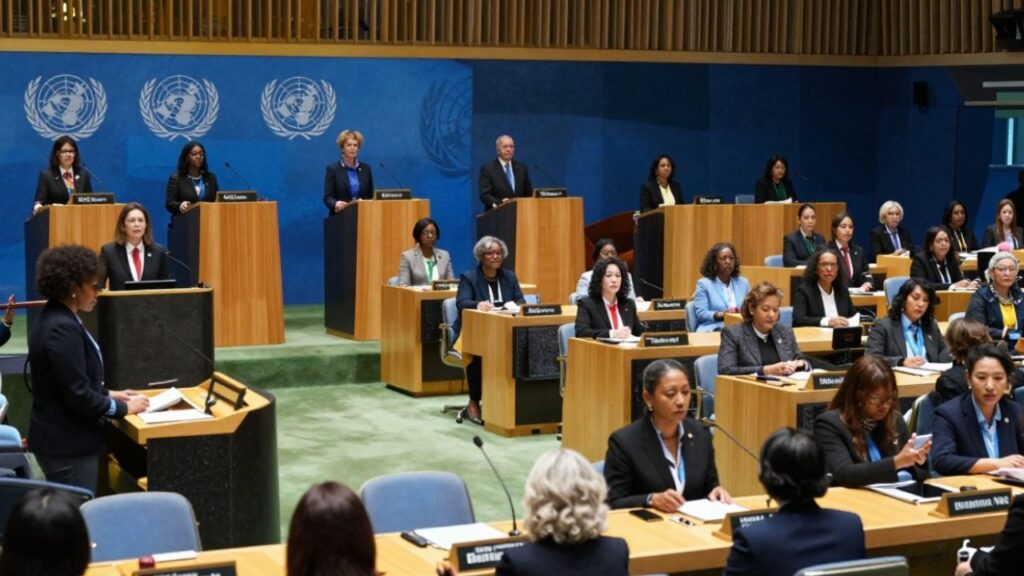
Every March, the UN’s Commission on the Status of Women (CSW) brings together governments, diplomats, and civil society in New York. Participants meet to negotiate the CSW’s Agreed Conclusions, which set global standards on gender equality in relation to the prioritised theme for the year. This year, the 70th session focused on ’Ensuring and strengthening access to justice for all women and girls‘. Its agenda included legal reform, the elimination of discriminatory practices, and the removal of structural barriers.
Gender equality is also a core UN 2030 Agenda objective. The Agenda’s goals, however, remain contested, and just as distant. Sadly, discrimination and violence against women and girls persist. Many governments frame gender justice as a matter of national sovereignty – and this leads to sharp priority divergences.
Ahead of the Commission on the Status of Women meeting in March, negotiations were tense, with some states pushing amendments to the Agreed Conclusions that diluted previously agreed commitments
Ahead of CSW70, negotiations were particularly tense, with some states pushing amendments that diluted previously agreed commitments. Disputes reflect policy differences, struggles over democracy and human rights, and the subtle conflict between national interests and multilateral norms. Unfortunately, such disagreement often results in weaker outcomes.
Feminist civil society has long played a role in the CSW. Organisations follow negotiations in real time, and contribute to the process. The decision at CSW70 to conduct negotiations in advance of the session, however, marked a significant procedural shift. It limited opportunities for civil society to access and influence decision-making.
CSW70’s Agreed Conclusions: a mixed bag
For the first time in the Commission’s history, participants adopted the Agreed Conclusions by vote rather than consensus. From the outset, the text was fragile and progressively weakened, as several states, including Russia, the US, Egypt, and Argentina, pushed to dilute previously agreed language. The resolution eventually passed with 37 votes in favour and six abstentions. Only the US voted against.
While this minority did not succeed in blocking the outcome, their sustained resistance did affect the final text. References to LGBTQIA+ rights, safe and legal abortion, and comprehensive sexuality education are absent. This leaves the text well below the 1995 Beijing Platform for Action standards.
The document does retain some important commitments, however. It reaffirms sexual and reproductive health and rights, acknowledges intersecting forms of discrimination, and includes strong language on gender-based violence and support for survivors.
The Agreed Conclusions eventually passed by vote. While they reaffirm sexual and reproductive health and rights, they contain no definition of these rights, nor do they mention conflict-related sexual violence
Yet gaps remain. There is no definition of sexual and reproductive health and rights, and no references to bodily autonomy. These rights are also disconnected from the justice focus of the session, weakening accountability. The omission of conflict-related sexual violence is particularly striking, given its increasing prevalence in crisis settings.
Making sense of CSW70 compromises
CSW70 unfolded amid overlapping crises that continue to reshape gender politics globally. Anti-gender actors are gaining influence, often in alliance with conservative governments. They also reflect shifting alignments among states that have traditionally negotiated as cohesive blocs, suggesting a fragmented and unstable multilateral landscape.
The UN, too, is facing financial constraints. Yet, as CSW70 makes clear, the crisis is not only economic; it is political. In 2025, UN Secretary General António Guterres launched UN80, a reform agenda aimed at efficiency and simplification, which responds to real institutional pressures. Many UN structures still reflect a postwar order that struggles to adapt to shifting geopolitical balances and new global challenges.
However, institutional reforms are never merely technical. They redistribute authority, redefine roles, and reshape participation. They determine whose voices are heard, and whose marginalised, in global governance. UN80 is therefore not just about making the UN more effective, but about the future of multilateral democracy, and the place that gender equality will occupy within it. These dynamics unfold within a broader context of increasing contestation of multilateral commitments.
The legitimacy of multilateral institutions depends in part on their ability to include civil society. In recent decades, transnational feminist networks have shaped UN agendas, norms, and political debates. Right now, structural reform is under discussion. Yet many feminist actors report being sidelined, from UN80 consultations as well as from CSW negotiations. While the reform agenda invokes inclusivity, limited participation risks deepening existing democratic deficits, often in ways that are politically consequential but remain difficult to detect.
Gender equality as democratic infrastructure
What is at stake becomes particularly clear in the field of gender equality. Human rights activities receive less than 1% of the UN’s regular budget. This makes them especially vulnerable in times of financial constraint. Among the proposed reforms, the potential integration of UN Women and the United Nations Population Fund (UNFPA) is raising more concern among feminist civil society actors. UNFPA’s mandate encompasses not only access to services, but bodily autonomy and individual choice. Its dilution could weaken longstanding commitments in areas where gender inequalities are most acute.
Gender equality and sexual and reproductive rights are not peripheral issues. They are central to political participation, self-determination, and full citizenship. When these commitments weaken, whether through austerity measures or political pressure, the credibility of multilateral governance is at stake.
Gender equality and sexual and reproductive rights are central to political participation. When these commitments weaken, the credibility of multilateral governance is at stake
At the same time, anti-gender actors are increasingly organised and influential, often co-opting the language of rights and development. This underscores a crucial point: multilateral norms are never fixed. We must defend them to prevent regression.
What happened at CSW70 is therefore not an isolated episode, but part of a broader shift. The move from consensus to voting, and the gradual dilution of language, show how gender equality is contested in everyday multilateral practice. Transnational feminist networks play a vital democratic role in keeping these spaces open.
UN80 is thus not just a technical reform, but a political turning point. What is at stake is not only how the UN is reorganised, but whose voices shape it, and which rights are allowed to endure.
This article has been published on the Loop. To access the original link click here.
About Serena Fiorletta
Serena holds a PhD in Social and Economic Sciences from Sapienza University of Rome. She is an Affiliated Researcher at the Department of Social Sciences and Economics, Sapienza University of Rome
Her research focuses on transnational feminisms from an intersectional and postcolonial perspective, as well as on advocacy and gender policy, with particular attention to key United Nations processes.
She coordinates the Intercultura module within the Master’s programme in Gender Studies and Policies at Roma Tre University.