

The strategy aims to embed gender equality across all areas of life, from education and healthcare to employment and public life, while also addressing modern threats such as cyber violence and the risks posed by artificial intelligence. Yet, EU civil society representatives have also voiced proposals and criticisms.
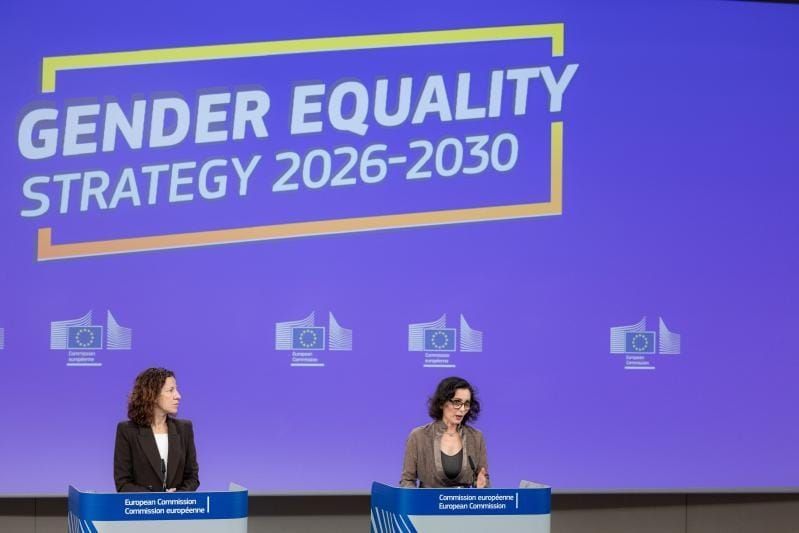
On 5 March 2026, the European Commission presented the new Gender Equality Strategy 2026–2030 to the public. The strategy seeks to mainstream gender equality in every sphere of online and offline life, from education and health to employment and public participation, while also addressing modern threats such as cyber violence and AI-related risks.
Scope of the Strategy
The strategy aims to translate into concrete action the Women’s Rights Roadmap adopted by the European Commission on 7 March 2025 and endorsed by all member states later that year. The Roadmap provides a long-term framework containing a declaration of principles for a gender-equal society and seeks to serve as a guiding compass for governments, institutions, and civil society. Adopting an intersectional perspective, it combines gender mainstreaming with targeted actions, while directly addressing anti-gender discourse and backsliding on acquired rights.
The strategy focuses on five main areas:
- Gender-based violence and cyber violence
- Equal pay and work-life balance
- Women’s health
- AI-related risks and online platforms
- Gender balance in decision-making mechanisms, sports, and culture
For the First Time: Health as an Independent Policy Area
The 2026–2030 strategy addresses health as an independent policy field for the first time within an EU gender equality framework. The Commission plans to launch a joint initiative with the World Health Organization aimed at improving the quality and accessibility of women’s healthcare. In cooperation with the European Medicines Agency, it will also examine how gender sensitivity can be systematically integrated into the development and approval of medicines.
The strategy also directly addresses the risks posed by artificial intelligence for women, including gender bias in recruitment processes and the spread of sexually explicit deepfake imagery.
My Voice My Choice
During the preparation of the 2026–2030 strategy, an important citizen movement that directly influenced the EU agenda emerged: the European Citizens’ Initiative titled “My Voice, My Choice: For Safe and Accessible Abortion” was submitted to the Commission after collecting 1,124,513 valid signatures from 27 member states and surpassing the required threshold in 19 countries.
Supported by more than 300 European organisations, the campaign also demonstrated how the European Citizens’ Initiative mechanism operates: once an initiative gathers one million signatures from at least seven countries, the European Parliament is obliged to debate the issue, while the Commission must explain within six months what legal or non-legal action it intends to take.
On 17 December 2025, the European Parliament adopted a resolution supporting the initiative with 358 votes in favour, 202 against, and 79 abstentions. The resolution stressed that many women across the EU still lack full access to safe and legal abortion, leading not only to physical health risks but also to serious economic and psychological burdens. Members of Parliament called on member states to align abortion legislation with international human rights standards and demanded that the right to abortion be incorporated into the EU Charter of Fundamental Rights.
In its response on 26 February 2026, the Commission highlighted the limits of EU competence in this field, while explaining that member states could improve access to legal and safe abortion services through existing EU instruments, particularly the European Social Fund Plus (ESF+). The ESF+ programme could be used voluntarily and in accordance with national legislation to support abortion services. Equality Commissioner Hadja Lahbib stated that the mechanism would support “women who need to travel, women in their own countries, women in remote regions, and women without financial means.”
With the inclusion of the initiative in the Gender Equality Strategy 2026–2030 on 5 March 2026, the issue ceased to be merely a citizens’ demand and became an official axis of EU policy.
Gender Equality Will Take 50 Years
According to data from the European Institute for Gender Equality (EIGE), at the current pace of progress it will take the EU another 50 years to achieve full gender equality. The strategy was prepared with this reality in mind and emphasises that inequalities between member states persist.
The data framing the strategy are striking: no country in the world is currently on track to achieve full gender equality by 2030. Globally, one in three women has experienced physical or sexual violence, while more than 200 million women and girls have been subjected to female genital mutilation.
European Parliament: Demand for Binding Measures
In a report adopted in November 2025 with 310 votes in favour, 222 against, and 68 abstentions, the European Parliament had called on the Commission to present an ambitious strategy containing concrete legal and non-legal measures. MEPs demanded that gender-based violence be recognised as a serious cross-border EU crime, that a consent-based definition of rape be incorporated into EU legislation, and that the right to safe and legal abortion be included in the EU Charter of Fundamental Rights.
MEP Nicolae Ștefănuță stressed that the previous strategy had been insufficient in practice: “Overall progress has been slower than I wanted. Unfortunately, the previous strategy fell short in implementation.” He also warned that progress could stall if equality bodies and civil society organisations continued to receive inadequate funding.
European Women’s Lobby: “Who Will Implement It Without Binding Measures?”
The European Women’s Lobby (EWL) welcomed the strategy while clearly expressing its main concern: the document does not foresee binding follow-up measures and leaves implementation largely to voluntary commitments. EWL positively assessed the strategy’s support for implementing the Istanbul Convention and the Directive on Violence Against Women, its growing attention to cyber violence, and initiatives concerning pay transparency and care work.
EWL Secretary General Mary Collins stated:
“In this turbulent world, we need more women at the helm. Europe must continue to be a guarantee for women’s rights. Today the challenges are immense and the road is long. Achieving gender equality is part of the solution itself. The Gender Equality Strategy will serve as a guide along the way, but we need bolder, more ambitious, and binding measures.”
WAVE: Progress in Combating Violence, But the Situation Remains Severe
WAVE, the European network of women’s organisations supporting survivors of violence, welcomed the strategy’s commitment to supporting member states in implementing the 2024 EU Directive on Violence Against Women and the accountability mechanism linked to the 2026 GREVIO baseline evaluation. It also regarded the EU’s accession to the Istanbul Convention in 2023 as the most critical achievement of the previous strategy period.
Nevertheless, WAVE highlighted the gravity of the situation in which the strategy was prepared: 18 women are killed every week in the EU, while women’s rights organisations are facing funding cuts from both European and international sources.
ENAR: Intersectionality Remains Rhetorical
The European Network Against Racism (ENAR) identified what it considers the strategy’s central problem: the binary framework of “women and girls, men and boys” is maintained throughout all policy pillars, structurally excluding trans and gender-diverse individuals from employment, violence prevention, healthcare, and access to justice. ENAR also criticised the absence of mandatory disaggregated data collection based on race, ethnicity, or migration status, arguing that this renders racialised, migrant, and undocumented women invisible. For this reason, ENAR argued that the strategy leaves intersectionality at a rhetorical rather than operational level.
EIGE: “Talk Less, Act More”
Carlien Scheele, Director of the European Institute for Gender Equality, the EU’s independent monitoring and research body on gender equality, stated that the previous strategy had produced concrete gains such as binding quotas and the Directive on Combating Violence Against Women. However, she noted that EIGE’s Gender Equality Index shows progress remains far too slow.
Scheele also delivered a clear message to technology companies:
“Big tech companies must be held accountable in Europe. Safety cannot be an afterthought or a public relations exercise; it needs to be built into design, deployment, and governance.”
(Source: EIGE — eige.europa.eu, 6 Mart 2026)