

As Western influence faces growing challenges, states such as Turkey, Russia, China, India, and Brazil are increasingly using media and narratives of historical grievance to promote alternative visions of global order. In this podcast, Bilge Yeşil, Professor of Media Culture at the CUNY Graduate Centre, discusses how global power struggles are increasingly shaped through information, identity, and competing claims to justice and legitimacy.
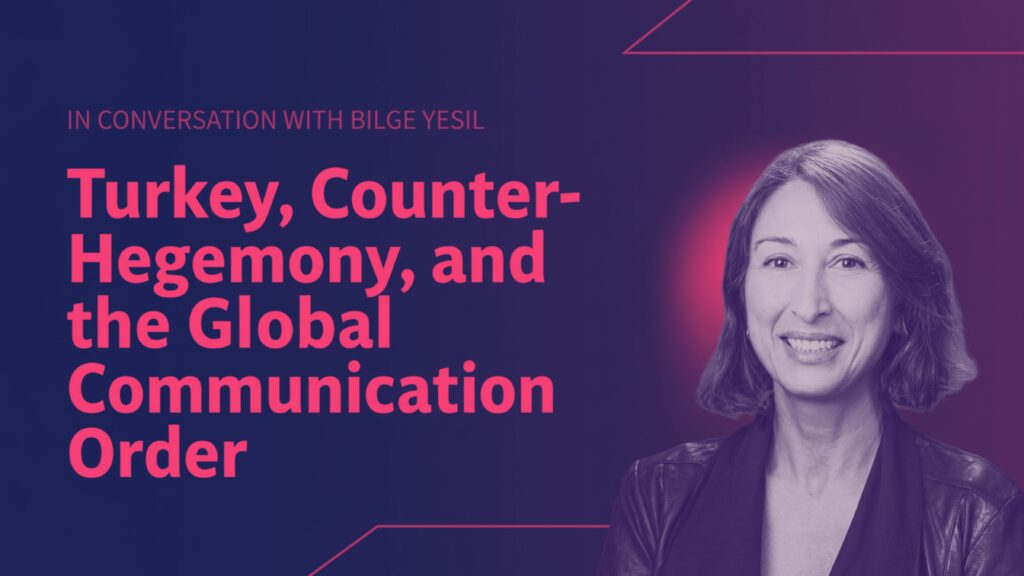
In this episode of the Global Disorder Podcast, Sasikumar Sundaram and Begum Zorlu, researchers in International Politics at City St George’s, University of London, speak with Bilge Yeşil, Professor of Media Culture at the College of Staten Island and affiliated faculty member in Middle Eastern Studies at the CUNY Graduate Center. Yeşil is the author of the award-winning book Talking Back to the West: How Turkey Uses Counter-Hegemony to Reshape the Global Communication Order, which examines how states such as Turkey increasingly use media, historical grievance, and narratives of justice to challenge Western dominance and promote alternative visions of global order.
The conversation focuses particularly on Turkey’s growing global media strategy under the Erdoğan government. Yeşil explains how events such as the Gezi Park protests, the 2013 corruption scandal, the Syrian refugee crisis, and increasing criticism of democratic backsliding created what she calls a “communication crisis” for Ankara. In response, the government invested heavily in international broadcasting, digital media, journalism training programmes, and English-language communication platforms designed to reshape Turkey’s global image and counter critical Western coverage. Central to this effort was the launch of TRT World in 2015, Turkey’s first 24-hour English-language news channel, modelled on outlets such as CNN International, BBC World, and Al Jazeera English.
A major theme of the discussion is how TRT World strategically engages with progressive political issues in the West. Yeşil notes that the channel frequently covers Islamophobia in Europe, racism and police brutality in the United States, colonial violence in Africa, anti-Muslim discrimination, environmental crises, and far-right extremism. The network’s extensive coverage of Gaza and pro-Palestinian campus protests is discussed as a particularly important example of how Turkey seeks to position itself as a moral voice for oppressed communities and the wider Global South.
Yet the episode also critically interrogates the contradictions within this strategy. While TRT World presents itself as a progressive and anti-imperialist platform, Yeşil points out that the same channel has aired anti-LGBTQ documentaries and hosted controversial figures such as Andrew Tate. She describes this approach as “strategic obfuscation”: highlighting real injustices and undeniable truths, such as racism, colonialism, or Islamophobia, while stripping away political complexity and reducing them to a simplified binary between a hypocritical West and an oppressed Muslim world.
The conversation also explores how Turkey mobilises narratives of Muslim victimhood and Ottoman history to position itself as a leader of the Muslim world. Yeşil argues that the Erdoğan government portrays Turkey as the protector of oppressed Muslims globally, particularly in regions such as the Balkans, Africa, South Asia, and the Middle East. Through humanitarian aid, development projects, cultural diplomacy, and media outreach, Ankara seeks to revive aspects of Ottoman political memory while presenting itself as a benevolent alternative to Western power.
The episode situates Turkey within a broader international trend. Comparisons are drawn with RT and CGTN, as well as the wider communication strategies of India and Brazil. While these countries differ politically and ideologically, they increasingly use media to expose Western hypocrisy, amplify historical grievances, and present themselves as alternative centres of political and moral authority in an emerging multipolar world.
To hear the full episode, see the link below.