

A Turkish court’s ruling against the country’s main opposition party has raised alarm far beyond party lines, with opposition forces across the political spectrum warning that democracy itself, not just one party, is under attack.
Turkey’s process of authoritarian consolidation has entered a new phase. In a case brought seeking the annulment of the CHP’s 38th Ordinary Congress and 21st Extraordinary Congress, the court issued a ruling of “cautionary absolute nullity.”
The ruling effectively ordered that Kemal Kılıçdaroğlu and the party organs in place prior to the congress continue in their roles meaning, in practice, a return to the governing structure that existed before November 2023. Should the case be finalised, it is expected that the statutory amendments adopted at the party rules congress held on 6–7 September 2024 will also be rendered void, with the previous statutes reinstated.
Over the past decades, democratic values have been gradually eroded through a creeping process of authoritarian consolidation in Turkey. Since the arrest of Istanbul Metropolitan Mayor Ekrem İmamoğlu who was seen as President Erdoğan’s most formidable rival on 19 March 2025, Turkey had entered a new phase entirely. This process, which continued with the detention and prosecution of the CHP’s presidential candidate and numerous CHP mayors, effectively removed the prospect of free and fair elections from the horizon for many.
The attack on the Republican People’s Party through a judicial nullity ruling is being assessed as a coup against the right to vote and stand for election, and against the multi-party electoral system itself.
“This Ruling Is an Intervention Not Only Against the CHP, But Against Democracy Itself”
Following the ruling, the CHP’s Central Executive Board (MYK) convened in an emergency session. After a meeting lasting approximately five hours, the first political decision taken was understood to be “non-recognition of the ruling and continuation of the struggle.”
CHP leader Özgür Özel, speaking after the meeting, used forceful language: “We are the owners of this house. Tenants come and go; the owners remain. Who sits in the family home is decided by its true owners.”
Stating that the court ruling constituted an intervention not only against the CHP but against democracy and the right to vote and stand for election, Özel called on all citizens and political parties to respond. Noting that the mechanism of democratic transfer of power in the history of the Republic had been interfered with, Özel declared: “We will not surrender to this coup.”
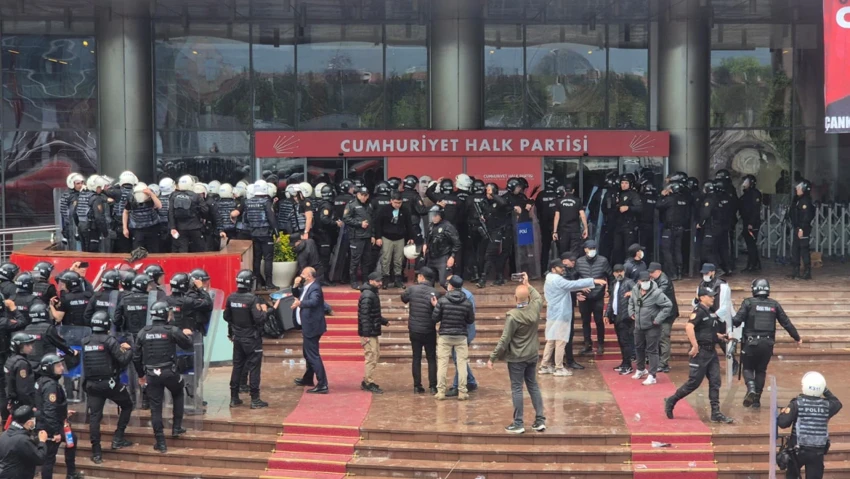
Addressing the crowd that gathered outside CHP headquarters following the press statement, Özel said: “From this moment on, until the danger has passed and until it is CHP members, not the judicial arm of the AKP who decide who leads the CHP, I am in this building, in my office. I am not going anywhere.”
Özel also called on people to take to the streets, saying: “If necessary, we will bring life to a standstill; if necessary, we will use the power that comes from our role as consumers. Yet we will not surrender.”
Following the announcement of the ruling, crowds gathered outside CHP headquarters in Ankara and in front of provincial party offices across the country.
Backlash Against Pro-Government Media
The crowd gathered outside CHP headquarters reacted to the crew of TGRT Haber, a pro-government channel whose broadcast had carried a congratulatory message from Kemal Kılıçdaroğlu following the nullity ruling. The channel’s reporter and cameraman were driven out of the area amid chants.
A similar reaction was directed at the crew of A Haber, known for its proximity to the government. Reporters and staff broadcasting from the headquarters garden were booed, with the crowd repeatedly chanting “A Haber, get out.”
“The Civil Court of First Instance Is Usurping the Authority of Electoral Justice”
CHP Party Council member, CAO Policy Board Chair, and Professor of Constitutional Law Şule Özsoy Boyunsuz offered an assessment of the legal basis of the ruling.
Boyunsuz recalled that party congresses are held under the supervision of electoral boards in accordance with the Electoral Law and the Law on Political Parties, and stated: “Article 2 of the Law on Political Parties is clear. Objections relating to congresses are submitted to electoral boards and resolved as final decisions. Civil courts of first instance cannot annul the certificates issued by the Supreme Electoral Council and electoral boards. They have no such authority.”
Boyunsuz argued that the provisions of the Civil Code on which the court relied were designed for associations, and that applying them to political parties was legally untenable: “This provision was envisaged for highly exceptional circumstances. There is no precedent for its application to political parties. What the civil court is doing here is a serious usurpation of a power that belongs to electoral justice.”
Cross-Party Solidarity
Following the announcement of the nullity ruling, a large number of political parties and democratic mass organisations published messages of support for the CHP leadership. The Turkish Workers’ Party, the Good Party, the Victory Party, the Left Party, and the National Path Party all visited CHP headquarters at leader level.
Women’s organisations also lent their support to the struggle for democracy, both in marches and at CHP headquarters. Representatives of the Women’s Platform for Equality (Eşik) paid a solidarity visit to Özgür Özel.
Opposition parties, in their statements, argued that the ruling targeted not only the CHP’s internal functioning but political competition and the multi-party system in Turkey as a whole. The statements emphasised that an attempt was being made to redesign the political arena through judicial means.