

Following Peter Magyar’s election victory in Hungary, American-Russian journalist M. Gessen reflected on the mood in Budapest in The New York Times. The Pulitzer Prize-winning writer examines the factors behind Magyar’s success and argues that the lessons of the Hungarian case offer a roadmap for opposition movements confronting authoritarian regimes.
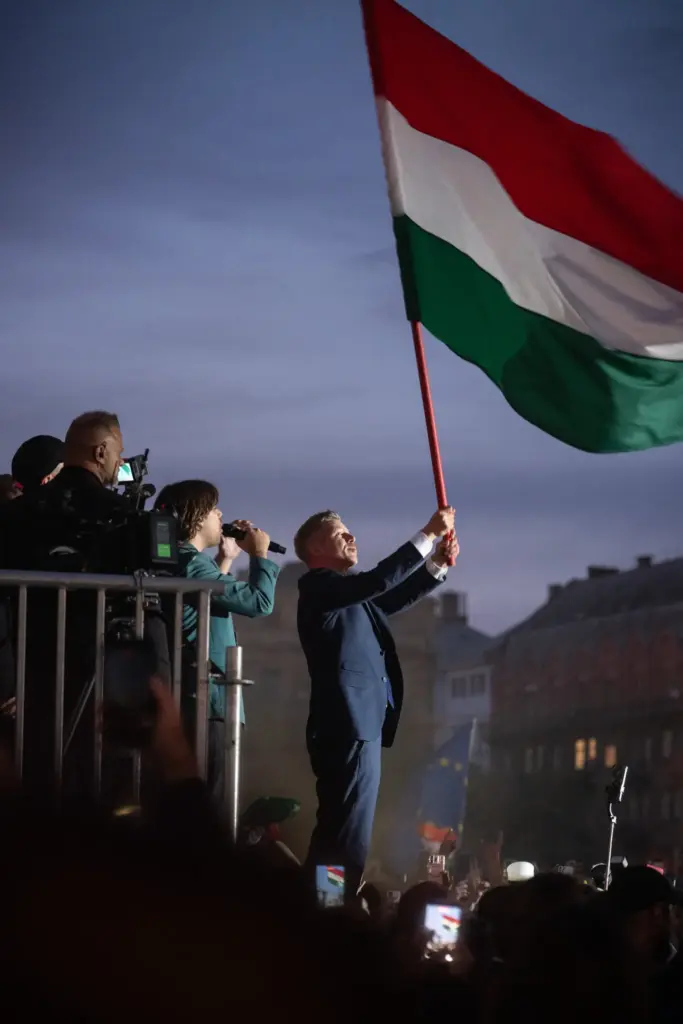
In a recent New York Times article, M. Gessen examines one of the most surprising political developments in Europe: the defeat of Viktor Orbán after sixteen years in power. Long regarded as one of the world’s most successful authoritarian populists, Orbán had transformed Hungary’s political system through media control, constitutional reforms, attacks on independent institutions, and electoral rules that heavily favoured his Fidesz party. Many observers believed that Hungary had reached a point where democratic change through elections was no longer possible. Yet in 2026, Peter Magyar and his Tisza Party achieved a historic victory, winning a constitutional majority and bringing the Orbán era to an end.
The article argues that Magyar’s success offers important lessons for democracies confronting authoritarian and populist leaders. Perhaps the most significant factor was organisation. Rather than relying solely on social media or television appearances, Magyar built a vast grassroots network that reached into communities across the country. Over the course of his campaign, he travelled to hundreds of towns and villages, holding multiple rallies every day and creating local “Tisza Islands” of supporters. Thousands of volunteers participated in canvassing, phone banking, and community organising. This extensive personal engagement allowed Magyar to bypass the pro-government media landscape and communicate directly with voters.
Another key element of the campaign was its moral framing. Previous opposition parties had often criticised Orbán’s government as corrupt, but Magyar went further by describing it as a “mafia state” that systematically used public institutions for private gain. Rather than treating corruption as a side issue, he made it central to his campaign. Post-election surveys showed that corruption was the most important reason voters turned against Orbán, ranking even above economic concerns such as inflation and declining living standards. Many Hungarians viewed the election as a referendum on the integrity of the political system itself.
The article also highlights the role of civil society and social movements. Teachers, students, anti-corruption activists, child welfare campaigners, and LGBTQ+ organisations all contributed to the broader opposition movement. These groups were not always directly involved in electoral politics, but they helped create networks of resistance and public engagement that later became valuable for the campaign. Magyar was able to unite many of these actors under a common goal: democratic change.
Importantly, Magyar did not present himself as simply an anti-Orbán candidate. Instead, he sought to offer a positive vision for Hungary’s future. His inauguration speech focused on restoring democratic institutions, improving public services, rebuilding trust in government, and reconnecting Hungary with European values such as the rule of law and human rights. Symbolically, he reinstated the European Union flag at Parliament and repeatedly emphasised national unity rather than political revenge.
Gessen argues that one of Magyar’s most effective strategies was reclaiming patriotism from the political right. Rather than allowing Orbán to monopolise national symbols, Magyar embraced Hungarian identity while promoting a more inclusive and pluralistic understanding of nationhood. His message was that democratic values, diversity, and European integration were not threats to Hungary but essential parts of its future. This enabled him to appeal beyond traditional opposition voters and attract support from citizens who were dissatisfied with Orbán but still identified strongly with national traditions.
The article also notes that scandals played an important role in weakening the regime. In particular, public outrage over a child abuse cover-up involving senior government figures exposed deeper concerns about abuse of power and elite impunity. These controversies helped reinforce Magyar’s argument that the Orbán system was fundamentally broken and required structural change rather than minor reforms.
At its core, the Hungarian case demonstrates that even entrenched authoritarian-populist governments are not invincible. Electoral victories against such regimes require more than criticism of individual leaders. They depend on long-term grassroots organisation, broad social coalitions, credible alternatives, and a compelling vision of democratic renewal. For Gessen, Hungary’s experience shows that citizens can overcome political cynicism and democratic backsliding when they are offered not only reasons to oppose a government but also reasons to believe in a better future.
Please see the full article here.