

The “Family and Population Decade” policy directive, published on 2 May 2026, signals the government’s continued focus on family, marriage, and fertility in population policy. Critics argue that it frames women primarily through family and demographic roles, prompting strong objections from the women’s movement.
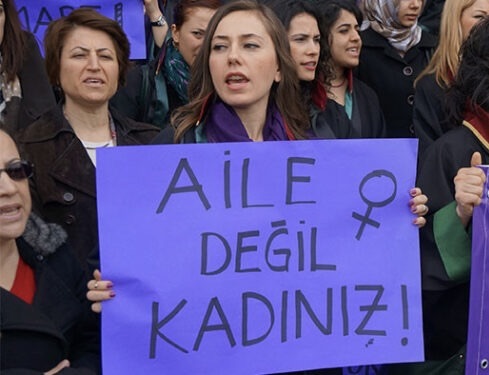
With the policy directive signed by President Recep Tayyip Erdoğan and published in the Official Gazette on 2 May 2026, the period 2026–2035 was declared the “Family and Population Decade.” The document demonstrated that the government will continue constructing its population policies around family, marriage, and fertility, marking a new phase in a political line that defines women not as autonomous individuals but only within the context of family structures and demographic goals.
What Does the Policy Directive Say?
In the preamble, the policy directive claims that the fertility rate has fallen to the lowest level in the history of the Republic and that changes in family and population structures have reached an “existential” dimension. Arguing that the rapid decline in Turkey’s fertility rate is sounding alarm bells, the government announced that it would take action against factors negatively affecting family formation and introduce measures encouraging marriage and childbirth. From now on, all public policies, regulations, and research will be evaluated according to their effects on the family institution and demographic change. Public institutions will conduct their activities with a family-protective and population-increasing approach. The last week of May each year will also be celebrated as “National Family Week.”
The document also characterizes the feminist movement and the struggle for gender equality as “harmful movements, especially gender-neutralization,” describing them as threats to “the family institution, future generations, and national and spiritual values.” Measures such as a “digital family shield” and “family-friendly broadcasting” regulations targeting media and digital platforms are also included in the package.
Federation of Women’s Associations of Turkey: “Contrary to the Constitution”
Federation of Women’s Associations of Turkey President Canan Güllü addressed both the legal and political dimensions of the policy directive in her assessment. According to Güllü, the core problem with this discourse is the following:
“Women’s policy should not be about reducing women to the family; it should be based on empowering women as individuals. Yet this decision and the political language surrounding it redefine women’s social position through the roles of ‘mother,’ ‘wife,’ and ‘domestic responsibilities,’ while pushing the struggle for equality into a secondary position.”
Güllü also emphasized that this approach openly contradicts the constitutional principle of equality. The policy directive, she argued, focuses not on strengthening women’s economic independence but on reinforcing their domestic roles. By rendering structural inequalities such as violence, employment, education, and access to justice invisible, the state replaces its obligation to ensure equality with the rhetoric of “protecting the family.”
Where Is the Reality of Violence Within the Family?
Güllü drew attention to the monthly femicide data published by the Federation of Women’s Associations of Turkey: violence overwhelmingly comes from within the family. Women are most frequently subjected to violence within the “family” and experience the greatest rights violations there. In the absence of an equality-based perspective, an emphasis on “family” risks deepening existing problems rather than solving them.
We Will Stop Femicide Platform illustrates this reality with statistics: throughout 2025, which had been declared the “Year of the Family,” femicides and suspicious deaths of women increased. A representative of the platform stressed that the difficult process would continue unless policies changed, because these incidents are the direct result of specific political choices.
Law No. 6284 Under Attack
After the publication of the policy directive, the broader picture became even clearer. A pro-government columnist claimed that “taking women’s statements as the basis” could lead to various “disasters,” directly calling for attacks on Law No. 6284. Law No. 6284 is designed to protect women and family members from domestic violence by providing preventive and protective measures such as restraining orders, shelter access, and emergency protection mechanisms.
A concrete example stands before us: murdered Chief Inspector Serap Doğan had obtained a protection order against the man who later killed her. When she arrived in Ankara, police reportedly told her, “That order is not valid here,” and sent her away; the electronic monitoring bracelet order was never enforced. Serap exhausted every avenue, yet neither Law No. 6284 was implemented nor was her testimony taken seriously. In light of this reality, the problem lies not in the law itself, but in its non-enforcement.
Constitutional Contradiction
Article 10 of the Constitution of the Republic of Turkey imposes on the state not only a duty to ensure formal equality, but also an obligation to implement positive discrimination policies aimed at overcoming women’s disadvantaged positions. However, the policy directive does not align with this constitutional framework. Instead, it reinforces an approach that defines women through their role within the family rather than as individuals, pushing the struggle for equality into a secondary sphere.
The international picture deepens this contradiction: according to the 2025 Global Gender Gap Index, Turkey ranks last among the 40 countries in the European region.
Not Just a Policy, but a Political Line
Women’s organizations have articulated the same principle for decades: women’s policy should be written with women and for women.
This policy directive appears less as an isolated policy document than as part of the broader political line the government is constructing ahead of the 2028 elections. In a context of persistently high inflation and worsening income inequality, the government seems unable to provide convincing economic solutions and is therefore expected to lean more heavily on identity politics. It will likely glorify the “family” while framing the feminist movement and LGBTQ+ rights as “threats to national survival.”
It appears that the government is launching an election campaign through women’s and family policies.