

On one of the hottest days Europe has experienced this year, as extreme temperatures once again highlighted the urgency of the climate crisis, women leaders from across diplomacy, academia, civil society, and international organisations gathered in London with a shared message: women must play a greater role in shaping global climate decisions.
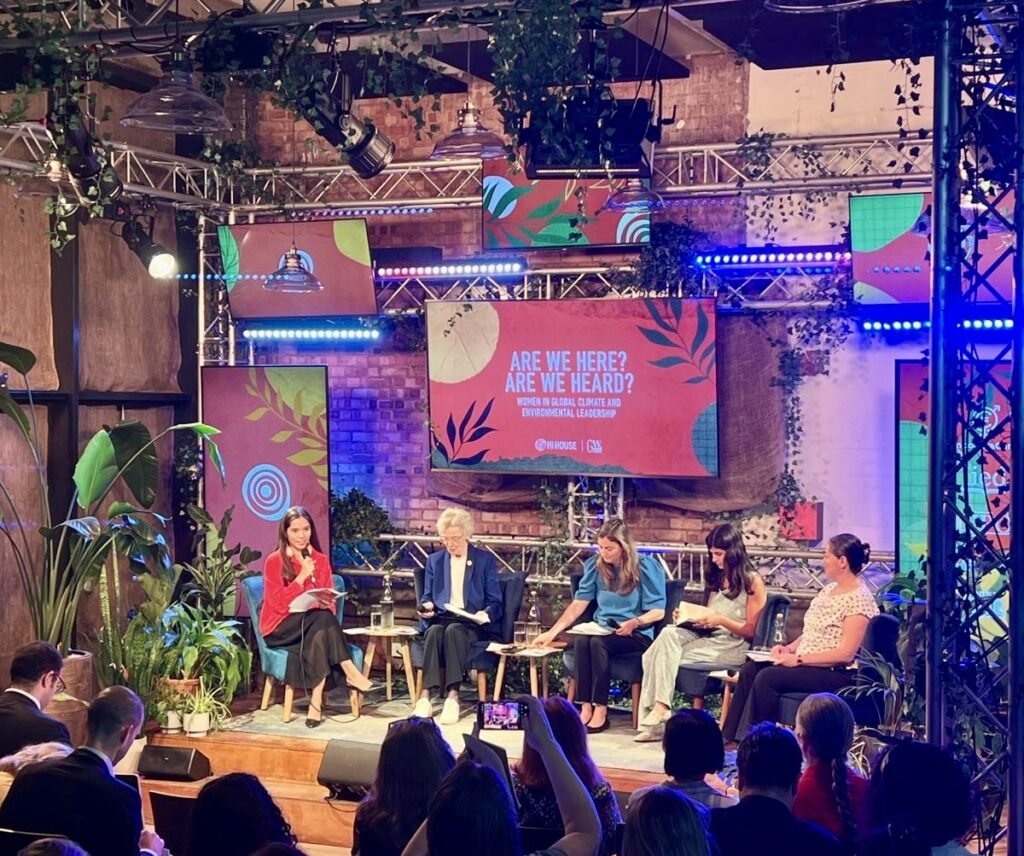
The event, organised by GWL Voices in partnership with the International Institute for Environment and Development (IIED), Project Dandelion and She Changes Climate, brought together an almost entirely female panel to launch a new report, Women in Global Climate and Environmental Leadership. While women have long played central roles in responding to climate change in their communities, the report argues that they remain significantly underrepresented in the institutions responsible for making global climate policy.
Opening the event, Cristina Gallach, Acting Executive Director of GWL Voices, explained that the report is the first of its kind to systematically examine women’s representation across major international climate and environmental organisations. GWL Voices, a global network of former women leaders from international organisations and governments, has previously documented women’s participation in multilateral institutions. This latest report extends that work by focusing specifically on climate governance, providing new data on who occupies the leadership positions that shape international negotiations, environmental policy and climate finance.
The keynote address was delivered by former President of Ireland and internationally recognised climate justice advocate Mary Robinson, whose remarks set the tone for the afternoon. Rather than beginning with familiar discussions about women’s vulnerability to climate change, Robinson deliberately challenged that narrative.
She acknowledged that women are often disproportionately affected by climate change through food insecurity, water scarcity, extreme heat and displacement. However, she argued that these realities should not overshadow another equally important story: women are among the world’s most experienced climate leaders, organisers and problem-solvers.
“We are not just the victims of the climate and nature crisis,” she told the audience. “We are among its most experienced responders, its most consistent advocates and, when given the chance, its most effective leaders.”
For Robinson, the central issue was no longer simply whether women should participate in climate negotiations but whether they are able to exercise real influence over the decisions being made. Women’s leadership, she argued, is not a matter of symbolism or representation alone. It is essential for building climate policies that genuinely respond to the needs of communities.
Presenting the report, Nadara Youssef, Co-Chair of the Coalition for the UN We Need, described what she called a “climate governance paradox.” Women make up around 90 per cent of national gender focal points within climate institutions, meaning they are frequently called upon to provide expertise on gender equality and inclusion. Yet as positions become more senior and decision-making power increases, women’s representation declines sharply.
The report examined seven of the world’s leading climate and environmental institutions, including the United Nations Framework Convention on Climate Change (UNFCCC), the Convention on Biological Diversity, the Green Climate Fund, UNEP and the Intergovernmental Panel on Climate Change (IPCC). Across these organisations, women remain significantly underrepresented in the positions that set agendas, chair negotiations and determine institutional priorities.
One finding that particularly resonated throughout the discussion was that, despite decades of international climate negotiations, women have held only around a quarter of COP presidencies since 1995. Across all seven organisations examined, women occupied top leadership positions for only around 30 per cent of the years analysed. Perhaps most strikingly, the IPCC (the world’s leading scientific authority on climate change) has never elected a woman Chair since it was established in 1988.
At the same time, the report also highlighted encouraging examples of progress. The Convention on Biological Diversity has moved much closer to gender parity than many other international institutions, suggesting that institutional reform and deliberate leadership pathways can make a measurable difference.
The panel discussion that followed expanded the conversation beyond statistics to examine the barriers women continue to face in climate governance. Moderated by climate justice activist Sheila Batista, the panel brought together Mary Robinson, Bianca Jagger, Mayara Folly, Executive Director of Plataforma CIPÓ, and Karen McAllister, Senior Researcher at IIED. Despite their diverse professional backgrounds, the speakers shared a common argument: representation alone is not enough if women are excluded from the spaces where the most important decisions are made.
Karen McAllister reflected on research examining women’s participation in climate negotiations, particularly those from developing countries and historically marginalised communities. She argued that many women continue to face overlapping barriers, including unequal access to funding, political networks, leadership opportunities and technical expertise. Meaningful participation, she suggested, requires sustained investment in leadership pathways rather than simply inviting women to attend negotiations.
Mayara Folly shifted the discussion towards climate finance, highlighting a gap that often receives less attention. While women are increasingly visible within international climate negotiations, they remain far less represented in finance ministries, development banks and financial institutions responsible for deciding where climate funding is allocated. As global climate governance increasingly moves from negotiating agreements to implementing them, she argued that women must also be present in the institutions controlling investment and financial decision-making.
A recurring theme throughout the afternoon was that gender equality should not be viewed as a separate issue from climate governance itself. Instead, speakers argued that more diverse leadership produces stronger institutions, broader perspectives and more effective policymaking. Climate governance, they suggested, is not simply about who attends meetings but about whose knowledge, experiences and priorities shape the decisions that affect millions of people around the world.
As temperatures outside continued to rise, the timing of the discussion could hardly have been more appropriate. The heatwave served as a powerful reminder that climate change is no longer a distant future challenge but an everyday reality. Against that backdrop, the event made a compelling case that responding effectively to the climate crisis will require not only ambitious policies and technological innovation but also more inclusive leadership.
The report concludes that meaningful participation cannot stop at increasing the number of women present in climate institutions. Women must also have the opportunity to influence agendas, shape negotiations, allocate resources and lead the organisations responsible for confronting one of the defining challenges of our time.