

For nearly a month, thousands of people have taken to the streets in many cities across Albania, above all in the capital Tirana, chanting “Albania is not for sale.” The protests, which began against a luxury tourism project on the Adriatic coast backed by Ivanka Trump and her husband Jared Kushner, have over time turned into a broader demand for democracy.
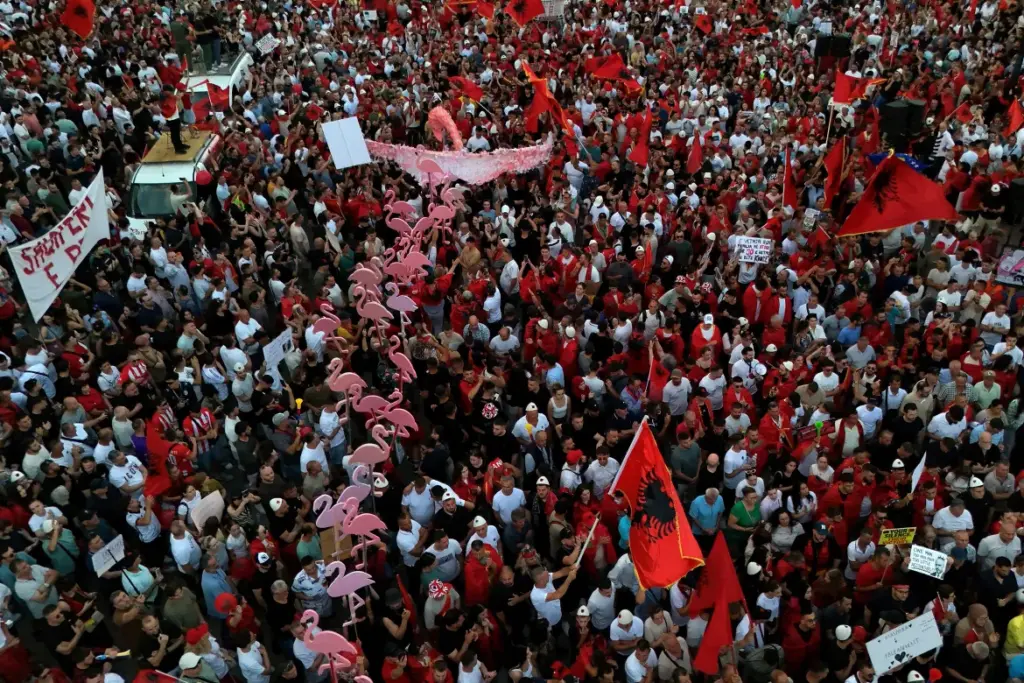
The Albanian people have been on the streets for nearly a month against a roughly $1.4 billion luxury tourism project planned for the Adriatic coast, in which US President Donald Trump’s daughter Ivanka Trump and her husband Jared Kushner are among the investors. A movement that began as an environmental struggle has merged with the anger built up over years of economic and political problems, turning into a broader struggle for democratic rights.
The first protests began with the backlash against construction machinery operating in a protected coastal area. The spark of the movement was struck by an incident on 30 May at Zvërnec on the country’s southern coast. Environmental activists and local residents were protesting against a beach in a protected coastal area that had been fenced off with barbed wire. During this, tension broke out between private security guards and the protesters. In footage that spread on social media, private security guards were seen dragging a protester along the ground and forcibly removing them from the area. The police present at the scene, controversially, did not intervene.
After the footage emerged, news quickly spread that work had begun on the $1.4 billion luxury tourism project in the protected area. The response to the action against the protesters and to the planned project spread the demonstrations across the country. Following the incident, the government cancelled the licences of the security companies involved, dismissed the local police chief, and announced that the fences would be removed. But these steps were not enough to calm the public reaction.
In a podcast programme broadcast the following day, Ivanka Trump spoke warmly of the tourism projects in Albania. She described “this magnificent peninsula with a lagoon on one side and the sea on the other,” which she and her husband, as among the lead investors, plan to transform. Speaking about plans for the development of Sazan Island, a former Soviet-era military facility, Trump pointed to the coast where this month’s protests and clashes took place and emphasised the scale of the investment, saying, “It’s not just the island, we also have a five-mile stretch of coastline right across from it.”
Democracy, Accountability and Flamingos
Kushner’s investment plans cover the protected Zvërnec Peninsula and Sazan Island. Closed to development for decades because of its use as a military base, Sazan Island is one of the rare preserved Mediterranean ecosystems. The island and the marine areas around it host a rich biodiversity, including endangered species and fragile coastal habitats. The nearby protected wetlands, particularly the Vjosa–Narta ecosystem, form a habitat for flamingos, sea turtles, seals and hundreds of bird species.
Sazan’s importance is not limited to its ecological value. Located on the Mediterranean’s important maritime trade routes, the island holds a commanding position over one of the most strategic coastal regions in the Balkans. Throughout history, the powers that controlled Sazan also gained a strategic vantage point from which to monitor the maritime traffic entering southern Albania.
Environmentalists state that reports on the project’s environmental impact have not been shared with the public, that decision-making processes have not been conducted transparently, and that the objections of local people have not been taken into account. For this reason, the protests have brought to the agenda not only the environmental struggle but also debates about the transparency and accountability of the administration. The struggle over the island, going beyond a real estate investment, has turned into a struggle for democratic rights in light of debates over the future of natural heritage, public spaces and strategic resources.
The demonstrators say that since the fall of communism the country has been governed by the same political elites, that state resources have been channelled to particular interest groups, and that the demands of ordinary citizens have been ignored. The slogan frequently heard at the demonstrations, “Rama to prison, Berisha to prison,” expresses anger directed at both the government and the traditional opposition.
The central boulevards of Tirana have become the stage for mass demonstrations attended by thousands of people every evening. The protests have come to be known as the “Flamingo Revolution,” in reference to the flamingos that have become a symbol of the region. But the flamingo figure does not only represent nature; it is also becoming a symbol of the demands for democracy, accountability and the protection of public assets in Albania.
The government of Prime Minister Edi Rama presents the projects as strategic initiatives that will increase tourism revenues and attract foreign investment to the country. The investors, too, say they aim to carry out one of the largest private investments in the region’s history.
For the protesters, the issue is a question of who will decide Albania’s future and whether these decisions can be taken without the knowledge and consent of society. For this reason, the struggle that began on Albania’s coasts is seen not merely as opposition to a hotel project, but as a new expression of the demand for democracy and public oversight. The objection that began with a call to protect the environment is, for more and more people, turning into a demand to protect the country’s political future.
A young protester taking part in the demonstrations says the reaction has now gone far beyond the Kushner family, expressing that when their friends listened on the podcast to Trump’s almost “Christopher Columbus-style” account of discovering Sazan Island, they were caught between laughing and crying. “We want this project stopped, but really the issue is much bigger than this. It’s about everything that is going wrong in Albania,” they said, emphasising the nature of the demonstrations.
Another protester, who works at a private bank and is a father of two, said: “More than 30 years have passed, but our hospitals are still terrible, our education system has collapsed, there are no jobs and everyone is leaving the country. The demonstrations are this big because people are fed up with this injustice. They are fed up with corruption. One of our slogans is ‘end the dictatorship of dirty money,’ because we know from experience that those who profit from these kinds of projects are always only a small and wealthy minority.”
The EU: Membership Negotiations Will Not Be Concluded Without Compliance on Environmental Legislation
The protests are no longer seen as a purely domestic Albanian matter. Last week the European Parliament adopted a resolution in support of the protesters, calling on the government to halt construction activities in protected areas. The resolution also drew attention to the “predatory capitalists” who accelerate their projects by bypassing environmental and democratic oversight through “strategic investor” status. This regulation, whose removal Brussels has been demanding for years, remains one of the central points of dispute in Albania’s EU accession process. EU officials emphasise that membership negotiations cannot be concluded without environmental standards and legal alignment being achieved.
Rama, for his part, did not back down while reacting to the European Parliament’s resolution. He announced that the Zvërnec project would continue “on the basis of an environmental impact assessment to be prepared in line with European Union standards.”
What Kind of Development?
Prime Minister Rama has repeatedly described the project, presented as the largest investment in Albania’s history, as “a blessing.” He argued that the project would not only create the employment the country needs but would also “ultimately produce around 25 per cent more trees and green space.”
Last year Albania, with a population of around 3 million, hosted 12 million tourists. A significant proportion of these tourists came to the country not only because of affordable prices but also because of its natural beauty.
Shkurti, one of the protesters, expressed the heart of the debate with these words: “This is also about what kind of development model we want. When it is clear that the existing infrastructure can barely bear its current load, do we really want this understanding of development and growth?”
In this framework, Sazan Island is also becoming part of the global debate on the “dilemma” between environmental protection and economic development. Historically, the idea that there is an opposition or contradiction between humanity’s economic development and the protection of natural areas has been a widespread belief. Governments, too, often present environmental protection as an obstacle standing in the way of economic development. Yet today, when the effects produced by this understanding are also clearly felt, the concept of sustainable development emphasises that lasting and just prosperity can only be achieved by securing the protection of nature, economic development and social participation together.