

In a podcast on our platform, Brazilian human rights lawyer and climate advocate Sara Branco discusses the racial inequalities underpinning the climate crisis, the exclusion of Global South organisations from international negotiations and the lessons Brazil’s civil society can offer activists preparing for COP31 in Turkey.
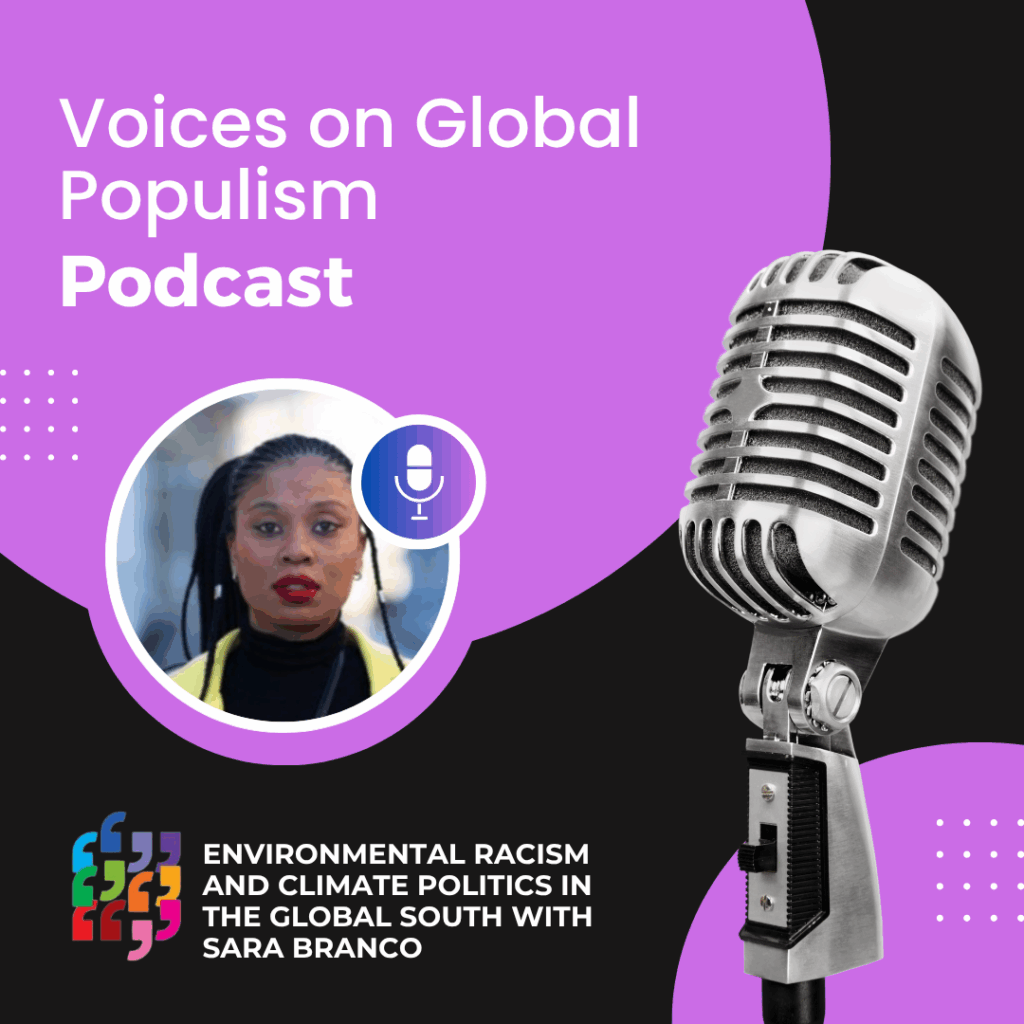
Climate change does not affect all communities equally. For Sara Branco, a Brazilian lawyer and international advocate, understanding this inequality requires recognising climate justice not as a separate environmental concern but as a fundamental human rights issue.
Branco is the International Advocacy Coordinator at the Instituto de Referência Negra Peregum in Brazil, where she works across racial justice, climate policy, education and democracy. She represents the organisation at United Nations climate negotiations and other multilateral forums. She also co-founded the South-South Confluence, a coalition established to strengthen grassroots leadership from the Global South within international climate governance.
Speaking on the Voices on Global Populism podcast, Branco discussed the relationship between environmental racism and climate change, the continued marginalisation of Global South organisations in international negotiations and the limits of governments’ climate commitments. She also reflected on her experiences at the climate negotiations in Bonn and offered advice to civil society groups preparing for COP31 in Turkey.
Climate justice as a human rights issue
Branco began her professional career in human rights law, but she does not regard her subsequent involvement in climate advocacy as a change of direction. Instead, she sees climate justice as a continuation of her human rights work.
“From my perspective, I see climate justice as part of human rights,” she said. “I always like to talk about the people who are affected by climate change because that is a matter of human rights as well.”
Her engagement with climate justice began in 2021 through her work with African youth leaders. At Peregum, she became more closely involved in environmental issues through the organisation’s Climate and City programme.
This people-centred approach, she explained, challenges accounts of climate change that treat it primarily as a scientific, technical or diplomatic problem. Climate policies must also address which communities are most exposed to environmental harm, which groups possess the resources to adapt and whose knowledge and experiences are included in decision-making.
Environmental racism in Brazil
In Brazil, Branco argued, the unequal effects of climate change cannot be separated from the country’s history of slavery and the racial inequalities that continue to structure Brazilian society.
Black people constitute the majority of Brazil’s population but are also disproportionately affected by poverty, police violence and social exclusion. These inequalities influence where people can live, the quality of the infrastructure available to them and their capacity to recover from environmental disasters.
“The majority of the people who are victims of climate disasters are those who live in low-income communities and informal settlements,” Branco said. “The majority of us are the ones most affected by climate change.”
Floods, extreme heat and other climate-related disasters are often presented through apparently neutral statistics showing the number of people killed or displaced. According to Branco, however, such reporting frequently fails to identify the racial composition of the affected communities. Victims are described simply as poor residents of vulnerable neighbourhoods, obscuring the recurring racial pattern behind their exposure to environmental harm.
Black movements in Brazil have therefore pushed for the country’s climate debate to be “racialised”. This means requiring governments to consider race when developing adaptation and mitigation policies and to recognise how historical inequalities shape present-day vulnerability.
The concept of environmental racism gives a name to this process. Initially developed through environmental justice struggles in the United States, it describes situations in which racialised communities are disproportionately exposed to pollution, environmental degradation and climate-related risks while receiving fewer resources and less protection.
For Branco, environmental racism in Brazil is not demonstrated by a single disaster. It is visible in the repeated pattern through which Black communities suffer the greatest losses whenever environmental crises occur.
“It is not necessarily one specific event,” she explained. “It is the fact that, over and over again, the people most affected are always Black people.”
The Global South is discussed but not represented
Branco also criticised the contradiction between the frequent use of the term “Global South” in international climate discussions and the limited presence of Global South organisations in the rooms where negotiations take place.
“There is a lot of talk in the rooms about the Global South,” she said. “But there is a lack of representation of Global South organisations in those spaces.”
Financial inequality is one of the principal barriers. Civil society organisations in the Global South generally have fewer resources than their counterparts in the Global North and may struggle to cover the costs of travelling to negotiations, securing accommodation and sustaining a presence throughout lengthy international meetings.
This means that international climate governance continues to be shaped largely by institutions and organisations based in the Global North, even when discussions concern communities in the Global South. Those most affected by climate change are frequently discussed as subjects of policy rather than included as participants with the authority to shape it.
Branco summarised this inequality with a simple observation: “The Earth does not heat equally.”
Climate change produces different consequences across regions, countries and communities. Historical responsibility for emissions is also unevenly distributed, as is access to the financial and technological resources required for adaptation. Policies designed without accounting for these differences risk reproducing the inequalities already embedded in the international system.
Branco also challenged the assumption that climate expertise flows only from North to South. Many countries in the Global South possess extensive experience of living with heat, drought and environmental instability. Brazil and other tropical countries, she argued, hold forms of knowledge that could help countries in the Global North respond to increasingly frequent heatwaves.
Indigenous peoples and other traditional communities similarly possess knowledge that can contribute to protecting ecosystems and limiting further environmental destruction. However, Branco emphasised that these communities must be placed at the centre of climate policymaking rather than treated simply as sources of knowledge for policies developed elsewhere.
“We have the knowledge,” she said. “But we need to be on the front line of policies addressing climate change.”
Frustration inside the Bonn negotiations
Reflecting on her first experience of attending the Bonn climate negotiations, Branco said the discussions surrounding adaptation finance revealed the continuing imbalance between developed and developing countries.
Global South representatives pushed wealthier states to commit more resources to adaptation, while richer countries resisted proposals that would increase their financial responsibilities. For Branco, this reluctance reflects a wider refusal to accept accountability for the historical role of industrialised countries and fossil fuel production in creating the climate crisis.
The influence of fossil fuel interests is not always immediately visible inside the negotiating rooms, she said. Yet it becomes apparent through states’ positions, the language removed from official texts and the continued failure to reach meaningful commitments.
Civil society representatives attempt to influence the process by meeting diplomats, submitting policy briefings, holding press conferences, organising demonstrations and forming alliances with other movements. Peregum has worked with Indigenous organisations, disability rights groups, Global North allies and other civil society networks to increase pressure on negotiators.
People of African descent have historically lacked formal recognition within the UN climate process. Branco noted that it took approximately three decades of negotiations before they were explicitly mentioned in a number of climate documents. This has made coalition-building particularly important for Black organisations seeking to enter and influence the process.
Civil society pressure can make governments uncomfortable, she said, particularly when activists visibly demand progress on adaptation finance and other contested issues. Nevertheless, the final decisions remain in the hands of states, leaving campaigners with a persistent sense of frustration.
This was particularly apparent in Bonn, where negotiators failed to make meaningful progress on adaptation finance even as a heatwave approached Germany. Similar temperatures were also being experienced elsewhere in Europe. Yet she insisted that participation still matters. Looking diplomats directly in the eye, presenting evidence and placing demands before governments can gradually change the terms of negotiations, even when immediate results are difficult to see.
“The fact that you are there, looking them in the eyes, saying something and handing them a policy brief is still powerful,” she said. “We know that this type of work takes time before we see something concrete.”
Brazil’s international leadership and domestic contradictions
Brazil is often presented as a leading voice in global climate politics because of the Amazon and its diplomatic role in international environmental negotiations. Branco said the country has continued to take relatively progressive positions in negotiating rooms and to work behind the scenes to build agreement.
However, she expects Brazil’s influence to change as the focus moves from COP30 to COP31 and Turkey and Australia assume greater responsibility for setting the agenda.
The legacy of COP30 may still allow Brazil to influence particular discussions. Yet Branco warned against judging the country solely by the progressive positions it presents internationally. Brazil’s climate diplomacy is accompanied by serious contradictions at home.
The Amazon attracts substantial international climate finance, but questions remain over which communities receive those resources. Indigenous and traditional communities are rightly central to many environmental programmes, Branco said, but climate funds must also reach Black urban communities facing floods, extreme heat and other climate-related disasters.
Peregum and other Black organisations are pressing the government to ensure that people of African descent are included in decisions about how climate funding is distributed. This is particularly important in Brazilian cities, where racial inequality, insecure housing and inadequate infrastructure expose Black communities to severe environmental risks.
Brazil’s continued involvement in oil production also complicates its international image as a progressive climate actor. Branco pointed to government decisions permitting further oil exploration in the Amazon region as evidence of the gap between the country’s international commitments and its domestic economic policies.
“Internationally, we can be very progressive, but that does not mean this is reflected inside the country,” she said.
For civil society organisations, this contradiction requires a flexible advocacy strategy. When they cannot persuade the Brazilian government, they may approach other countries and build international pressure around their demands. Climate diplomacy therefore involves not only negotiations among states but also civil society efforts to influence different governments and create alliances across borders.
Lessons for civil society in Turkey
Brazil’s hosting of COP30 created an opportunity for civil society organisations to mobilise around the negotiations and press the government for greater participation. Branco believes this experience offers lessons for activists preparing for COP31 in Turkey.
Brazilian civil society, she explained, has a long history of street mobilisation, political organisation and direct pressure on state institutions. Throughout preparations for COP30, campaigners repeatedly contacted the Ministry of Foreign Affairs, identified the diplomats responsible for specific negotiating areas and requested meetings.
Even when officials offered only limited time, civil society groups used every available opportunity to present their demands and compare them with the government’s negotiating agenda.
Branco encouraged Turkish organisations to begin applying similar pressure well before COP31. They should identify the officials responsible for the presidency, request meetings, organise public events, invite negotiators to listen to affected communities and demand access to the conference itself.
“Civil society needs to be on top of the COP31 presidency: calling, asking for meetings, demanding participation and understanding how it will position itself,” she said.
Securing accreditation is another essential part of participation. Brazilian organisations repeatedly contacted officials to request the badges needed to enter negotiating spaces. Branco advised Turkish campaigners to press for the same access, particularly if the COP31 presidency publicly identifies youth engagement and civil society participation as priorities.
“If they are saying that civil society is a priority and that they want you in the room, then say: ‘Give us access to the room,’” she said.
Hosting COP31 also gives Turkish civil society an opportunity to draw international attention to environmental and social problems within the country. Organisations can use the presence of the global media, international campaigners and foreign delegations to raise issues that may otherwise receive limited recognition beyond Turkey.
Branco said campaigners should identify the issues most important to their own communities and insist that they are reflected in Turkey’s climate agenda. Brazil’s Black movement used COP30 to demand the inclusion of people of African descent in negotiating documents. Turkish organisations could similarly use COP31 to bring nationally specific inequalities and underrepresented communities into the international debate.
“Keep pushing”
Branco’s final message to activists in Turkey and elsewhere was direct: “Keep pushing.”
Civil society should not regard itself as a marginal presence in international climate politics, she argued. Activists, social movements and community organisations bring issues into public debate, provide knowledge that governments lack and create pressure for subjects to enter formal negotiations.
“We are the ones who give them the topics to negotiate in the room,” she said. “Civil society is not just a small piece of the broader process. We are important, and governments need to hear us. We have solutions that they do not see.”
For Branco, meaningful climate action requires more than the inclusion of environmental language in diplomatic documents. It requires confronting environmental racism, addressing historical responsibility for the climate crisis and transferring influence to the communities already living with its most serious consequences.
Until Global South organisations, Black communities, Indigenous peoples and grassroots movements are able to shape climate policies rather than merely respond to them, global climate governance will remain unequal. The task for civil society, she argued, is to continue entering these spaces, building coalitions and demanding recognition, representation and accountability.