

The 81st UN General Assembly (New York, 22–28 September) exposed deep political divisions over international norms on women’s rights, gender, and sexual and reproductive health. Alongside it, UN Women’s Gender Snapshot 2026 report reignited debate over who makes decisions, how women take part in them, and how politics is funded.
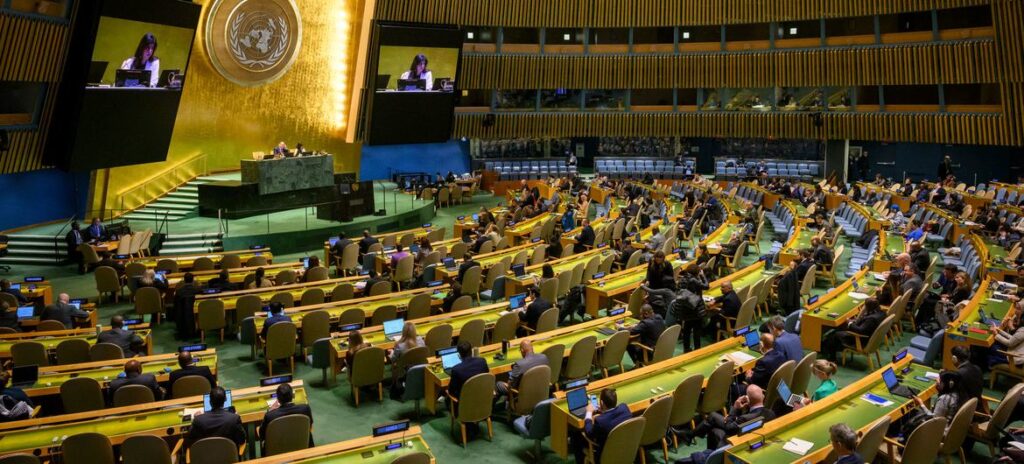
Photo: UN Photo/Loey Felipe
The 81st session of the United Nations General Assembly convened at a time when the world faces multiple crises. With wars, humanitarian crises, slowing progress on the Sustainable Development Goals and political challenges to women’s rights shaping the international agenda, all of these issues push us to ask who is making the decisions.
UN Women’s Gender Snapshot 2026 report offers a striking answer to that question. According to the report, women, who make up half the world’s population, are still a minority in the decision-making bodies that shape their lives and the future of societies. Moreover, progress has not merely slowed: the report finds that in some areas it is going into reverse.
“Equality Could Take 171 Years”
The Gender Snapshot 2026 report prepared by UN Women shows that serious global inequality persists in women’s representation in leadership positions. Five out of every six countries in the world are led by men. Women hold only 27.4 per cent of seats in parliaments worldwide and 22.4 per cent of positions in national cabinets. Of the world’s 175 chief justices, only 31 are women. In publicly listed companies, women hold 25.1 per cent of board seats but only 5.8 per cent of CEO positions.
This picture also makes visible the gap between representation and real decision-making power. A woman sitting on a board does not mean she is the one shaping the company’s strategic decisions. Indeed, according to the report, in 71.8 per cent of publicly listed companies worldwide, women’s decision-making power lags behind their overall representation on boards. The gap widens as company size increases. There is a difference in power between having a seat at the table and being able to make decisions.
According to the report, if the current pace of change continues, reaching gender parity in national parliaments will take 63 years. More broadly, achieving equal rights and opportunities for women and girls could take 171 years on the current trajectory. Rather than turning equality into a matter for the distant future, this figure demands that we question the consequences of today’s policies.
When Women Take Part in Governance, the Whole of Society Benefits
Treating women’s leadership as merely a question of representation for women means missing the broader picture the data reveal. The UN Women report identifies various links between women’s presence in decision-making bodies and social outcomes.
For example, in countries where women’s parliamentary representation exceeds 20 per cent, child vaccination rates are higher and a greater proportion of children survive early childhood. In the 2025 UN General Assembly general debate, women politicians raised gender equality roughly three times as often as their male counterparts. Issues such as care services, parental leave, unpaid care work, social protection, pensions and workers’ safety also feature more prominently on women’s political agendas.
Rwanda is a notable example in this respect. Women hold 64 per cent of seats in parliament. The integration of gender equality into education policy and school textbooks shows that women’s representation can affect not only the composition of political institutions but also the field of education.
None of this, on its own, proves that women’s leadership automatically produces better outcomes. It does, however, offer important indications that women’s access to decision-making can shape policy priorities and how public services are designed.
The Climate Crisis and Gender Inequality
This year, discussions held as part of Climate Week NYC, which ran alongside the UN General Assembly, put the gender dimension of the climate crisis back on the agenda.
One of the key points to emerge from these discussions was that women are not only among the groups most affected by the consequences of the climate crisis but also play a critical role in developing solutions to it.
The relationship between the climate crisis and gender inequality becomes especially pronounced in countries experiencing conflict and fragility. Afghanistan is one of the starkest examples. In assessments made during Climate Week NYC, experts highlighted that climate change, gender inequality and conflict form a mutually reinforcing “triple intersection” in the country. Afghanistan’s position among the worst-performing countries on the Women, Peace and Security (WPS) Index, the Global Peace Index and the Climate Vulnerability Index also shows the scale of this intersection.
This is not simply because the climate crisis hits women harder. Excluding women from the making and implementation of climate policy can also weaken societies’ resilience to climate change. The international community therefore faces a twofold need: on the one hand, the specific impacts of climate change on women and girls must be taken into account; on the other, women must have real decision-making power in designing and implementing climate solutions. The way to achieve this runs through increasing women’s access to climate finance.
Who Is Designing AI?
As with the climate crisis, inequality in decision-making power in the technology sector affects the quality of the solutions produced. Women remain under-represented in the teams developing the artificial intelligence systems, digital services and technology products of the future.
What data algorithms are trained on, whose needs are taken into account and which risks are prioritised all determine technology’s impact on society. Women’s equal participation in the development, governance and regulation of AI is important for reducing risks such as algorithmic bias and digital violence against women.
Why Is It Difficult for Women to Participate in Decision-Making?
There are many reasons for women’s low representation in decision-making bodies. In this context, UN Women draws attention to gender stereotypes and to inadequate equal opportunities, affirmative action policies and investment.
For women, entering politics first means contending with economic and institutional barriers. In addition, women politicians face disproportionate threats of violence and intimidation in public life. While 76 per cent of women parliamentarians report having experienced intimidation or violence in public, the figure falls to 68 per cent among male parliamentarians. A significant share of political violence against women is also gender-based and sexual in nature.
Gender Back at the Centre of Political Struggle
Against this backdrop, what UNGA81 produced for women takes on particular importance. At this year’s Assembly, political divisions over international norms on women’s rights, gender, and sexual and reproductive health and rights emerged as an issue.
In recent years, more restrictive approaches like on abortion, family policy and LGBTQ+ rights have sought to influence the international normative framework. This contest is not conducted through rhetoric alone; international funding mechanisms and humanitarian aid policies have also become important instruments in the struggle.
Considered together with debates over funding for organisations such as the UN Population Fund, the changes to US foreign aid policy and the closure of USAID create a picture that could have significant consequences for the future of international sexual and reproductive health programmes.
Women’s and LGBTI+ rights are thus no longer merely a social policy issue within the international system. They have moved to the centre of questions about how funding will be distributed, which rights will be accepted as international norms, and around which common goals states can unite.
This political divide is especially significant for the future of the multilateral system. On one side are international mechanisms aimed at strengthening equality and rights; on the other are political initiatives and funding changes aimed at narrowing the scope of these gains.
So What Can Be Done?
UN Women’s recommendations focus on structural change rather than conducting the debate solely in terms of representation rates. Foremost among them is the genuine implementation of political quotas. In countries with strong quotas targeting more than 40 per cent women’s representation, women’s representation in parliament is reported to be 16 percentage points higher than in countries without quotas, and 17 points higher in local government.
In addition, political campaign financing needs to be reformed, economic barriers to women entering politics reduced, gender equality institutions strengthened, and the gap between the legal rights held by women and those held by men closed. Direct and sustainable funding for women’s organisations is another important issue, because women’s organisations are often closest to the problems while operating with the fewest resources. In the climate field, increasing women’s access to climate finance and including women in decision-making on the design and implementation of climate policy should be an integral part of this agenda.
Women’s Leadership Determines Who Builds the Future
The picture UNGA81 presents for women shows that equality can be achieved only when women participate in decision-making and hold real influence. Women must be represented in parliaments, governments, courts, corporate boards, the technology sector and at the tables where climate policy is designed and that representation must translate into genuine power-sharing. Inequality is reflected in almost every area of life, from wars to the economy, from health policy to artificial intelligence, from climate to education.
Women’s leadership is directly linked to who makes decisions, which issues reach the agenda and how resources are allocated. Seemingly disparate issues from the climate crisis to conflict, from technology to sexual and reproductive health and rights intersect at this point. The more present women are in decision-making, the greater their power to shape their own lives and the future of their societies.