

Despite bans on public gatherings, police interventions and mass detentions, the 2026 Istanbul Pride March took place once again. This article examines the security measures introduced before the march, the events of 28 June, and the developments that followed, assessing what this year’s Pride Week represents for the LGBTQ+ movement in Turkey.
Before the Pride March: Bans and Security Measures
Even before the Pride March began, Istanbul Pride Week was marked by heightened security measures. The district governorates of Kadıköy and Beyoğlu issued consecutive bans on public events. Taksim Square and its surrounding streets were barricaded, while Taksim Metro Station and several public transport routes were suspended. As a result, the 24th Istanbul Pride March took place under the shadow of security measures introduced days in advance.
How Did the 24th Istanbul Pride March Take Place?
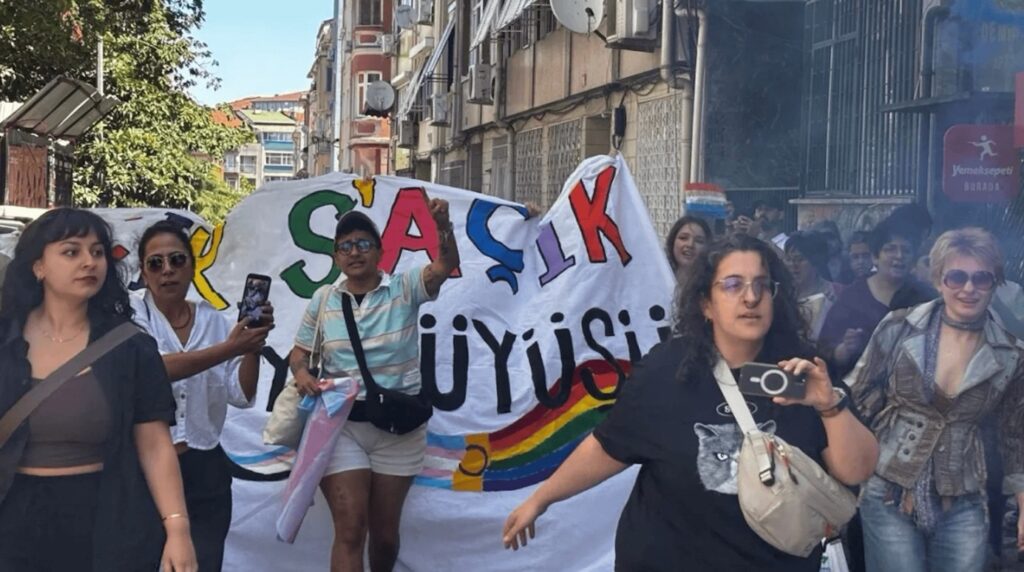
Despite the bans, the Pride March began on 28 June at multiple locations across Kadıköy. Rather than forming a single procession, LGBTQ+ participants gathered in small groups across different streets, remaining visible throughout the day despite repeated police interventions. This decentralised form of organisation reflected one of the new protest strategies developed in response to years of restrictions on Pride events.
From the early hours of the day, participants assembled at various locations including Yaverbey Street, Keresteci Aziz Street, Şair Latifi Street, Moda Avenue, and Ziverbey. Police interventions prevented demonstrators from gathering in one place, but banners were unfurled and slogans were chanted at multiple points throughout the neighbourhood.
Throughout the march, participants repeatedly chanted this year’s Pride Week slogan, “Açık S’Açık.” The slogan is a wordplay on the Turkish expression açık saçık, a phrase traditionally used to describe someone as indecent or immodest. By reclaiming the expression, Pride organisers affirm that LGBTQ+ people are openly visible, unashamed, and unwilling to hide their identities. Participants also chanted slogans including “Neredesin aşkım?” (“Where are you, my love?”) and “Dönmeyiz, dönmeyiz, biz bu yoldan dönmeyiz” (“We will not turn back; we will not abandon this path.”).
One of the most prominent images of the day was a banner displayed in Ziverbey reading: “You cannot silence trans people. We are here.”
The march also received support from opposition politicians. DEM Party Istanbul MP Özgül Saki and Workers’ Party of Turkey (TİP) MP Sera Kadıgil joined LGBTQ+ participants, while journalists and human rights defenders monitored the demonstrations. Throughout the day, however, both protesters and journalists were subjected to police intervention.
During the march, the Istanbul Pride Week Committee responded directly to restrictions on public space, declaring, “Public space belongs to all of us.” The statement continued, “We are here without fear, without hiding, and without submitting.” Reaffirming this year’s theme, the committee added: “We are out. We are openly queer. We are not hidden. We are organised. We are together.”
Despite repeated police interventions, the demonstrations continued throughout the day as participants regrouped at different locations across Kadıköy. By the end of the day, the march had evolved from a single procession into a decentralised display of visibility and solidarity spread across the city.
Police Intervention and Detentions
Police intervened throughout the day against both LGBTQ+ participants and journalists covering the march. By the end of the day, at least 65 people, including journalists and human rights defenders, had been detained.
The DİSK Press Workers’ Union and the Journalists’ Union of Turkey (TGS) condemned the arrests, declaring, “Journalism is not a crime.”
According to human rights defenders, detentions continued even after the demonstrations had dispersed. One activist reported being approached by police while walking down the street and told, “You’re coming with us.” Police reportedly stated that the detention would be carried out under Law No. 2911 on Meetings and Demonstrations. When this was challenged, officers allegedly responded, “With the prosecutor’s instructions, we can arrest you anywhere.” Human rights organisations argued that the legal conditions required to apply Law No. 2911 had not been met.
Several detainees also reported being subjected to reverse handcuffing and other forms of ill-treatment.
The Istanbul Pride Week Committee later stated:
“During today’s 24th LGBTQ+ Pride March, our friends were detained under torture. But once again today we are in the streets. We are here with our courage. We are here to carry forward the laughter and the voices of those who have been detained.”
All 65 detainees were released later that evening after procedures at Istanbul Police Headquarters, although investigations under Law No. 2911 remain ongoing.
Following their release, the committee issued another statement:
“You prolonged the night. You prolonged the road. You prolonged the waiting. But we prolonged our determination. We waited until every one of our friends was released. Your lies will end. Your delays will end. Our return to one another never will.”
The statement highlighted not only the detention process itself but also the solidarity that characterised Pride Week.
What Does the March Statement Tell Us?
The 24th Istanbul Pride March was not simply a call to gather but also a political declaration outlining the priorities of Turkey’s LGBTQ+ movement during Pride Month 2026.
The statement reaffirmed that public space belongs to everyone and insisted that years of bans would not force LGBTQ+ people out of the streets. Declaring “Public space belongs to all of us” and “We have never given up the squares, streets and living spaces that you have closed to us,” organisers presented public visibility as one of the movement’s central political demands.
The declaration also criticised the government’s “Year of the Family” campaign, proposed restrictions affecting transgender people’s access to healthcare, and the security operations linked to the NATO Summit in Ankara. It reaffirmed that access to hormone treatment is a fundamental right and expressed solidarity with journalist Yıldız Tar and other detained activists. In this sense, the 24th Istanbul Pride March represented not only a march held despite official bans, but a broader political defence of public visibility, transgender rights and freedom of association.
Pressure Continued After the March
The end of the march did not mark the end of the pressure surrounding Pride Week. In the following days, restrictions targeting LGBTQ+ communities continued in different forms. Measures limiting public visibility were accompanied by bans on cultural events, new investigations and further detentions, extending the atmosphere of repression beyond Pride itself.
During this period, the queer nightclub Tek Yön was closed, while a planned event by the LGBTQ+ cruise ship Scarlet Lady was also prohibited, prompting public criticism. Investigations were additionally launched over banners displayed during the Pride March, demonstrating that legal action continued after the event had concluded.
At the same time, the impact of security operations initiated in Ankara ahead of the NATO Summit also continued. Journalists, human rights defenders and LGBTQ+ activists were among those detained or arrested, with numerous organisations describing these actions as violations of freedom of expression and freedom of association. Calls for solidarity with Yıldız Tar during the Pride March therefore reflected broader concerns extending beyond Istanbul, highlighting restrictions affecting rights defenders across Turkey.
The aftermath of Pride Week 2026 illustrates that repression was not confined to the day of the march. As bans, investigations and detentions continued, the LGBTQ+ movement maintained its resistance not only through street demonstrations but also through legal advocacy, public campaigning and collective action.
Remaining Openly and Unapologetically Queer
The 2026 Istanbul Pride March will be remembered not simply as a demonstration held despite official bans, but as a powerful assertion of the right to exist visibly in public space. While days of restrictions, police interventions and detentions undoubtedly shaped the form of the march, they did not prevent LGBTQ+ people from gathering, expressing solidarity or claiming public space.
The themes explored throughout this year’s Pride Week found concrete expression in the streets on 28 June. As a result, Pride Week 2026 leaves behind not only a record of rights violations, but also a lasting demonstration of resilience, visibility and collective determination in the face of sustained pressure.