

Berlin’s state election took place on 20 September amid growing support for the far right. Sevim Aydın of the SPD, Kübra Beydaş of the Greens and Elif Eralp of Die Linke brought distinct perspectives to the campaign, placing issues such as affordable housing, social justice, education, public services and environmental protection at the centre of their appeals to Berlin voters.
Berlin’s state election took place on 20 September, just two weeks after the far-right AfD won 43.8 per cent of the vote in Saxony-Anhalt. In Berlin, however, Die Linke, led by Elif Eralp, came first with 25.7 per cent, while the AfD finished third.The result showed that, amid the far right’s growing strength and debates over migration, security and economic insecurity, political discontent could also benefit a party campaigning on housing and social issues. Coalition negotiations will determine who forms Berlin’s next government.
In recent years, the decline in support for Germany’s centrist parties has often been discussed alongside the rise of the Alternative for Germany. Economic stagnation, the rising cost of living, the housing crisis and debates over migration have helped the far right expand its influence, particularly in the eastern states. While results in states such as Saxony demonstrate the difficulties facing centrist parties in responding to these problems, women in Berlin are making a different possibility visible. They show that social discontent can be channelled not only towards the far right but also towards a left-wing politics centred on social justice.
In Berlin, the AfD is polling at around 17–18 per cent, while the Left Party is also gaining ground. The Left Party’s rise cannot be explained solely by opposition to the AfD. By placing issues that directly affect everyday life—such as rents, the right to housing, wages, welfare provision and public services—at the centre of politics, the party has renewed its support, particularly among young people, tenants and public-sector workers. It has also overtaken the Greens in membership and become Berlin’s largest political organisation.
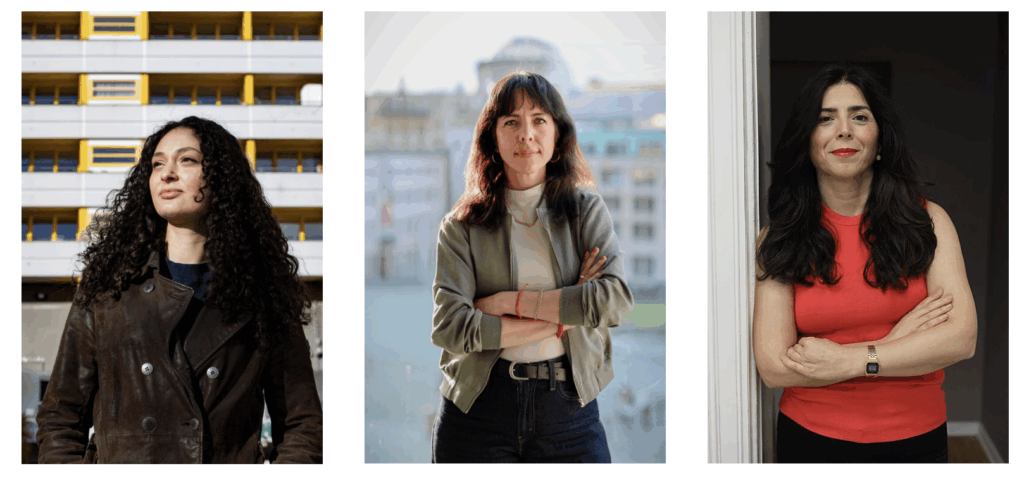
Within this political landscape, the prominence of three women candidates of Turkish origin is especially significant. They are not figures whose political representation is confined to their migrant backgrounds. On the contrary, they are political actors working within different parties and traditions, addressing Berlin’s shared problems, reaching out to voters and putting forward competing visions for the city’s future.
Elif Eralp: Could Become Berlin’s First Left-Wing Governing Mayor from a Migrant Background
Born in Munich in 1981, lawyer Elif Eralp comes from a socialist, trade-unionist family that moved from Turkey to Germany following the military coup of 12 September 1980. Eralp’s mother was pregnant with her when the family fled to Germany. Eralp says that, from childhood, her family home was always filled with refugees, workers and people involved in struggles for rights. She also witnessed racism in public institutions. These experiences led her to begin campaigning against racism and housing inequality at a young age.
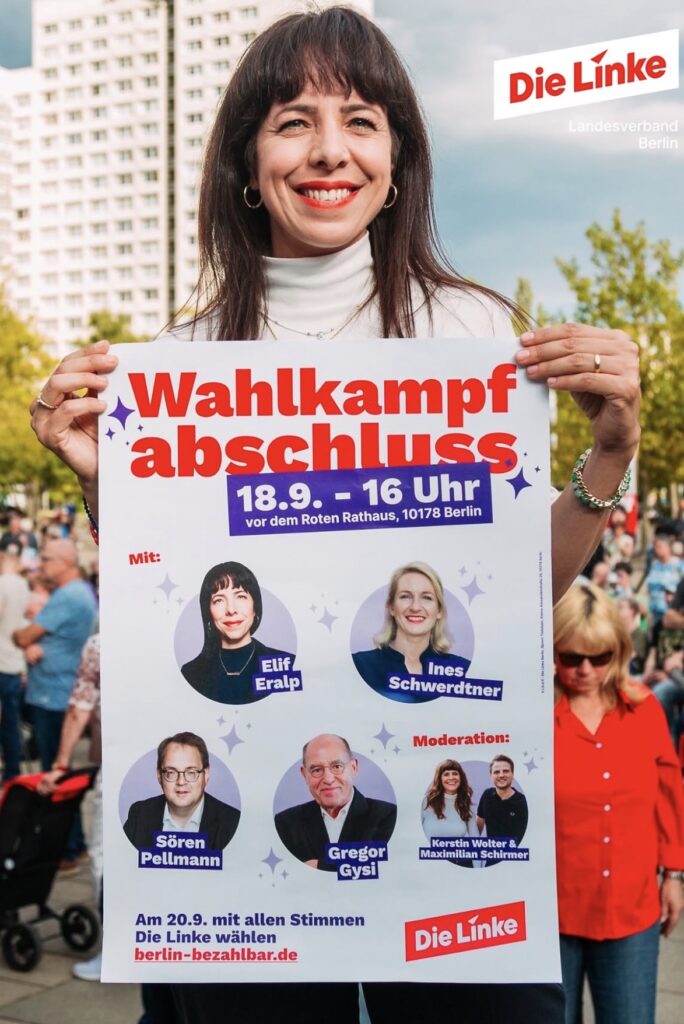
Eralp has been a member of the Berlin House of Representatives since 2021. She is now standing as the Left Party’s candidate for Governing Mayor of Berlin. Polls conducted before the election showing the Left Party in first place with 23 per cent have made her candidacy especially significant for German politics. The CDU is in second place with 21 per cent, followed by the AfD with 17 per cent, the Greens with 16 per cent and the SPD with 10 per cent.
What makes Elif Eralp one of the strongest candidates for Berlin’s leadership is her effort to bring different sections of Berlin society together around common material concerns without making her migrant background the sole defining axis of her politics. Moving her campaign beyond identity politics, Eralp has placed the housing crisis, rising rents, expensive public transport, inadequate social services and income inequality at its centre. Her aim is to make Berlin “liveable and affordable again.”
Housing policy is a central part of this programme. Eralp supports reintroducing rent controls, building 75,000 affordable homes over the next decade and bringing the housing portfolios of major property companies into public ownership. The fact that approximately 60 per cent of Berliners voted in favour of such expropriation in an earlier referendum demonstrates the level of public support for this debate in the city.
Eralp’s politics therefore offers a different account of the causes of economic and social problems from that advanced by the AfD, which portrays migrants as their source. According to Eralp, as people’s economic insecurity and fear of the future increase, so does the search for someone to blame. She argues that people of Turkish origin were previously cast in this role, while Syrians and other migrants are being targeted today. The solution is not to scapegoat migrants but to improve people’s material conditions and restore trust in democracy.
This approach distinguishes Eralp not only from the AfD but also from traditional centrist politics. She seeks to move Berlin’s political debate away from the idea of “uniting at the centre against the far right” and towards the provision of concrete solutions to the problems people encounter in their everyday lives.
Kübra Beydaş: Social Justice, the Environment and Kreuzberg
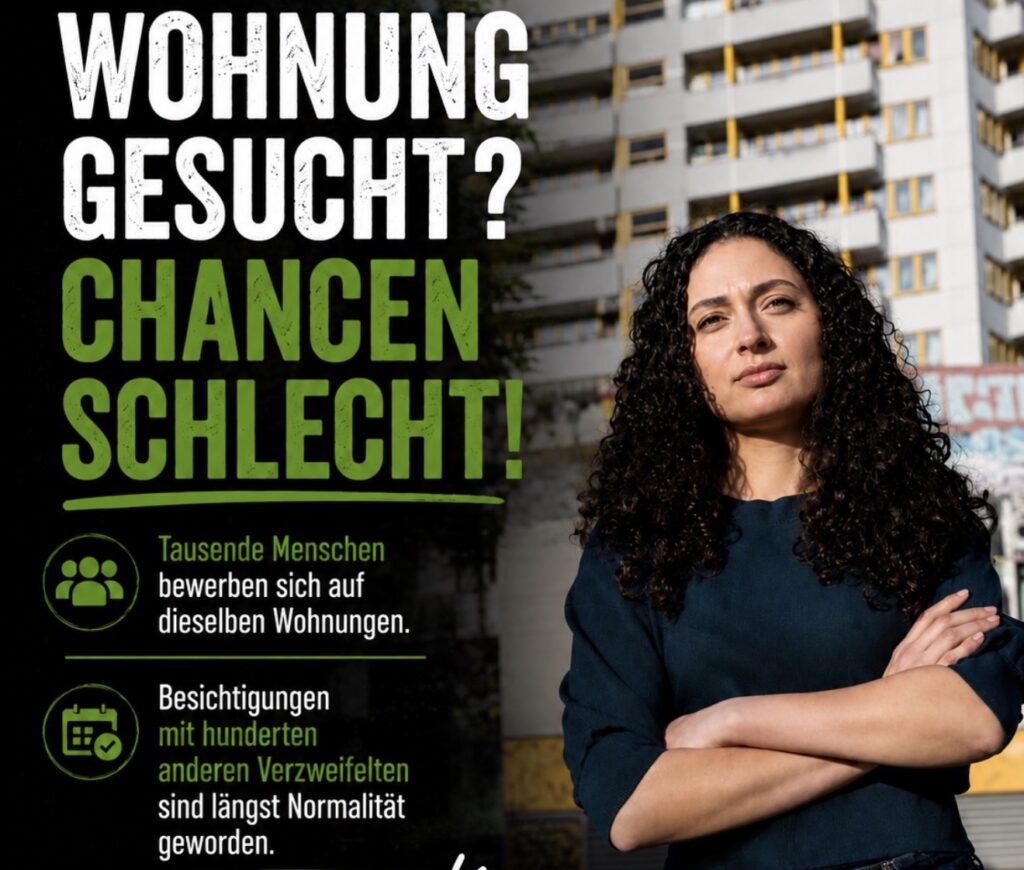
Green Party candidate Kübra Beydaş represents another dimension of this political landscape. Campaigning in Berlin’s Kreuzberg district, Beydaş stresses that the fundamental responsibility of an elected representative is to be the voice of the people. Human rights, social justice and environmental protection lie at the centre of her politics.
Beydaş’s agenda includes issues associated particularly closely with life in a major city, ranging from education and drug addiction to homelessness and environmental problems. She argues that comprehensive projects are needed to address homelessness and drug addiction in Kreuzberg, while identifying the protection of young people and the strengthening of social justice as key priorities. She also draws attention to the protection of water resources and the importance of climate policy for Berlin’s future.
Sevim Aydın: From a Working-Class Family to Parliament
Sevim Aydın is one of the SPD’s women candidates of Turkish origin in Berlin politics. The daughter of a working-class family and a lawyer by profession, Aydın has been a member of the SPD parliamentary group in the Berlin House of Representatives since November 2021. She is standing for re-election on 20 September 2026.
The issues Aydın emphasises include equality of opportunity in education and the housing and rental crisis. In her own words, her goal is a Berlin where people are happy to live—a city that is clean, safe and affordable for everyone. She draws particular attention to the need to ensure that people can once again afford their own homes.
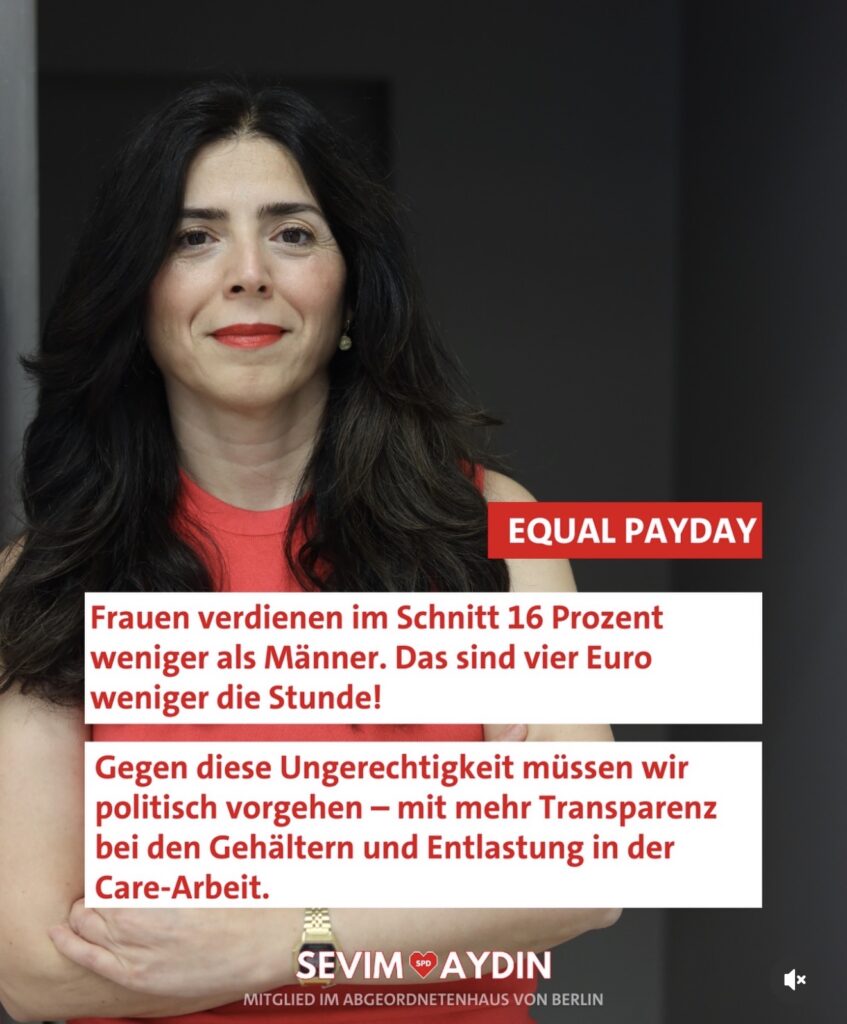
Aydın’s position within the SPD also makes the broader picture significant because the three women do not belong to the same political tradition. Eralp is standing for the Left Party, Beydaş for the Greens and Aydın for the SPD. Women of Turkish origin are thus becoming political actors within different German political traditions and making women’s voices heard from their own distinct perspectives.
As the Far Right Grows Stronger, Women Are Demanding Democracy with a More Visible and Powerful Political Voice
At a time when political life in Germany and elsewhere in Europe is increasingly shaped by male-dominated, nationalist and reactionary rhetoric, the participation of three women of Turkish origin in Berlin’s election across different political parties demonstrates that politics can be organised differently. While Elif Eralp’s victory stood out, Sevim Aydın was elected for the SPD. Kübra Beydaş, the Greens’ candidate in Friedrichshain-Kreuzberg 1, lost her constituency race to Eralp
All three candidates campaigned on issues that directly affect Berliners’ everyday lives, including the housing crisis, equality of opportunity in education, social justice and the environment. Their presence in politics should therefore be understood not merely as evidence of the political participation of Germany’s Turkish migrant communities but as part of a broader political transformation. The growing visibility of migrant women in politics also constitutes a challenge to far-right rhetoric that excludes migrants from the political community or portrays them as the cause of social problems.
As Klaus Dörre, a sociologist at the University of Jena, has observed, Germany’s political crisis is strengthening not only the AfD but also Die Linke. The Berlin election may demonstrate that the collapse of centrist politics does not necessarily result in the strengthening of the authoritarian right. The same crisis may also create space for a strong politics of social justice to regain mass support. The candidacies of three women of Turkish origin from different political parties offer a small but powerful indication of this possibility. Elif Eralp’s campaign for Governing Mayor, in particular, transforms this visibility from something merely symbolic into a direct claim to political power.
At a time when the far right is gaining strength, the Berlin election offers both hope and an indication of whether the future of politics will be shaped by a further shift to the right or rebuilt around social justice, equality, public services and democratic representation.