

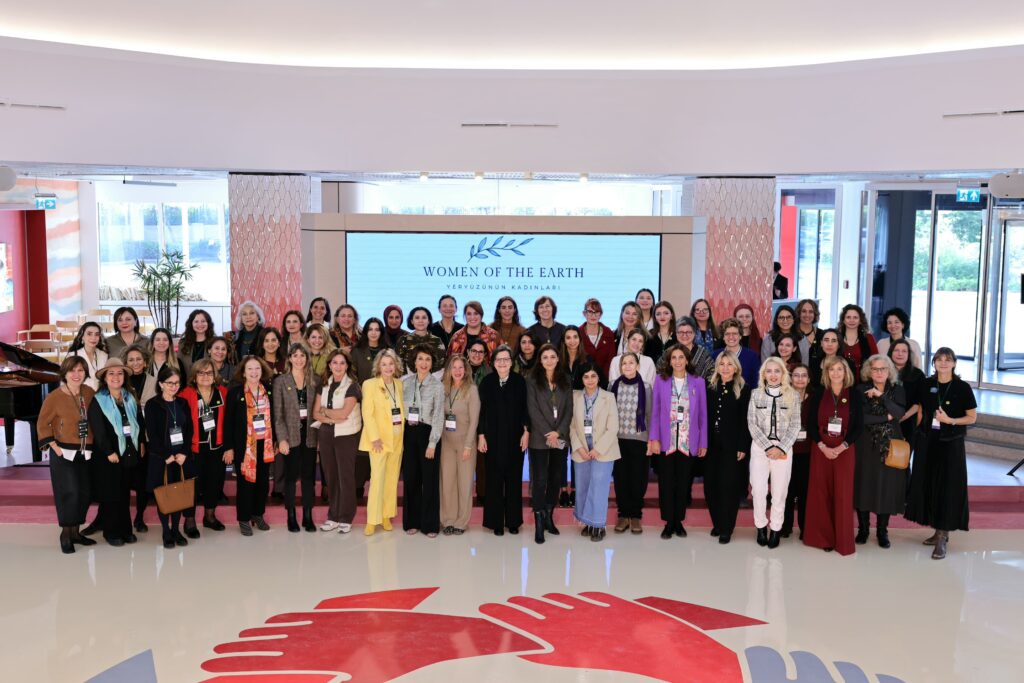
Gülseren Onanç, SES Equality and Solidarity Association
Those who keep watch over the olive groves, forests and rivers of these lands are very often women. They stand at the front line against the coal mine in Akbelen, the quarry in İkizdere and the mining companies in the Ida Mountains (Kaz Dağları). Yet their struggle often goes unseen, and their voices rarely reach the rooms where decisions are made.
That is exactly why I saw COP31, the UN Climate Change Conference of the Parties, being held this year in Antalya, Turkey, as such an important opportunity. With the eyes and ears of the world on Antalya from 9 to 20 November 2026, we had a real chance to make visible the environmental and ecological struggle that women are waging in these lands.
The Peoples’ Climate Summit
In parallel with COP31, the Peoples’ Climate Summit (Halkların İklim Zirvesi, HİZ) is bringing together ecology organisations, trade unions, women’s and youth movements, human rights defenders and local struggles for life in Antalya from 14 to 18 November. Supported by more than 390 organisations, including SES Equality and Solidarity Association, the summit opens on 14 November with a Global Day of Action march, and continues from 15 to 18 November with panels, forums and workshops ranging from the phase-out of fossil fuels and energy democracy to the rights of nature, peace and food sovereignty. Throughout the summit, HİZ is also publishing monitoring bulletins that record the gap between what is said and what is done at COP31.
We organised the Women of the Earth gathering before COP31 began, hoping it would also contribute to the struggle of the Peoples’ Climate Summit, and to carry to COP the shared demands of women whose voices are not heard. We wanted to bring social entrepreneurs, academics, activists, artists and young climate activists to the same table, to put our heads together and, as the Women of the Earth, set out our expectations of COP together.
Our goal was clear: to bring together 100 women, distil their knowledge and experience into a report, and take that report to COP31.
From an idea to a team
The person who motivated me from the very beginning of this journey, and who made me feel that doing something was worthwhile, was Mary Robinson: the first woman President of Ireland, former UN High Commissioner for Human Rights, and a founding member and former Chair of The Elders. She is one of the most remarkable women of integrity I have ever met.
The movement she founded, Project Dandelion, is a global movement growing women’s leadership for climate justice. Its co-founders, my dear friends Pat Mitchell and Ronda Carnegie, supported my idea from day one.
Together with my friend Ayşe Gül Altınay, an activist and ecofeminist academic, we turned the idea into a project. Along the way, our path joined that of my friend Sibel Asna, founder of the Armaş Foundation. Then Arzu Semiz from Upcycle Istanbul and Beyza Beyzade Berkol from Change NOW Istanbul Hub joined us.
While looking for a venue suited to workshops, we thought of the excellent facilities at Akbank Campus. When the Akbank team offered us their support, we became a wonderful team.
The Women of the Earth gathering took place at Akbank Campus on 7 November, two days before COP31 opened in Antalya. We had aimed for 100 women; more than 100 answered our call.
The wisdom that protects the olive tree
In my opening address, I first reminded everyone who is responsible for the crisis. The climate crisis is man-made. The companies causing it, and the states and international institutions responsible for regulating them, all know what needs to be done; yet they are not doing it. For thirty-one years, at COP after COP, there has been talk, writing and signing. Even so, in 2025 carbon emissions from fossil fuels reached a record high of 38.1 billion tonnes.
I read out to the participants the COP31 outcome declaration we, as women, would like to see: an end to fossil fuel subsidies by 2030; renewable energy as a public priority; permanent joint mechanisms with civil society; at least half of every negotiating table made up of women; finance for women-led climate solutions; and protection for women who defend their forests, water and land. We know it will not turn out this way. That is why the purpose of our gathering was clear: to be the VOICE of women whose voices are not heard.
(SES, the name of our association, means “voice” in Turkish.)
When creating the identity of our gathering, I chose an olive branch as our logo. The olive is the wisest and most generous plant of these lands. It withstands drought, sprouts again after it burns, and lives for thousands of years. In the ancient city of Teos in Seferihisar, the 1,800-year-old olive tree, named after Umay Nine, the guardian of fertility, still bears fruit.
Today, it is once again women who stand at the front line protecting our olive groves, forests and rivers against mining companies and construction projects driven by capitalism’s insatiable appetite.
There are no rights, only responsibilities
What is more, this women’s wisdom exists all over the world. This year, during the days I spent with Kogi women in the Sierra Nevada of Colombia, I was deeply moved by their philosophy of life, centred on protecting the Earth. There, a 29-year-old woman named Gunna told me: “For us, there are no rights; there are responsibilities.” As someone who has devoted her life to women’s rights, my first reaction was to object inwardly. After Gunna explained, I understood women’s wisdom better. She said: we have no right to use water; we are responsible for protecting it. We have no right to use the land; we are responsible for keeping it alive. Gunna was not talking about giving up rights, but about taking on responsibility. This is exactly what the women of Akbelen, İkizdere and the Ida Mountains are doing. When they say “We are not the owners of this land, but its guardians,” this is what they mean.
As women, we carry this wisdom within us. It lives in all of us. My mother, for example, knew the language of the flowers on the small balcony of her flat in Istanbul. She would talk to them and share her troubles with them. She knew when they were sulking and when they were thriving.
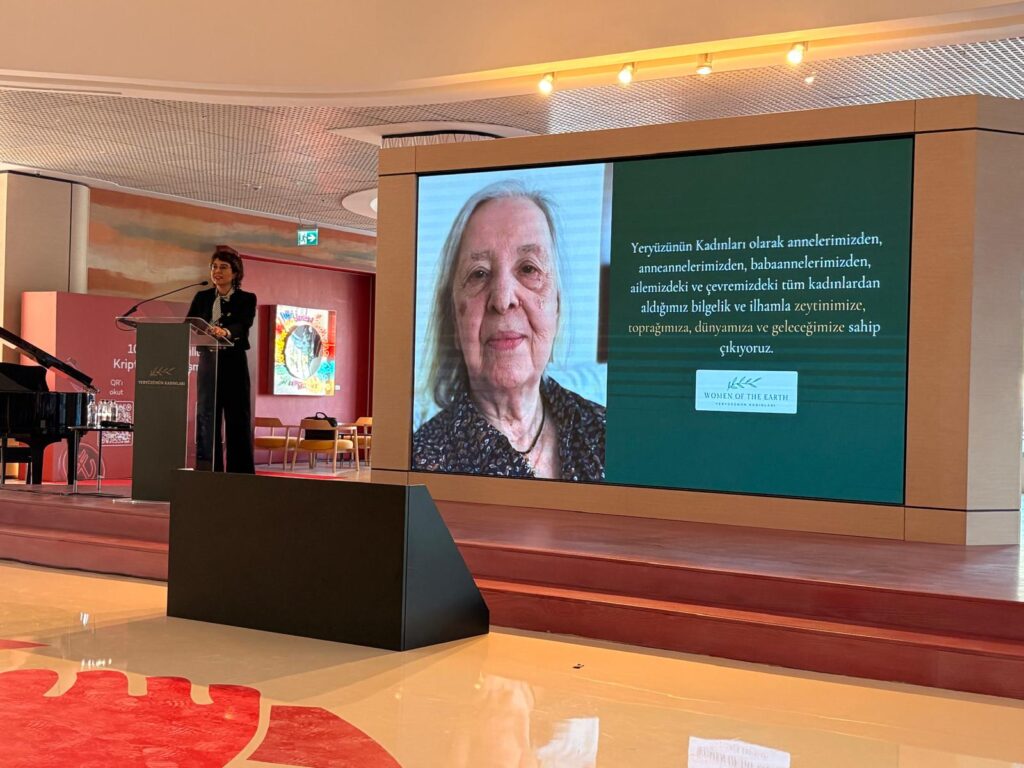
That is why our stance as women is very clear: as the Women of the Earth, with the wisdom and inspiration we have received from our mothers, our grandmothers and all the women in our families and communities, we stand up for our olive trees, our land, our world and our future.
Solidarity from around the world
This was not only Istanbul’s gathering. Our international friends were with us too: Pat Mitchell and Ronda Carnegie, co-founders of Project Dandelion; Dr. Regine Grienberger, Consul General of Germany in Istanbul; and Oksana Antonenko, international expert at the European University Institute among others.
In her keynote, Pat Mitchell told the story of how Project Dandelion was founded. She shared how Mary Robinson described it as a movement, and how, because they believe in the power of symbols, the movement grows each time a yellow dandelion badge is pinned on someone newly invited. She stressed the importance of women being at the decision-making table, and of solidarity across borders.
“Hope is a verb with its sleeves rolled up.”
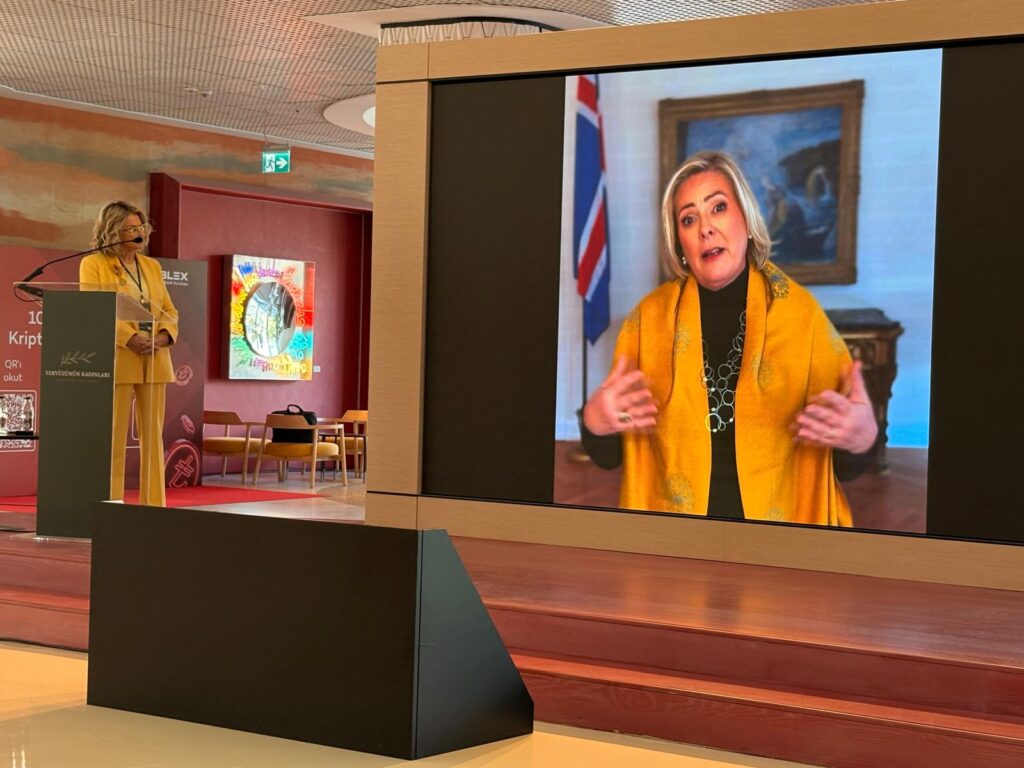
In her video message, President of Iceland Halla Tómasdóttir reminded us of the power of dialogue and solidarity. More than 50 years ago, 90 per cent of Icelandic women stopped work for a day and brought the country to a standstill; five years later, Iceland became the first country in the world to democratically elect a woman president. Tómasdóttir said that we need more women leaders who build bridges, listen, and put young people’s future at the centre, and she left the room with these words: “Hope is a verb with its sleeves rolled up.”
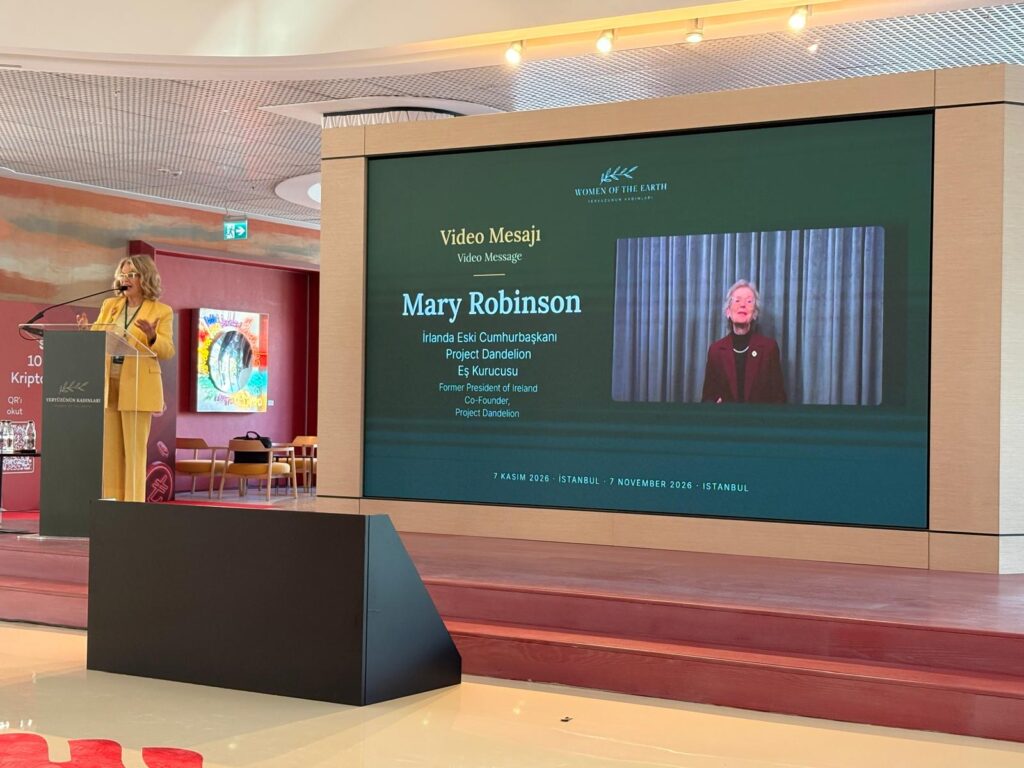
Mary Robinson said that COP31 is the first COP in what we call “overshoot”, beyond the 1.5°C goal, which makes the gender dimensions of the crisis all the more important. She reminded us that extreme heat affects women, particularly pregnant women, more severely, and that in developing countries women, who produce the vast majority of food, are hit hardest by drought and floods, and yet they are resilient. She said that we need to change the narrative and talk about the infrastructure women create, which holds communities together: “Make them visible, make them funded, make them appreciated.”
Mary Robinson promised to reinforce the recommendations from Istanbul on COP31’s Gender Day.
Collective wisdom at five tables
In the afternoon, we held five parallel workshops on five themes, each led by its own facilitator. The women worked on two questions: How can we tell better stories and be more effective? Which steps will we take, and with whom? Here are some of the outcomes:
- Women’s Knowledge and Leadership: start from village-level needs and bring rural and urban women to the same table; support women from the movement into key positions; put care and rural women’s knowledge at the centre.
- Women Building Climate Solutions: clear legal frameworks, dedicated funding and long-term roadmaps for social enterprise; open access to biodiversity data and nature education from primary school onwards.
- The Next Generation: an “I Can Do It Too” project to make young women climate role models visible, and a national solidarity platform for young climate activists; a call for a climate commission in the Turkish parliament (TBMM).
- The Power of Art: an accessible art platform that reaches every corner of Türkiye, including groups usually left out; stories that give the floor to the people affected.
- From Istanbul to COP31: take women’s climate stories to COP31; connect women facing similar problems across borders; make unpaid care work visible and fund care infrastructure.
The same voice rose from all five tables: women are already leading climate action on the ground. What is missing is for this knowledge to reach the places where decisions are made, and for women’s solutions to be properly resourced.
In one word: we are not alone
At the end of the day, we asked participants to describe their feelings in a single word: hopeful, responsible, happy, empowered, in solidarity, with a broader vision, inspired and no longer alone, like an olive tree.
These words told us that the gathering had achieved its aim. The women left the room carrying with them the value of their own knowledge, the strength of one another and a shared agenda. These words have also motivated us to organise similar gatherings in the future.
18 November: our VOICE at COP31
We are bringing together the workshop outcomes and presentations into a comprehensive collective report. I will give voice to this report on 18 November, COP31’s Gender Day, at the panel “Carrying the Torch: Women’s Leadership from Antalya to Addis Ababa” at the Ireland/EU Pavilion in the Blue Zone in Antalya.
The panel will be moderated by Mary Robinson and is organised by The Elders, the Africa-Europe Foundation Women Leaders Network and Project Dandelion. It will discuss how women’s leadership can be carried from COP31 to COP32 in Ethiopia.
At a table that has spoken largely in men’s voices for thirty-one years, the demands set out together by more than 100 women in Istanbul will be heard where the negotiations take place.
The torch is in our hands
Women of the Earth began as a one-day gathering. But on 7 November, something more was born in that room: a solidarity in which women from different fields and generations saw one another, trusted one another’s knowledge and stood side by side for the same goal.
COP31 will end, and its outcome declaration will most likely, once again, fall short of what we asked for. But the women protecting their olive groves, forests and rivers will still be there. And we will stand with them: with the network born of this gathering, with this report and with this VOICE.
The woman who planted Umay Nine, which has borne fruit for 1,800 years, never saw the grandchildren of the grandchildren who would eat its olives. This is our task too: to take responsibility today and plant tomorrow’s olive tree. The torch is now in our hands. We will keep carrying it from COP31 in Antalya to COP32 in Addis Ababa, and from there to every place we call home.
I thank everyone who has stood with us on this journey: Project Dandelion, the Armaş Foundation, Upcycle Istanbul, Change NOW Istanbul Hub, our host Akbank, and every woman who was in the room that day.
You can visit the Women of the Earth / Yeryüzünün Kadınları website here.