

In Turkey, the issue of violence against women remains one of the country’s most pressing human rights concerns. Alongside documented cases of femicide, women’s rights organisations have increasingly drawn attention to the growing number of “suspicious deaths of women,” cases in which women die under unexplained or contested circumstances.
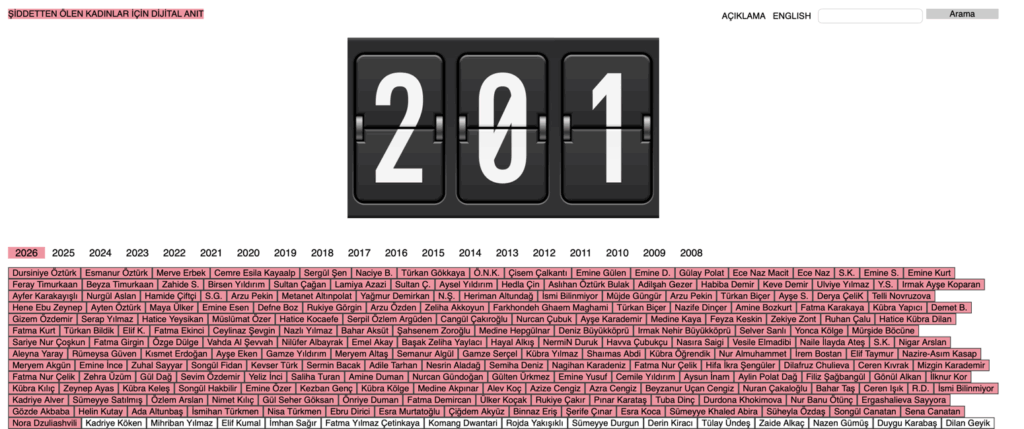
When following news reports about the deaths of women in Turkey, one of the most frequently repeated words is “suspicious.” Sometimes a woman is found dead in her home. It has been reported that she fell, sometimes her death is officially recorded as a suicide. Days pass, the story disappears from the headlines, yet the families are left asking the same questions. Why was the evidence not collected? Why were CCTV recordings not examined? Why were witnesses not interviewed?
Seven cases recently highlighted by the We Will Stop Femicide Platform bring these questions back into public focus. Because the issue is not only how these women died, but also how their deaths were investigated and whether the truth was ever established.
What Does “Suspicious” Mean?
In Turkey, the word “suspicious” appears in reports concerning women’s deaths almost every week. Its frequent use has made the concept itself part of the public debate.
A “suspicious death of a woman” is not a legal category of crime. Rather, it is a monitoring term developed and used by women’s organisations to emphasise that every case should be investigated thoroughly and from every possible angle.
The point is not to assume from the outset that every suspicious death is a femicide. On the contrary, it is to ensure that no possible explanation is ruled out prematurely.
Women’s organisations continue to use this term because previous experience has shown why it is necessary. Some cases initially recorded as suspicious deaths were later proven to be murders. According to the Platform’s latest report, investigations conducted during the first six months of this year established that 12 cases previously classified as suspicious deaths were in fact femicides.
This demonstrates that the label “suspicious” is not intended to create uncertainty but forms part of the effort to ensure that the truth can eventually emerge.
For this reason, women’s organisations repeat the same demand in every suspicious death case:
An effective investigation.
Seven Women, One Recurring Pattern
The Platform’s latest statement once again illustrates why this issue remains urgent. Within just a few days, seven women died under suspicious circumstances in different parts of Turkey.
Ceylan Tanrıverdi, Refah Kadour, Gülay Polat, Nurcan Akpirinç, Elif Bulut, Merve Erbek, and 16-year-old Y.Ş.
Different cities. Different lives. Different circumstances.
At first glance, these cases may appear unrelated. Yet this is precisely the point highlighted by women’s organisations. What connects them is not merely the deaths themselves, but the unanswered questions they leave behind.
During the Platform’s press conference, family members repeated remarkably similar statements across almost every case.
“It wasn’t properly investigated.”
“The evidence wasn’t collected.”
“Our objections were ignored.”
This is where the real commonality lies. The debate concerns not only why these women died, but whether the investigations necessary to establish the truth were conducted effectively.
For this reason, the discussion extends beyond determining the cause of death to examining the process of uncovering the truth.
As Gülsüm Kav, General Representative of the We Will Stop Femicide Platform, stated during the press conference:
“The truth cannot wait. Justice cannot wait. Evidence cannot wait.”
Evidence not collected during the crucial first hours, crime scenes not properly examined, or objections not adequately considered can make it significantly harder to establish the truth later.
Women’s organisations, therefore, regard effective investigations not merely as a legal procedure but as an essential component of protecting the right to life.
Cases Left Unfinished
According to the Platform’s report covering the first six months of 2026, 151 women died under suspicious circumstances during this period.
The same report also found that investigations established 12 cases previously classified as suspicious deaths were actually femicides.
This demonstrates why suspicious deaths should never be assigned a predetermined explanation and why every case must be investigated comprehensively.
The case of Hamide Çiftçi, which attracted public attention in June, is among the latest examples. Initially treated as a suspicious death, the investigation later resulted in the perpetrator confessing to murder.
Similarly, the death of Türkan K., initially recorded as a suspicious death in 2023, was later shown to have been homicide rather than suicide.
These examples reinforce the central argument women’s organisations have made for years. Recording a case as a suspicious death should never signal the end of an investigation. Instead, it should mark the beginning of an even more careful inquiry in which no possible explanation is dismissed.
Some cases require months—or even years—before the truth emerges.
For this reason, debates over suspicious deaths concern not only how women died, but also the determination shown in uncovering the truth.
The Cycle of Impunity
Incomplete investigations, delays in collecting evidence, or the premature closure of cases are widely regarded as contributing to impunity.
When the truth is not established, justice becomes much more difficult to achieve from the outset.
Women’s organisations, therefore, view effective investigations as more than a procedural legal obligation. They regard them as one of the fundamental safeguards of the right to life.
The Istanbul Convention likewise requires states to conduct effective, independent, and diligent investigations into violence against women and suspicious deaths.
According to women’s organisations, failing to establish the truth in one suspicious death does not simply leave a single case unresolved. It also reinforces a wider cycle of impunity that creates conditions in which similar violations may occur again.
The Case May Close, But the Struggle Continues
Even when official case files are closed, the struggle rarely ends for families.
Testimonies shared during the Platform’s press conference show that many continue searching for answers years later.
Some pursue evidence that was never collected from the crime scene. Others fight to have overlooked witnesses heard. Still others spend years in court trying to ensure that the deaths of their daughters or sisters are no longer dismissed as merely “suspicious.”
This is precisely where the work of women’s organisations becomes significant.
The search for justice takes place not only in courtrooms but also through a sustained human rights struggle to ensure that the truth is neither forgotten nor abandoned.
Women’s Organisations’ Demands Have Not Changed
Women’s organisations continue to call for every suspicious death of a woman to be investigated effectively, independently, impartially, and without excluding any possible explanation.
They demand that evidence be collected in full, crime scenes examined thoroughly, families allowed to participate meaningfully in investigations, investigations conducted without preconceived assumptions, and no case closed prematurely.
These demands extend beyond individual cases. They reflect the need for a justice system capable of guaranteeing women’s right to life.
Women’s organisations, therefore, continue to invoke the protections and investigative obligations established by the Istanbul Convention, arguing that protecting women’s lives requires not only preventing violence but also ensuring that every suspicious death is investigated until the truth is established.
Questions That Remain Unanswered
Suspicious deaths of women are not simply matters for criminal case files.
They are also indicators of how effectively the right to life is protected.
Although recording a death as “suspicious” should trigger a more thorough investigation, incomplete inquiries and unanswered questions only deepen suspicion.
For this reason, the struggle led by women’s organisations has never focused solely on identifying perpetrators. It is equally concerned with uncovering the full truth.
Perhaps the more important question today is not how many women have died under suspicious circumstances, but how many of those cases have truly resulted in the truth being established.
Justice is achieved not simply when a case file is closed, but when every question has been answered.
Every suspicious death that remains unresolved casts a shadow not only over that individual case, but also over public confidence in the justice system.
For this reason, suspicious deaths of women remain a fundamental public issue in Turkey that deserves continued attention. Not only as a legal matter, but also as an issue of human rights and the protection of women’s right to life.