

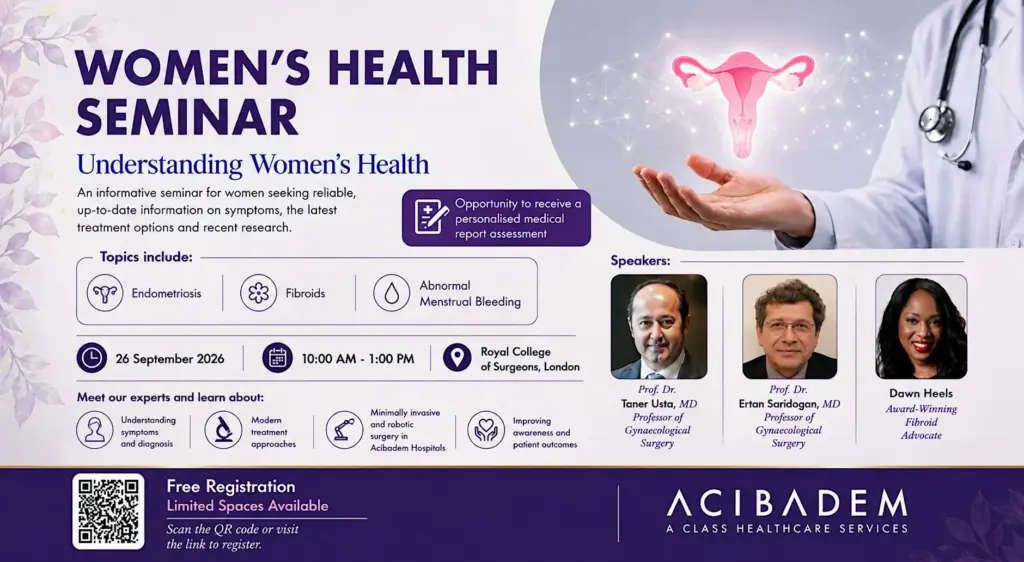
Endometriosis is common, complex and too often missed. In a public seminar, Professors Ertan Saridogan and Taner Usta explain why earlier diagnosis, expert care and personalised treatment can transform women’s lives.
Many women spend years living with debilitating period pain and persistent pelvic pain before they receive a diagnosis, and for many of them, the answer turns out to be endometriosis. According to the World Health Organization (WHO), the condition affects an estimated one in ten women of reproductive age worldwide, around 190 million people, and the average time to diagnosis is between four and twelve years. For many, those are years of being told their pain is “just a bad period”.
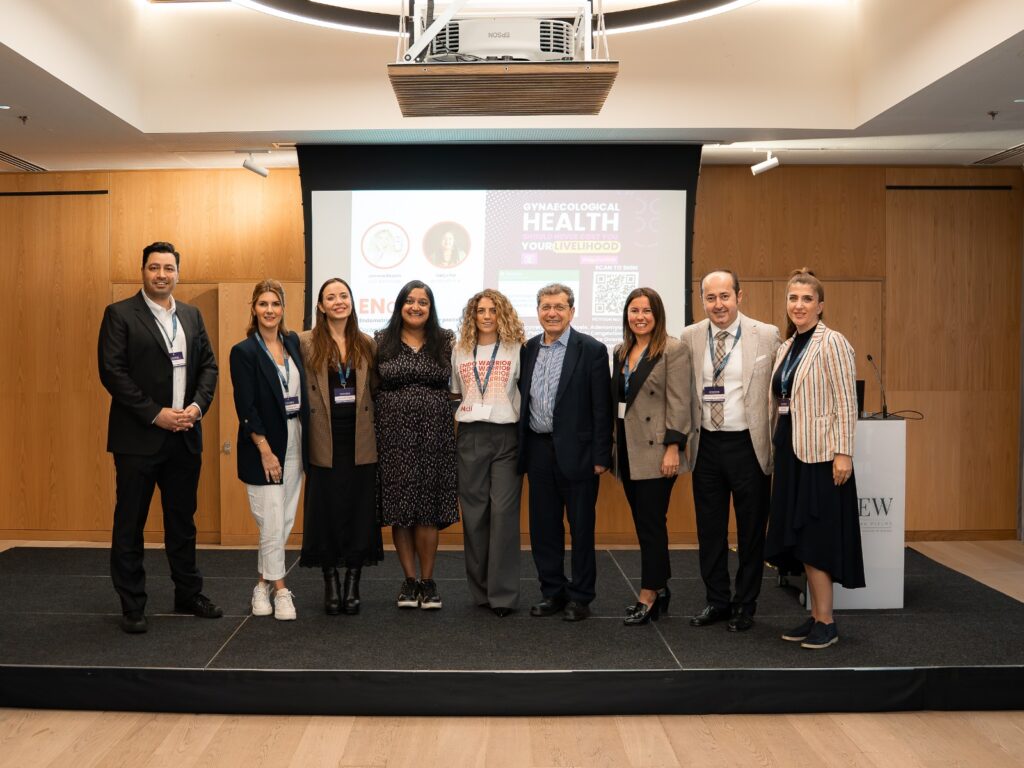
That gap between how common endometriosis is and how long it takes to recognise it was the starting point for the endometriosis session at Acibadem’s Women’s Health Seminar. The organisers opened with a statement of intent. Many in the audience had come to understand their symptoms and take more control of their health, but the day was also meant for listening. By sharing knowledge and experience, they argued, patients and clinicians can work together towards a future in which women with endometriosis are diagnosed sooner, better informed and better supported. The seminar covered several areas of women’s health, and here we are focusing on endometriosis.
Professor Ertan Saridogan, Professor of Gynaecological Surgery, opened the endometriosis session by explaining what the condition is and how it is diagnosed. He then handed over to Professor Taner Usta, also Professor of Gynaecological Surgery, who turned to how endometriosis is managed and treated.
A common condition we still struggle to measure
Professor Saridogan began with a definition. Endometriosis is the presence of tissue similar to the lining of the uterus, the endometrium, outside the uterus itself. A closely related condition, adenomyosis, occurs when that tissue grows into the muscular wall of the uterus, and the two are often found together.
Endometriosis is common, but exactly how common is surprisingly hard to say. He noted that reliable population-level estimates remain difficult to establish. Among women who seek help for pelvic pain or difficulty conceiving, it is found very often. Across the population as a whole, estimates range from one in ten to one in twenty women. Because the condition depends on oestrogen, it is largely confined to the reproductive years. It rarely appears before periods begin and tends to fade after menopause. It affects women of every ethnic and social background.
When he began his medical career, Professor Saridogan recalled, doctors were taught that endometriosis mainly affected women in their later reproductive years. We now know that is wrong. It can begin early in life, and its roots probably lie in adolescence.
The research points to several patterns. Endometriosis is more common in women who have never been pregnant. It is also more common in women with short menstrual cycles, because a 21-day cycle rather than a 28-day one means more periods, and so more bleeding, each year. Women with heavy periods face a higher risk too. The common thread, he explained, is the volume of menstrual blood. Family history also matters: a woman whose mother or sister has endometriosis faces a risk several times higher than the general population.
An enigmatic disease
How endometriosis develops is still debated, and Professor Saridogan explained that more than one mechanism is probably involved. The most widely accepted explanation is retrograde menstruation. During a period, not all menstrual blood leaves the body through the vagina. Some flows backwards through the fallopian tubes into the abdominal cavity, carrying endometrial cells that may implant on pelvic surfaces. This fits the risk factors neatly: the more blood that reaches the abdomen, the greater the chance of disease.
However, he explained that the theory cannot be the whole story. Retrograde menstruation happens in almost everyone. Studies that have looked inside the abdomen during menstruation, he noted, find blood there in around 90% of women, and most of them never develop endometriosis. Something else must allow the cells to take hold. That something may be genetic. The endometrial cells of affected women may be unusually good at attaching and invading, or the body’s defences may fail to clear them.
Other routes help explain the disease’s more unusual appearances. Some cells can change from one type into another, a process called metaplasia, which may account for endometriosis in places such as the lining of the chest. Cells may also travel through blood or lymph vessels, which may explain rare cases found in the limbs. And surgery itself can spread them, which is why endometriosis sometimes develops in caesarean section scars.
Many forms, many places
There is no single look to endometriosis. It may appear as superficial spots or blisters on the lining of the pelvis. It may form cysts on the ovaries, filled with old blood that turns brown and thick, which gives them their familiar name, “chocolate cysts”. Or it may take the form of deep nodules, a mixture of endometrial tissue and scarring. These were once thought to be rare but are now recognised far more often. In some cases, organs can become stuck together: ovaries to the pelvic wall, the uterus to the bowel. Professor Saridogan showed surgical images of pelvises distorted in exactly this way, and explained that this distortion is one reason endometriosis can make it harder to conceive. Some lesions are subtle, appearing as pale scarring rather than the classic brown or blue, and a surgeon who does not know what to look for can easily miss them.
Endometriosis has been found almost everywhere in the body. It most commonly affects the ovaries and pelvic lining, the space between the bowel and vagina, the bowel wall itself, the appendix and the bladder. It can also appear in scars from caesarean sections, fibroid surgery or episiotomy.
Pain, fatigue and fertility
The symptoms fall broadly into two groups. The first is pain: during periods, during sex, with bowel movements, and for some women much of the time. Fatigue is one of the most frequently reported symptoms. That is hardly surprising, Professor Saridogan noted, for anyone who lives with pain for a large part of their life.
The second group concerns fertility. Endometriosis is found more often in women who struggle to conceive, but Professor Saridogan also underlined that endometriosis does not mean infertility. Most women with the condition do become pregnant. A woman diagnosed before she has tried for a baby still has a good chance of conceiving naturally, depending on the extent of her disease and other factors.
Less common signs include cyclical bleeding from the bowel or blood in the urine. These are unusual because the disease rarely reaches the inner lining of those organs. A painful lump in a caesarean scar that swells and hurts more around a period is a classic sign of scar endometriosis.
Diagnosis: the shift away from surgery
Diagnosis starts with a careful history, although the symptoms overlap with many other conditions. For decades, laparoscopy, a keyhole examination of the abdomen, was regarded as the gold standard for diagnosis. Professor Saridogan explained that it still has a role in both diagnosis and treatment, but imaging is now being used more widely. The exception is very superficial lesions, which remain difficult to see without surgery. Ultrasound is widely available and highly accurate, but only in experienced hands. That, Professor Saridogan suggested, is one of the central problems in the UK and elsewhere: there are not yet enough sonographers with the expertise to detect deep endometriosis reliably. Ovarian cysts are easy to spot, but deep nodules are harder, and more work is needed to close that gap. MRI is mainly useful for planning surgery rather than as a first test.
The tip of the iceberg
Professor Usta turned to management, starting with an image: endometriosis as an iceberg. Specialists spend their time on advanced disease, he said, but many general gynaecologists lack the knowledge to diagnose the condition confidently or treat it well. He also admitted that talking about endometriosis to patients rather than colleagues is a challenge. The disease is complex, and it takes care to explain it in plain language.
He described endometriosis as a silent epidemic and estimated that two million women in Turkey live with it. It causes chronic pain, affects fertility and can badly damage quality of life. Its costs reach well beyond the clinic, into lost working days, treatment expenses and strain on relationships. He praised the UK as one of the leading countries for raising awareness, and stressed that awareness among patients and the public is what drives earlier diagnosis.
A century of change
One of the most striking parts of Professor Usta’s talk explained why endometriosis may matter more now than ever. A century ago, women typically had many pregnancies, each followed by months of breastfeeding during which they did not menstruate. Today people marry later, delay pregnancy and have fewer children, if any.
At the same time, life expectancy has risen dramatically, so women now live with the condition and its consequences for far longer. He suggested that environmental endocrine disruptors, Western diets, lifestyle and genetics may also play a part.
Treat the person, not the scan
The heart of Professor Usta’s talk was a simple principle: treat the person, not just the scan. Patients told they have endometriosis often search online, find the worst possible outcomes and become frightened. But the type and extent of the disease matter enormously. A small ovarian cyst with no adhesions and no organ damage may need nothing more than monitoring.
He challenged several persistent myths. Pregnancy does not cure endometriosis, though it can suppress it. More disease does not necessarily mean more pain: some women with advanced disease report little pain, while others with limited disease suffer severely. Hysterectomy is not a solution in itself. He recalled a patient who had her uterus removed to treat her pain, only for the pain to continue. And surgery is not always the first step. Many women do well on medical treatment alone, although for others, delaying surgery would be the wrong choice.
The right treatment depends on a woman’s main symptoms, whether and when she wants to become pregnant, where her disease is located, and her own preferences. According to Professor Usta, painkillers help some women but are not the foundation of treatment. Hormonal options suit many, including combined contraceptives, progestins, the hormonal coil and implants.
When surgery makes sense
According to Professor Usta, surgery can become an option in several situations: when pain stays severe despite medical treatment, when an organ is at risk, when a cyst is very large or has ruptured or become infected, or when fertility is the priority. But he was clear that not every patient needs it. Some surgeons believe “cutting out” the disease is the only answer, while some fertility specialists favour medication alone, he said. The truth, he argued, lies in balance and in choosing carefully for each patient.
The aim of surgery is to remove the disease, protect the organs and restore normal anatomy. It is complex work with real risks, including bleeding, infection, organ damage and loss of ovarian reserve. And it is, in his words, “not a one-man show”. Good outcomes depend on a team that may include colorectal surgeons, urologists, radiologists, gastroenterologists and physiotherapists.
Listening as well as treating
Together, the two talks highlighted a condition that is common, complex and frequently diagnosed only after years of symptoms. Endometriosis can begin in adolescence, but diagnosis and treatment do not always require surgery. Many affected women conceive naturally, while others need fertility support. Treatment should reflect each person’s symptoms, priorities and circumstances, with specialist input where needed.
This article is based on presentations given at Acibadem’s Women’s Health Seminar, held at the Royal College of Surgeons, London, on 26 September 2026. It is for general information only. Anyone with symptoms of endometriosis should speak to their GP or a gynaecologist.