

Olivia Rodrigo’s inaugural Daisy Chain Fields festival brought together women artists across generations while raising $20 million for organisations supporting women’s and girls’ rights, reproductive healthcare and workplace protections.
Daisy Chain Fields was created in part in response to the continued underrepresentation of women at major music festivals. Despite the growing commercial and cultural influence of women in music, they remain far less likely than men to be given headline slots. A 2025 report by Book More Women found that women accounted for only 21.6 per cent of headliners across nine major festivals.
Rodrigo looked to Lilith Fair as an important precedent. Founded by Sarah McLachlan in 1997, the touring festival challenged the music industry’s claim that audiences would not support events featuring multiple women artists. It placed women musicians at the centre of its programme and became a landmark of the alternative music scene in the late 1990s. McLachlan was therefore one of the first people Rodrigo consulted when developing Daisy Chain Fields.
The participation of Garbage also reflected how much the political context has changed. The band declined an invitation to perform at Lilith Fair in the 1990s, when its lead singer, Shirley Manson, felt that women were already making meaningful progress within the industry. Nearly three decades later, Manson concluded that a women-centred festival had become necessary again, particularly as women’s rights are being eroded in the United States and elsewhere.
Daisy Chain Fields reflected this commitment in its organisation as well as its line-up. Performances were scheduled without clashes, allowing audiences to see every artist rather than forcing them to choose between acts. The festival also avoided reproducing the usual hierarchy between established stars and emerging performers: every artist, from Stevie Nicks to those at the beginning of their careers, appeared in the same-sized type on the festival poster.
$20 Million in Support for Ten Organisations
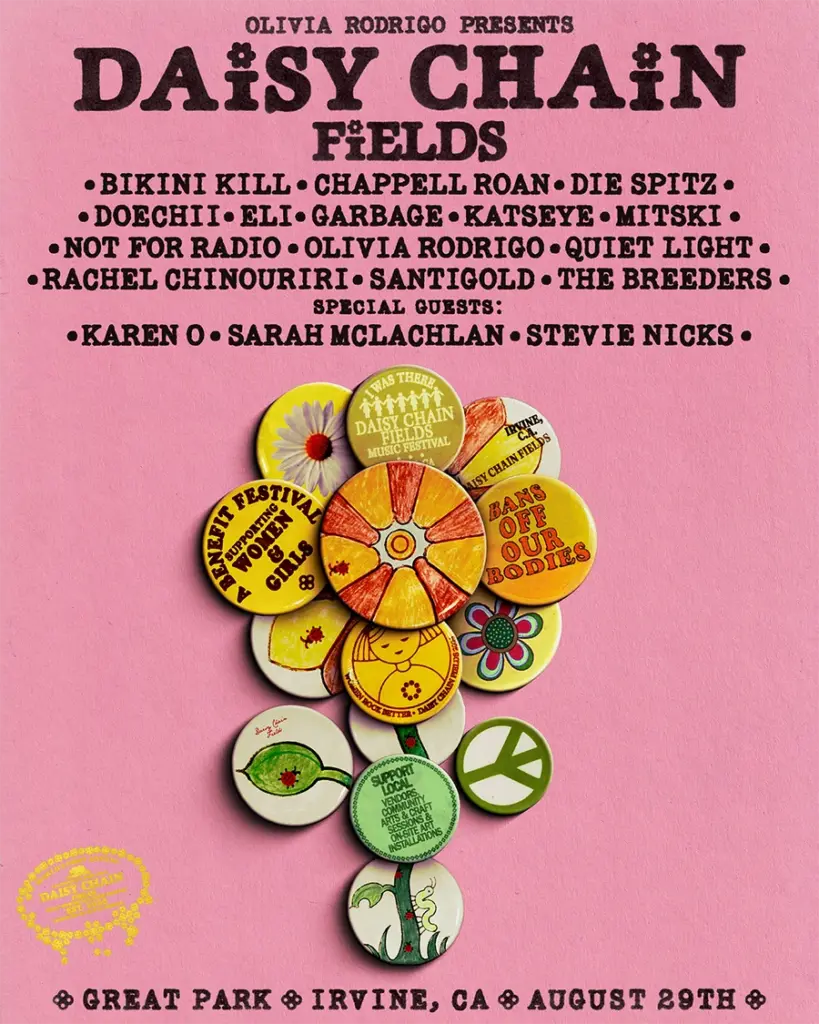
The festival was not limited to musical performances. Reproductive rights, women’s health, workplace rights and legal protections were also central to Daisy Chain Fields. It was initially announced that $10 million raised through ticket sales would be donated to ten civil society organisations. A surprise contribution of a further $10 million from philanthropist Melinda French Gates, made through Pivotal Ventures, brought the total to $20 million.
The ten organisations sharing the funds equally are Baby2Baby, the Black Mamas Matter Alliance, the Center for Reproductive Rights, FreeFrom, Jhpiego, the Johns Hopkins Center for Indigenous Health, the National Domestic Workers Alliance, the National Institute for Reproductive Health, the National Women’s Law Center and Planned Parenthood.
All ten organisations were also physically represented at the festival. Visitors could learn about reproductive rights and women’s health while engaging directly with the organisations’ work. The National Institute for Reproductive Health and Planned Parenthood focus on reproductive justice, while Baby2Baby supports mothers living in poverty. The Johns Hopkins Center for Indigenous Health works to improve healthcare for Native American communities. FreeFrom works to address the epidemic of gender-based violence, while the National Domestic Workers Alliance advocates for care workers, the overwhelming majority of whom are women.
Rodrigo: “Individual Parts Can Come Together to Form a Strong Chain”
Rodrigo also explained the meaning that the festival’s name, “Daisy Chain”, holds for her. According to the artist, it serves as a reminder that individual parts can come together to create a strong chain that is difficult to break.
Rodrigo’s activism did not begin with Daisy Chain Fields. During the leg of her Guts tour that began in February 2024, she launched the Fund 4 Good initiative. The initiative directed $2.5 million from tour profits and donations to global organisations working in the fields of women’s rights, women’s health and reproductive healthcare. These included Jhpiego, a women’s health organisation affiliated with Johns Hopkins, Women’s Shelters Canada, Women Against Violence Europe and the Korea Foundation for Women.
Rodrigo said she wanted people to leave the festival feeling hopeful and believing that they could create change:
“There is a growing belief among young people and women that we need to create change. I hope people will feel inspired to take action, whether by engaging with our non-profit partners or by finding whatever path feels right for them.”
According to Rodrigo, protecting women and girls and ensuring that they have control over their own bodies should be a priority for everyone.
“A Time When Women’s Rights Are Being Rolled Back”
Daisy Chain Fields took place at a time when women’s rights and reproductive healthcare were at the centre of political debate in the United States. Trump’s return to office led to the passage of legislation such as the One Big Beautiful Bill Act, which significantly reduced healthcare funding; substantial cuts to organisations such as USAID; and the appointment of the controversial Robert F. Kennedy Jr. as Secretary of Health and Human Services. The risk that issues crucial to women’s health would be neglected and that existing rights would be eroded has consequently increased.
Ahead of the festival, Rodrigo explained that while she was excited by the opportunity to perform at Glastonbury, she was also deeply disturbed by the knowledge that women’s rights were being taken away.
Activists participating in the festival also described the present period as particularly difficult. Angela Aina, co-founder and executive director of the Black Mamas Matter Alliance, said that Black women in the United States were three times more likely than white women to die during childbirth and that 87 per cent of these deaths were preventable.
According to Aina, one of the festival’s most important achievements was connecting organisations working on these issues with a wide audience. She explained that Black maternal health had long been discussed among public-health experts but was subsequently pushed into the background. By placing these issues at the centre of a sold-out music festival attended by large numbers of young women, Daisy Chain Fields helped make them part of “everyday civic life”.
Nancy Northup, president of the Center for Reproductive Rights, also emphasised the importance not only of Rodrigo’s financial support but also of her decision to use her public platform to draw attention to these issues. As part of its legal campaign against abortion bans in the United States, the organisation has filed lawsuits in 11 states and led the first case in 50 years to be brought on behalf of women denied access to abortion.
Olivia Rodrigo Performs Her New Song “Serena Joy” for the First Time
Olivia Rodrigo performed her new single, “Serena Joy”, for the first time at the festival. The song addresses the hypocrisy of privileged women who support systems that oppress women, only to find themselves subjected to the same oppression in the end.
The song’s title was inspired by Serena Joy Waterford, a character in Margaret Atwood’s The Handmaid’s Tale. In the world of the novel, Serena Joy belongs to the group of women who help establish a society based on strict control over women, their bodies and their rights.
Serena continues to believe in and support the system until it begins to restrict her own life. She assumes that her connections to powerful men, together with her status, will protect her—and that the rules she helped create will apply only to other women. That belief lasts until her own rights are taken away.
The song therefore acts both as a criticism of and a warning to women who believe that they can collaborate with patriarchy, adapt to its system and benefit from it. The lyric that sums up its message—“if they do it to them, they’ll do it to you”—warns that ignoring oppression is not an option.
Artists Performed Without Payment
All the artists at Daisy Chain Fields performed without payment. Alongside Olivia Rodrigo, the festival featured Chappell Roan, Mitski, Doechii, Bikini Kill, The Breeders, Garbage, Eli, Quiet Light, Rachel Chinouriri, Devon Again and Not For Radio. Stevie Nicks, Karen O, Lilith Fair founder Sarah McLachlan and Katseye appeared as special guests.
Rodrigo expressed her gratitude:
“Today, many of the biggest artists headlining festivals and filling arenas are women. I feel incredibly fortunate to be able to call many of these women my friends. When I first had the idea for this festival, I was deeply moved by the enthusiasm each of them showed. These women are already doing incredible work, and many of them have major tours of their own. Despite this, they all agreed to come together for this one-day event, with 100 per cent of the net proceeds going to non-profit organisations dedicated to advocating for and supporting women and girls.”
“We Must Stand Together in Solidarity, Not Remain Isolated”
Bikini Kill founder Kathleen Hanna said it was encouraging that artists were now speaking out more openly about these issues. Referring to artists such as Megan Thee Stallion and Hayley Williams, Hanna noted that musicians were becoming more vocal about women’s rights.
“In a fascist era, instead of remaining isolated from one another, we need to come together and stand in solidarity with each other.”
According to Rodrigo, the purpose of Daisy Chain Fields was not simply to organise a one-day music event. It was also intended to connect young people with organisations working for women’s rights and gender equality and to encourage them to become part of the movement for change.
As the festival’s name suggests, the aim was to turn different artists, activists and audience members into links in the same chain. The hope is that this gathering, which began through music, will develop into a broader social movement for the rights of women and girls.