

Feminist journalist and activist Gloria Steinem, who founded Ms. magazine and helped establish the National Women’s Political Caucus during a lifetime of campaigning that encompassed journalism, abortion rights and political representation, has died at the age of 92. We wanted to take a closer look at her story of activism, sustained by optimism, to understand her journey towards becoming a feminist activist and reflect on the lessons of her life.
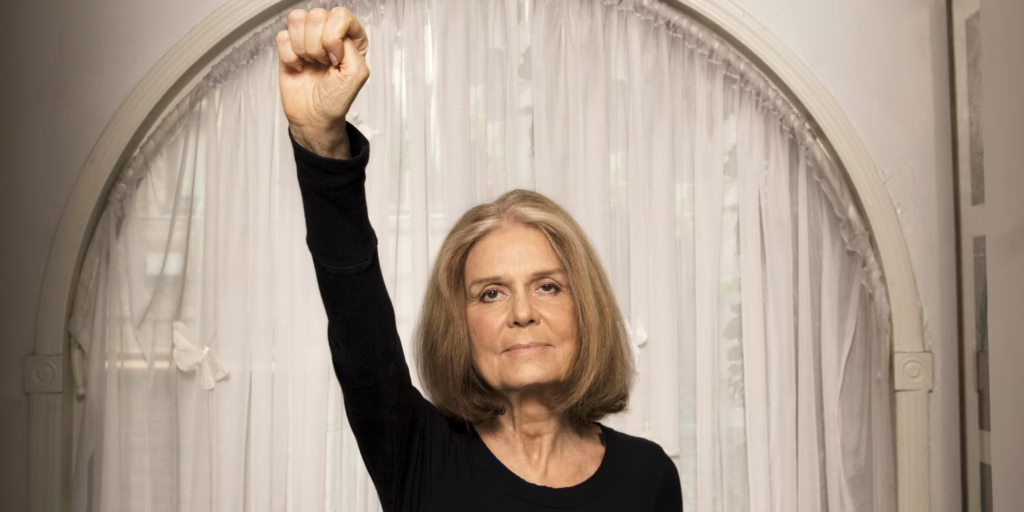
Gloria Steinem was one of the pioneers of second-wave feminism. She died at her home in New York on 3 September 2026, aged 92. Her family announced her death in a brief statement, after which feminist organisations, politicians and journalists around the world paid tribute to her legacy.
A recurring theme in the tributes, including those led by Hillary Clinton, was that Steinem’s activism was driven not by pessimism but by optimism. Neighbours who left flowers outside her Manhattan home remembered her not as a distant icon but as an active member of their community. Looking back at the organisations she established, the paths she opened and the struggle she sustained for more than seven decades reminds feminist activists that the struggle never truly ends.
The Origins of a Struggle
Gloria Steinem was born in Ohio in 1934 and spent much of her childhood living in a trailer. Her mother’s mental health problems prevented her from maintaining employment, and the exclusion she consequently experienced shaped Steinem’s earliest observations about women’s work.
In 1956, Steinem graduated with a degree in government from Smith College, a women’s college in Massachusetts. After graduation, she travelled to India, where she spent two years working as a legal clerk at the country’s Supreme Court. Upon returning to the United States, she briefly worked for a CIA-linked organisation that mobilised students against Soviet influence at international youth festivals during the Cold War. Years later, she spoke openly about this period and said that she stood by her decision. This episode illustrates that her career did not follow a single, straightforward path, but also that she did not attempt to escape her past.
From Journalism to Organising
Steinem first came to public attention in 1963 with a two-part investigative report based on eleven days spent working undercover at a Playboy Club. Entitled “A Bunny’s Tale”, it was published in Show: The Magazine of the Arts. It was her first major journalistic breakthrough. The investigation exposed the working conditions of women who were required to wear tight costumes and pressured to lose weight. Afterwards, however, she struggled to find work for a time, as she had become known simply as the “Bunny girl”.
In a 1968 article for New York magazine about an abortion rights demonstration, she used the term “reproductive freedom”, which has since become one of the movement’s central concepts. Steinem regarded her experience following an abortion in London at the age of 22 as the beginning of her life as an activist.
Founded by Steinem and Dorothy Pitman Hughes in 1971, Ms. magazine is regarded as the first national publication produced by women for women. Its first issue featured an article about Wonder Woman, who had relinquished her powers to remain with a man, and called for the character to return to her feminist roots.
Was Duygu Asena Inspired by Ms. When Producing Kadınca in Turkey?
Historians of the feminist press place Kadınca, Turkey’s first popular feminist women’s magazine, within the same generation of publications. According to Şule Akdoğan’s 2016 comparative doctoral thesis, the magazine, which Duygu Asena began editing in 1978, followed a model similar to Britain’s Spare Rib and the United States’ Ms. This is a retrospective academic classification. Although no statement has been found in which Asena herself identifies Steinem or Ms. as a direct model, it suggests that she may have been influenced by the same feminist wave.
During the same period, Steinem helped establish the National Women’s Political Caucus, an organisation created to mobilise and train women to stand for political office. Speaking at a 1970 US congressional hearing on the Equal Rights Amendment, she directly challenged the testimony of those who had opposed the amendment before her. In response to claims that women were different “by nature”, she argued that differences between the sexes were far smaller than the individual differences within each sex. Drawing on concrete evidence, she explained that women earned 40 per cent less than men, that the welfare system degraded women and that trade unions excluded women’s labour.
She argued that women’s liberation would benefit not only women but also men, who were burdened with the expectation of being the sole breadwinner. The amendment passed Congress in 1972 but failed to secure ratification by the required 38 states before the 1982 deadline. The constitutional protection for which Steinem fought 56 years ago has still not come into force.
Activism Across Different Causes
Gloria Steinem’s activism extended beyond the boundaries of the women’s movement. In 1984, she was arrested during a demonstration against apartheid outside the South African Embassy in Washington. She was part of the Free South Africa Movement, which was attracting an increasingly broad base of support in the United States at the time.
Thirty years later, in May 2015, she joined 30 women activists, including two Nobel Peace Prize laureates, Leymah Gbowee and Mairead Maguire, in crossing the Demilitarised Zone from North Korea to South Korea. They called for the Korean War to be formally ended, for families separated by the war to be reunited and for women to play a central role in peace processes. Steinem described the action as “accomplishing something that everyone said could not be done”.
In 2017, she became one of the co-chairs of the Women’s March, held the day after Donald Trump’s inauguration and widely described as the largest single-day demonstration in US history.
During her six decades of activism, Steinem received numerous honours. She was inducted into the National Women’s Hall of Fame in 1993, awarded the Presidential Medal of Freedom by Barack Obama in 2013, received Spain’s prestigious Princess of Asturias Award in 2021 and was included in the BBC’s annual “100 Women” list in 2023.
“Only Women Become More Radical with Age”
In a 2016 interview with the Financial Times, Steinem said that she did not underestimate the anger of the generation that followed hers. On the contrary, she believed that their anger went far beyond that of her own generation. She explained that she had not identified as a feminist until her thirties but had become increasingly angry after that age. In her view, this was because women encountered inequality more extensively as they grew older, through paid employment, domestic labour and the double standards surrounding ageing.
In the same interview, Steinem said she did not regard some young American women’s support for Bernie Sanders rather than a female candidate as a “betrayal”. Instead, she saw it as evidence of young women’s interest in activism. She emphasised that the struggle was not simply about bringing an individual woman to power but about improving the lives of all women.
Steinem also argued that the prevalence and normalisation of violence against women within a society could help us anticipate that society’s broader tendency towards violence, including both internal conflict and aggression against other countries. Her reasoning was straightforward. If a society regards it as “normal” for one person to use power to control another, whether at home or on the street, this acceptance eventually creates the conditions for every form of hierarchy and violence. Children first learn that power can be legitimised through violence within the family, by witnessing or experiencing violence against women.
Black Feminist Women’s Leadership: Sexism and Racism Cannot Be Separated
Steinem repeatedly acknowledged that she had learnt much of the intersectional framework underpinning her activism from Black feminist women leaders, including Florynce Kennedy, Evelyn Cunningham, Shirley Chisholm and Fannie Lou Hamer. She compared the partnerships she formed with these women to finding a family.
The idea that sexism and racism could not be addressed separately was central to her writing from 1971 onwards. In 2017, she used the same framework to explain why some of the harshest restrictions on abortion had emerged in the southern states. Her long-standing collaboration and shared public appearances with Dorothy Pitman Hughes offered a concrete expression of her solidarity with Black women.
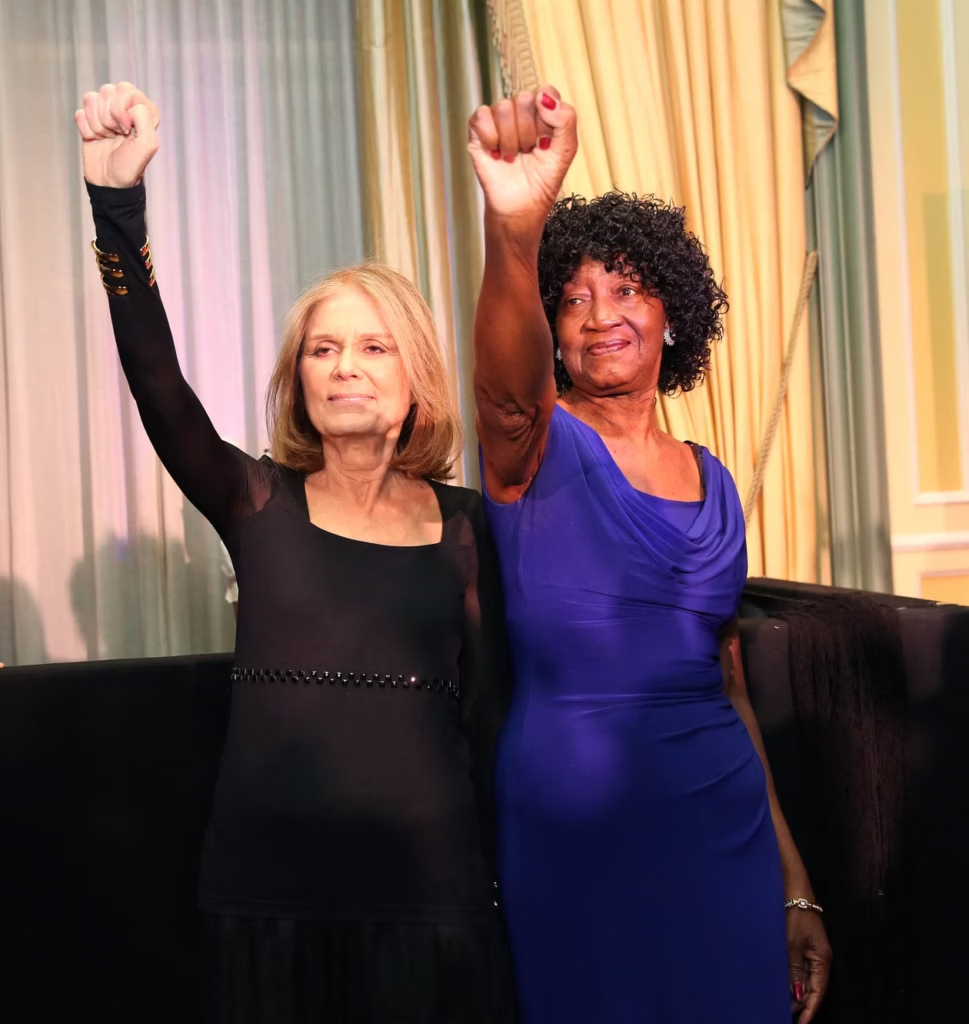
Gloria Steinem and Dorothy Pitman Hughes at the Ms. Foundation for Women’s 2016 Gloria Awards gala in New York City on 27 April 2016. Monica Schipper/Getty Images via AFP.
Listen First, Then Tell the Story
Gloria Steinem described herself not as a theorist but as an organiser who inspired action by listening. She argued that feminist theory emerged not from academia but from activism in the streets.
This approach had its roots in the two years she spent in India. While travelling from village to village with Gandhian women organisers, she took part in “talking circles” in which everyone spoke and listened in turn. These experiences taught her that the woman telling her story was also the expert on that subject. Steinem applied this principle to both her journalism and organising over the following 60 years. Whether visiting a women’s shelter in Alaska or repeatedly volunteering her support to the post-apartheid women’s movement in South Africa, she followed the same method: listen first, then tell the story.
The federally funded National Women’s Conference, held in Houston in 1977, represented a turning point that Steinem remembered as the moment when second-wave feminism became a genuinely national movement. Attended by 2,000 official delegates and 18,000 observers, the conference entrusted Steinem with bringing together the demands separately articulated by Black, Asian American, Latina and Native American women and turning them into a shared text. She later described it as the moment when she first understood that being a writer also meant being an activist.
For many years, she also followed a rule that she would not speak or participate in an organising event unless a woman of colour shared the stage with her. This helped her manage her fear of public speaking while also passing the microphone to women who experienced forms of discrimination even more severe than her own.
“What Is Not Good for All Women Is Not Good for Any Living Being”
In Steinem’s own words, this approach could be summarised as follows: “What is not good for all women is not good for any living being.”
Some generations of feminists have interpreted this perspective, which treated discrimination based on race, class, age and sex as elements of a single struggle, as the point at which feminism became a mass political movement. In this reading, Steinem’s approach was more influential in shaping the movement than Simone de Beauvoir’s philosophical legacy or Betty Friedan’s demand for middle-class women’s access to careers.
Her Mistakes Are Also Part of Her Legacy
An article Steinem wrote for The New York Times in 1998, defending then-president Bill Clinton against allegations of sexual harassment, remained a source of criticism for years. In 2017, she reconsidered her position, saying that women’s testimony was now taken much more seriously and that she would not write the same article today.
Similarly, a 1977 article led to criticism that she was unsympathetic to trans rights. In 2013, however, she explicitly revised this position, writing that trans people’s lives were real and authentic and should be celebrated rather than questioned.
Some feminist circles also argued that Steinem became the public face of the movement not simply because of merit but because the media preferred a figure who was young, white and conventionally attractive. Steinem did not dismiss this criticism. Even in later life, she wrote that she found the accusation painful.
A Struggle in Numbers: “There Is So Much More to Do”
When Steinem began her activism in 1971, only 15 women served in the US Congress. Today, that figure has reached 150. This progress did not occur on its own; it was the result of decades of work by the organisations she helped establish.
Steinem also made a deliberate effort to promote younger organisers so that the movement would not become dependent on a single individual. Ai-jen Poo, a domestic workers’ rights advocate who was among those Steinem mentored through meetings held in her home, described her as an organiser committed to sharing leadership and always more interested in elevating other women than herself.
Steinem was diagnosed with breast cancer in 1986 and with trigeminal neuralgia, a condition causing chronic pain, in 1994. Despite these health problems, she continued working until the end of her life. In a 2011 interview, she said that she hoped to live to the age of 100, explaining simply: “There is so much more to do.”
Her final memoir, An Unexpected Life, which is due to be published at the end of September, will ensure that her voice remains in the public sphere for some time yet.
Gloria Steinem’s death marks the loss of a pioneer of the feminist movement. As members of the SES Equality and Justice Women’s Platform, where we regard writing as a form of activism, we remember with respect a woman whose life set an example for us.
Sources
- “Gloria Steinem: ‘Only women become more radical with age’,” Financial Times, 8 March 2016
- “Feminist icon Gloria Steinem dies at 92,” Financial Times, 3 September 2026.
- “Gloria Steinem, groundbreaking feminist campaigner, dies aged 92,” The Guardian, 3 September 2026.
- “Road Warrior: Gloria Steinem’s Life on the Feminist Frontier,” The New Yorker, 12 October 2015.
- “Gloria Steinem, trailblazing journalist and activist, dies at 92,” NPR, 3 September 2026.
- “Gloria Steinem, feminist icon, dies at 92,” Axios, 3 September 2026.