

On 14 November, a Peoples’ Climate March was held against the COP31 climate summit underway in Antalya. About 10,000 people from cities across Turkey and from countries around the world marched under the slogan “Against COP31, we defend life.” Protesters criticised corporate sponsorships, fossil fuel projects, the exclusion of local communities from decision-making, and official climate policies.
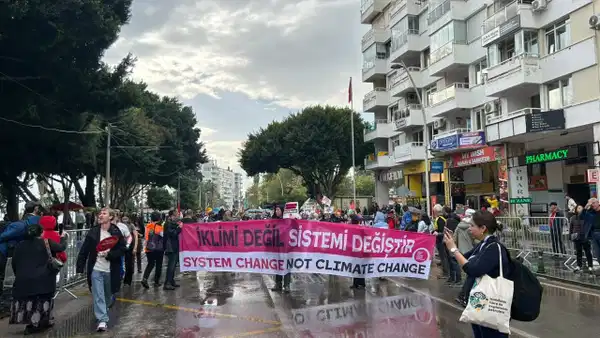
Photo: Cumhuriyet newspaper
Antalya is hosting the United Nations Climate Change Conference (COP31), and at the end of the summit’s first week the city saw a major protest. Environmental organisations, activists and citizens came together on 14 November for the Peoples’ Climate March.
About 10,000 people from cities across Turkey and from countries around the world marched under the slogan “Against COP31, we defend life.” Participants protested against environmental destruction, the impact of corporations on nature, and official climate policies.
From Local Groups to International Organisations
Environmental organisations, trade unions, representatives of opposition parties and rights advocates joined the march. International organisations such as Greenpeace, 350.org, Fridays for Future and Climate Action Network (CAN) also took part. Pro-Palestinian, feminist, anti-war and anti-nuclear groups joined the demonstration too. Giant puppets made by art collectives, along with banners and placards, were among the march’s most striking sights.
According to Le Monde, one notable feature of the demonstration was the strong turnout of small local environmental groups from across Turkey. Villagers fighting mining projects, groups opposing dam construction on protected rivers, and environmental activists marched with banners they had made themselves.
“We Will Hold Climate Criminals to Account”
The march’s main demands were climate justice, a phase-out of fossil fuels, and a say for local communities in decision-making. Activists said they had come together to expose the corporations and governments at COP31 that are driving the climate crisis.
Protesters argued that despite nearly 30 years of climate summits, states and corporations still haven’t taken adequate action against the climate crisis. Another participant stressed that the struggle isn’t limited to the climate crisis. This participant said they were there in solidarity against human and animal rights violations, and against rights violations targeting women and LGBTI+ people.
Criticism of Sponsors
COP31’s sponsors and their environmental impact were also on the protesters’ agenda. Participants criticised the support that companies such as Cengiz Holding, Limak and Sinpaş have given the summit, and drew attention to the environmental struggles of local communities affected by these companies’ operations.
One activist condemned the displacement of people from their homes for coal mining and energy production, and criticised Limak’s place among the main sponsors.
Participants said they wanted to amplify the voices of communities fighting to protect nature in places from Akbelen to the Gidengelmez Mountains. They stressed that local resistance can succeed through solidarity.
Local Struggles from Türkmen Mountain to Aliağa
Groups fighting mining, energy and industrial projects in different parts of Turkey also voiced their demands at the march.
Ayşe, from the Türkmen Mountain Villagers collective near Eskişehir, explained that they are fighting a gold and copper mining project together with 16 villages in the area. According to Ayşe, the mining will use cyanide and around 20 other chemicals. She said this threatens water sources, forests, pastures and farmland.
Activists opposing the expansion of the Afşin-Elbistan A Thermal Power Plant were also at the march. The project in Kahramanmaraş has long been criticised by local and national organisations, and Human Rights Watch and the Turkish Medical Association have also criticised it. However, the Ministry of Environment, Urbanisation and Climate Change, headed by COP31 President Murat Kurum, supports the project.
Sıla, an environmental activist from İzmir, called for the closure of the Habaş steel plant in Aliağa. Sıla said steel production, refining and ship-breaking in the area have caused pollution for a long time. The plant returned to the spotlight after an explosion and fire on 9 November, COP31’s opening day, killed 19 workers. Sıla said the whole facility should be re-inspected after the incident.
Journalist Hakan Tosun Remembered
One of the small groups at the march honoured Hakan Tosun, an independent journalist, documentary filmmaker and environmental activist. Tosun died in hospital after being attacked on the night of 10 October 2025 in Esenyurt, Istanbul. He had covered urban transformation projects in Istanbul, human rights violations in Hatay after the 2023 earthquakes, and the struggle to protect Akbelen Forest.
Not an Alternative but the Real Home of Solutions: The Peoples’ Climate Summit
The Peoples’ Climate Summit, held in parallel with the official COP31 meetings, was another major theme of the protests. The summit runs from 14 to 18 November. It opened with the 14 November march, and its sessions are taking place from 15 to 18 November at the Antalya Mimar Sinan Congress Centre.
Participants argued that governments and corporations put profit and economic growth first. They said they aim to create an alternative public space where local communities, workers, women and children can have a say in decision-making. Activists believe alternative summits matter because they let people who are under-represented at the official COP meetings put forward their own solutions.
The march ended with a call for a fairer life in harmony with nature, in response to the climate crisis.