

Turkey’s opposition has spent years defending its municipalities and leaders from judicial intervention. Now, with the Republican People’s Party itself effectively taken over through the courts, its leaders are confronting a question that would once have been unthinkable: is it time to abandon the country’s oldest political party?
Begüm Zorlu and Canan Özbey Gül
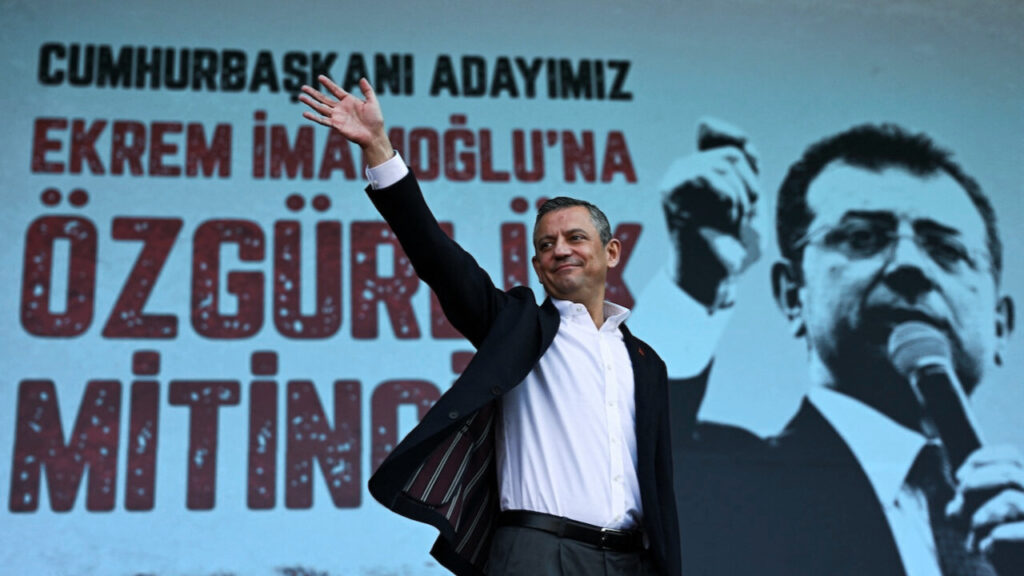
Since 2016, Turkey has frequently removed elected pro-Kurdish mayors and replaced them with state-appointed trustees, usually on terrorism-related allegations. Since the Republican People Party’s (CHP) strong showing in the March 2024 local elections, the same tactics have expanded to opposition-run municipalities, with several CHP mayors arrested or jailed pending trial and trustees appointed in some districts.
The highest-profile case came in March 2025, when Ekrem İmamoğlu, the mayor of Istanbul and widely seen as President Recep Tayyip Erdoğan’s leading challenger in head‑to‑head polls, was arrested at dawn and later jailed on corruption‑related charges. Shortly before his arrest, his university diploma was revoked in a highly unusual legal move, raising concerns that even an eventual acquittal might not restore his eligibility to stand as a presidential candidate. The arrest sparked some of the largest protests Turkey had seen in over a decade. By November 2025, prosecutors had filed an indictment listing around 140 offences and seeking an extraordinarily long cumulative sentence.
Around a year later, a similar mechanism was used against the CHP. In May 2026, a Turkish appeals court annulled the party’s 2023 congress, where Özgür Özel had unseated long-serving leader Kemal Kılıçdaroğlu, citing allegations that delegates had been bribed with cash and gifts. Because Turkish law treated this finding as mutlak butlan (absolute nullity), as making the congress void from the moment it happened, the ruling wiped out everything the Özel leadership had done since, and reinstated Kılıçdaroğlu and the pre-2023 leadership on a provisional basis. Turkey’s opposition has called this a “judicial coup”, accusing Erdoğan of using the courts to remove his strongest political rival ahead of future elections; the government denies any political interference. Days later, riot police broke into CHP’s Ankara headquarters using tear gas, forcibly removing Özel and his allies, after Kılıçdaroğlu’s lawyer petitioned the police to enforce the court’s order.
Taken together, these episodes point to a coherent strategy on the part of the incumbent. The government has used criminal investigations and suspensions to remove individual opposition mayors from office, while relying on civil litigation to challenge the legitimacy of the CHP’s internal leadership election. Since the 2024 local elections, more than thirty CHP-run municipalities have faced such operations, yet the party itself has not been formally banned. This strategy allows the authorities to weaken the opposition without incurring the higher domestic and international costs of outright dissolution.
What comes next: a brand-new party
Two months on, with Kılıçdaroğlu still in place, Özel’s camp is dropping the CHP label and launching a new party. They have treated the stalled appeal at the Court of Cassation as the signal to move, with founding papers for a provisional party.
What do other cases in non-democracies say about this strategy? In Thailand, the Constitutional Court dissolved the reformist Future Forward Party in 2020; most of its MPs and supporters then rallied behind Move Forward, which won the most seats in the 2023 election. When Move Forward was itself dissolved in 2024 over its lèse‑majesté reform campaign, more than a hundred of its MPs swiftly regrouped under a new banner commonly described as the People’s Party, largely preserving their base. Cambodia shows a starker outcome: after the main opposition CNRP was dissolved in 2017, its networks rebuilt around the Candlelight Party, which took roughly a fifth of the vote in 2022 but was disqualified it from the 2023 national election, leaving the ruling CPP essentially uncontested. Together, these cases suggest that rebranding can initially protect an opposition constituency, but not indefinitely, when authorities repeatedly rewrite the legal and electoral rules.
Özel has reportedly been weighing three options: fighting on to reclaim CHP through the courts, founding an entirely new party, or using another already-registered party as a technical vehicle for candidates if snap elections were called first. While he initially presented a new party as a last resort following the ruling, positive public reactions during his nationwide visits reportedly made the idea increasingly attractive.
What the polling shows
CHP’s own polling gives the clearest sense of the stakes. A June 2026 survey by Gündemar found that if a snap election were held with CHP still under Kılıçdaroğlu, the party would take 27.89 percent against AKP’s 31.20 percent, once undecided and protest voters were distributed. A new party under Özel, İmamoğlu and Ankara mayor Mansur Yavaş, by contrast, would take 34.92 percent against AKP’s 30.46 percent moving from second place into a clear lead of over four points. Before undecided and protest votes were allocated, the new party still led AKP, 28.12 percent to 24.53 percent, though close to a fifth of respondents remained undecided or registered a protest vote, a reminder that polling for a party that does not yet exist should be read with some caution.
What is at stake
The immediate risk is fragmentation rather than consolidation. Two parties both claiming CHP’s legacy, one holding the name and official apparatus, the other holding most of the recent leadership and, on current polling, the larger vote share, splitting the anti-AKP vote at precisely the moment a united opposition looks capable of beating the government. Much depends on two things: whether the Court of Cassation eventually overturns the original ruling, reopening the question of CHP’s legitimate leadership, and whether the new party, once formally registered is eventually blocked.
The Risk of Forming a New Party: Lack of Legal Guarantees
One of the main practical obstacles to forming a new party is the 2022 election law amendment. Whereas parties previously needed only a parliamentary group to contest elections, they must now also be fully organised at least six months before polling day. This creates a significant timing challenge for Özgür Özel and his team should an early election be called. As a result, they may be forced to contest any early election through an existing party, or by appearing on another party’s lists.
The new party debates are unfolding amid pronounced legal and institutional uncertainty. In recent years, there have been recurrent instances in which lower courts and the Court of Cassation have openly defied or failed to implement decisions of the Constitutional Court. At the same time, judicial interventions into intra‑party disputes and electoral processes have blurred the boundaries of authority among courts and the Supreme Election Board, raising doubts about the reliability of existing safeguards. Under the Law on Political Parties, the formal procedure remains straightforward: founders must first apply to the Ministry of Interior for registration. Yet in the current political climate, the core issue is less the formal possibility of establishing a party than whether such a party can subsequently operate without facing closure cases, financial sanctions, or other forms of legal and administrative pressure.
There is also the risk of parliamentary immunity being lifted. Kılıçdaroğlu, now head of the court-appointed CHP administration, continues to defend his 2016 support for lifting parliamentary immunity from MPs, a measure that overwhelmingly targeted the Kurdish movement, with some of its MPs remaining imprisoned nearly a decade later. He has also said that, were he in Özel’s position, he would again call for immunity to be lifted. This is actually like knowingly falling into a trap everyone knew about from the beginning: if immunity is lifted, it is not at all unlikely that Özel will also be imprisoned on some pretext. However, contrary to Kılıçdaroğlu’s claim, the moral superiority lies with Özel and his administration, who have toured more than 20 cities with an incredible performance since the ruling. During this extraordinary performance, Özel has been in close contact with the people. The people are embracing Özel and persistently demanding that he form a new party. Polling companies, in direct proportion to the public’s persistent demand, show the newly formed party in first place in their polls, while Kılıçdaroğlu’s CHP consistently falls below the electoral threshold. Perhaps listening to the voice of the people is more logical, despite all the risks, and after all, what does the main opposition party have left to lose?
This article has been published on the Political Studies Association’s Blog. To see the original text, click here.