

The newly established New Party (Yeni Parti), led by former CHP chair Özgür Özel, marks a significant realignment within Turkey’s opposition. Drawing on the party’s programme and constitution, this article examines its commitments to women and LGBTI+ people.
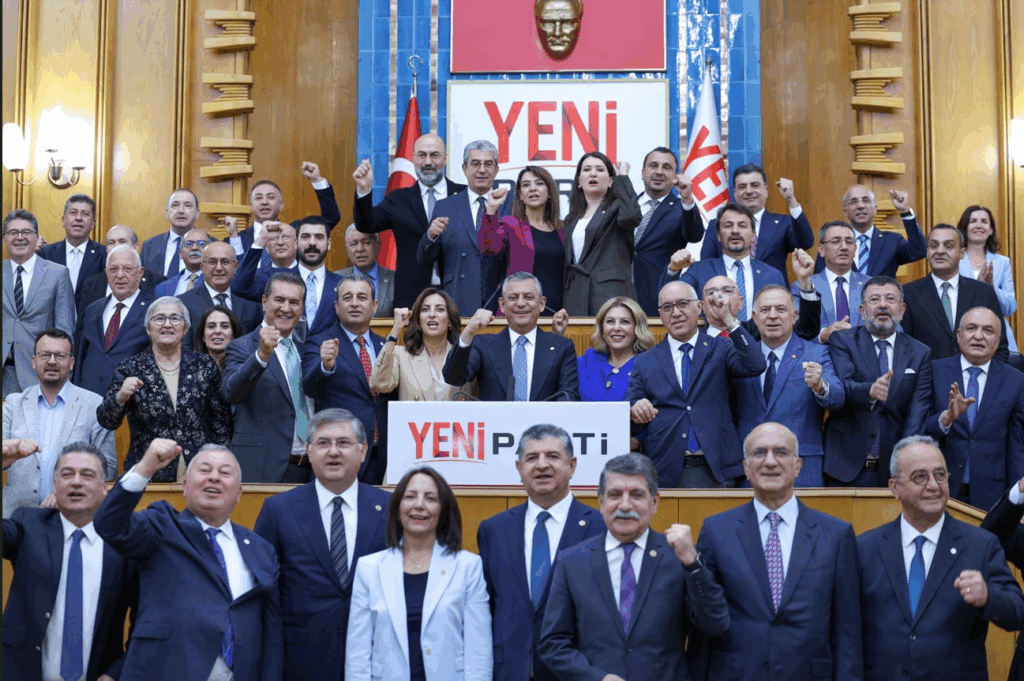
The New Party emerged from an unprecedented crisis within Turkey’s main opposition party, the CHP. After a court annulled the party congress that had elected Özgür Özel as chair and reinstated the previous leadership, Özel and 90 CHP parliamentarians resigned to establish a new political party. In this article we examine what the New Party’s programme and constitution promise women and LGBTI+ people.
Women’s Rights in the Program and Charter
The New Party’s program addresses gender and women’s rights across multiple policy areas. Commitments to women’s rights and to improving women’s lives appear under headings such as Development and Economy, Education, and social welfare policy. An emphasis on care work (childcare, eldercare, and care for people with disabilities) recurs throughout the document. By spreading women’s issues across many different policy areas rather than treating them as a single separate topic, the program presents what it calls a holistic approach.
Gender equality is described as one of the fundamental criteria of democracy. The program states that everyone, regardless of gender, should have equal access to rights, opportunities, decision making, and resources. It emphasizes equal and free participation in all areas of life, and ensuring women have the means to pursue their own goals and potential. This reflects an approach centered on individual freedom, while still acknowledging collective social structures and public responsibilities. The program frames women’s issues not only as a matter of social assistance, but as tied to economic and democratic participation more broadly.
Development, Economy, and the “Purple Transformation”
The program’s development and economic goals are built around welfare, equality, and efficiency. It calls for transforming agriculture, industry, and services along “green” (environmental), “purple” (gender equality), and digital lines. Notably, this “purple transformation” is presented as a theme running across all sectors, placed at the center of economic policy, meaning women’s economic position is treated as a structural feature of development rather than a separate, sector specific issue. In the program’s own terms, purple economic transformation means women’s equal access to employment, decision making, resources, and social rights.
To help women gain equal access to the economy, the program proposes special support for women in farming, along with tax breaks, social insurance incentives, training, and other measures to increase women’s employment. It also proposes targeted support for women’s cooperatives, women entrepreneurs, and women producers in rural areas, and states that the principle of equal pay for equal work will be actively enforced. These are meaningful commitments, but the program does not explain which institutions would carry them out, how they would be funded, or how success would be measured.
Invisible Labor: Care Work
The program also addresses, in several places, the goal of easing the burden of unpaid care work that falls disproportionately on women. Among its general economic commitments is a promise to redesign working hours around work-life balance and caregiving responsibilities. This points toward equal sharing of care responsibilities between men and women, rather than treating care as women’s default role, and toward more balanced working hours for everyone.
At the same time, the program recognizes current social realities and proposes public policies to relieve women specifically of the care burden. It states that “care services will be made one of the core areas of the social state” (that is, the government’s welfare responsibilities). Care services occupy a substantial place in the program. Turkey’s current public care services lag well behind the OECD average, so defining care as a core state responsibility would be a meaningful shift if implemented. The program lists nurseries, kindergartens, after school programs, home care for the sick, elderly, and people with disabilities, elder care centers, and disability support centers as services to be expanded, alongside increased capacity for local governments to deliver social services.
For care of people with disabilities, work that is disproportionately done by women, the program proposes bringing family caregivers into the social security system. This kind of caregiving, especially for more severe disabilities, is often lifelong and demands constant attention. If implemented, this promise would matter greatly to the people providing that care.
Education and Health Policy
The program frames its overall goal for women as empowerment and liberation, building on the economic measures discussed above through greater access to education and healthcare.
It commits to measures ensuring equal educational opportunity for girls, though it gives no detail on what those measures would involve. It also promises a literacy campaign aimed not just at girls but at adult women. For context, according to Turkey’s national statistics agency (TÜİK), as of 2025, 96.4% of women in Turkey are literate, compared with 99.3% of men.
The program also commits to improving women’s health and expanding women’s health services, particularly through new health centers in rural and underserved regions where access is currently difficult. It plans to make it easier for women to access family planning, reproductive health care, and care before and after childbirth. Expanding these services matters not only for general health, early detection of illness, and safe pregnancy and childbirth, but also because health services can be a point of contact for identifying cases of abuse.
Combating Violence Against Women
The program addresses violence against women on two fronts: legal and social.
It commits to implementing international agreements that protect women from discrimination and violence, including CEDAW (the UN Convention on the Elimination of All Forms of Discrimination against Women), the Lanzarote Convention (a Council of Europe treaty protecting children from sexual abuse and exploitation), the UN Convention on the Rights of the Child, and various International Labour Organization conventions.
Notably, it commits to rejoining the Istanbul Convention (the Council of Europe’s treaty on preventing violence against women and domestic violence) and implementing it in full. Turkey withdrew from the Istanbul Convention in 2021, a decision that women’s rights advocates say weakened protections and penalties in cases of violence against women.
Beyond these legal commitments, the program addresses social measures too. It emphasizes education, promising to embed a gender equality perspective throughout all levels of formal and informal schooling. It also commits to countering sexist rhetoric and narratives that encourage violence in politics and media. It proposes a support network of women’s shelters, counseling centers, sexual violence crisis centers, and a 24/7 emergency hotline, all elements specified in the Istanbul Convention. Similar services already exist through the Istanbul Metropolitan Municipality; the plan would expand and strengthen them nationwide.
On digital violence, a growing concern, the program states that abusive and hateful content will be tackled, but does not define what counts as such content or explain how it would be addressed. It also has no specific proposal on AI generated content made without a person’s consent, or non consensual image sharing, both issues that have already caused real harm to many women.
Women in Politics: Equal Representation
Another stated goal is ensuring women’s equal representation in decision making and amplifying women’s voices in public life. The program promises changes to election and political party law but gives no detail on what those changes would involve. It proposes affirmative action and quotas as tools for achieving full equality and participation, while noting that quotas alone are not enough: male dominated political culture and undemocratic political structures need to change alongside any technical reforms. It also commits to removing the economic and social barriers that prevent women from running for or being appointed to political office, consistent with the program’s broader holistic approach.
How the Party Charter Compares to the Program
The party’s internal charter maintains a general commitment to equality and non discrimination. It follows through on the program’s equal representation goal by introducing a 50% gender quota for internal party elections at all levels. However, that quota would be phased in gradually: 33% until the party’s first ordinary congress, 35% at the first congress, 40% at the second, 45% at the third, and reaching 50% only at the fourth congress.
LGBTQ+ Rights in the Program and Charter
The New Party’s program explicitly names sexual orientation and gender identity, stating that no one should face discrimination on these grounds. This kind of explicit language is still unusual in Turkish party programs.
That said, many issues central to LGBTQ+ advocacy, such as marriage equality, civil partnerships, gender transition processes, and trans people’s access to healthcare, are not addressed. The program has no specific policy on combating homophobia or transphobia, and does not mention Pride marches, the pressure LGBTQ+ organizations face, or ongoing debates over freedom of expression and assembly for LGBTQ+ people.
Overall, this suggests the New Party approaches LGBTQ+ rights not as a distinct policy area, but as something folded into a broader framework of human rights and equal citizenship.
A Rights Based, but Incomplete, Approach
The program clearly states a principle against discrimination, but does not explain what legal changes would enforce it, what mechanism would address existing rights violations, or what specific policies would target discrimination against LGBTQ+ people. In short, it states the principle while leaving the details of implementation open.
Even without a dedicated LGBTQ+ policy section, the program’s broader emphasis on rule of law, fundamental rights, equal citizenship, and anti discrimination could, in practice, extend to LGBTQ+ people. Its commitments on freedom of expression, freedom of assembly, and hate crimes could also strengthen rights protections if actually implemented.
Do the Program and Charter Agree?
While the program explicitly names sexual orientation and gender identity, the charter does not use the same specific language. The charter does prohibit discrimination, but in broader terms, without explicitly listing sexual orientation or gender identity as protected categories.
This is a notable inconsistency: the program uses language that clearly includes LGBTQ+ people, while the charter uses a more general equality framework. Because of this gap, it’s worth reading both documents together to understand the party’s actual position.
What’s Missing: Concrete Mechanisms
Taken as a whole, the party’s program and charter build their approach to women’s issues around empowerment and freedom, addressing women’s rights not just through family policy but across economy, care work, education, health, political representation, and violence prevention. The emphasis on care work and “purple transformation” stands out as distinctive. On LGBTQ+ rights, explicitly naming sexual orientation and gender identity is still uncommon in Turkish politics, making this notable, but major issues like marriage equality, civil partnership, gender transition, and trans rights are left out entirely. This suggests the party sees LGBTQ+ rights as part of a general human rights and citizenship framework rather than a dedicated policy area of its own. Whether this translates into real change will depend less on the program’s stated principles and more on the party’s future actions, legislation, and rhetoric. Notably, the program does not specify implementation tools, budgets, or performance indicators for any of its gender equality commitments. Its success will ultimately depend on whether these principles turn into concrete policies and institutions.
“A Mother’s Embrace Instead of a Father’s Hearth”
Gülseren Onanç, Chair of the SES Equality and Solidarity Association and founder of the Equality Justice Women Platform, offered the following response to the New Party’s founding:
“The new political approach, new language, and hope for equality and justice that the NEW Party is trying to represent excites me. I hope the party works closely with the women’s movement, LGBTQ+ people, civil society, and rights advocates, embraces every part of society, and transforms the language and character of male dominated politics into something more equal.
When the ‘father’s hearth’ that Özgür Özel was so devoted to was taken over by an outdated, statist, authoritarian style of politics, it was women, offering their ‘mother’s embrace,’ who stood by him first.
What Turkey needs today isn’t a ‘father’s hearth.’ It’s a more inclusive, more compassionate, more conciliatory, and more equal politics of the ‘mother’s embrace.’ If the NEW Party can bring that kind of politics to life, one that includes everyone without exception, it could be a real opportunity to strengthen democracy and advance gender equality in Turkey.”